
We read your photo as:
Provide the electron configurations (spdf notation, orbital diagram, and noble-gas-core abbreviation) for Phosphorus (P) and Chlorine (Cl).
ScanSolve AI Answer
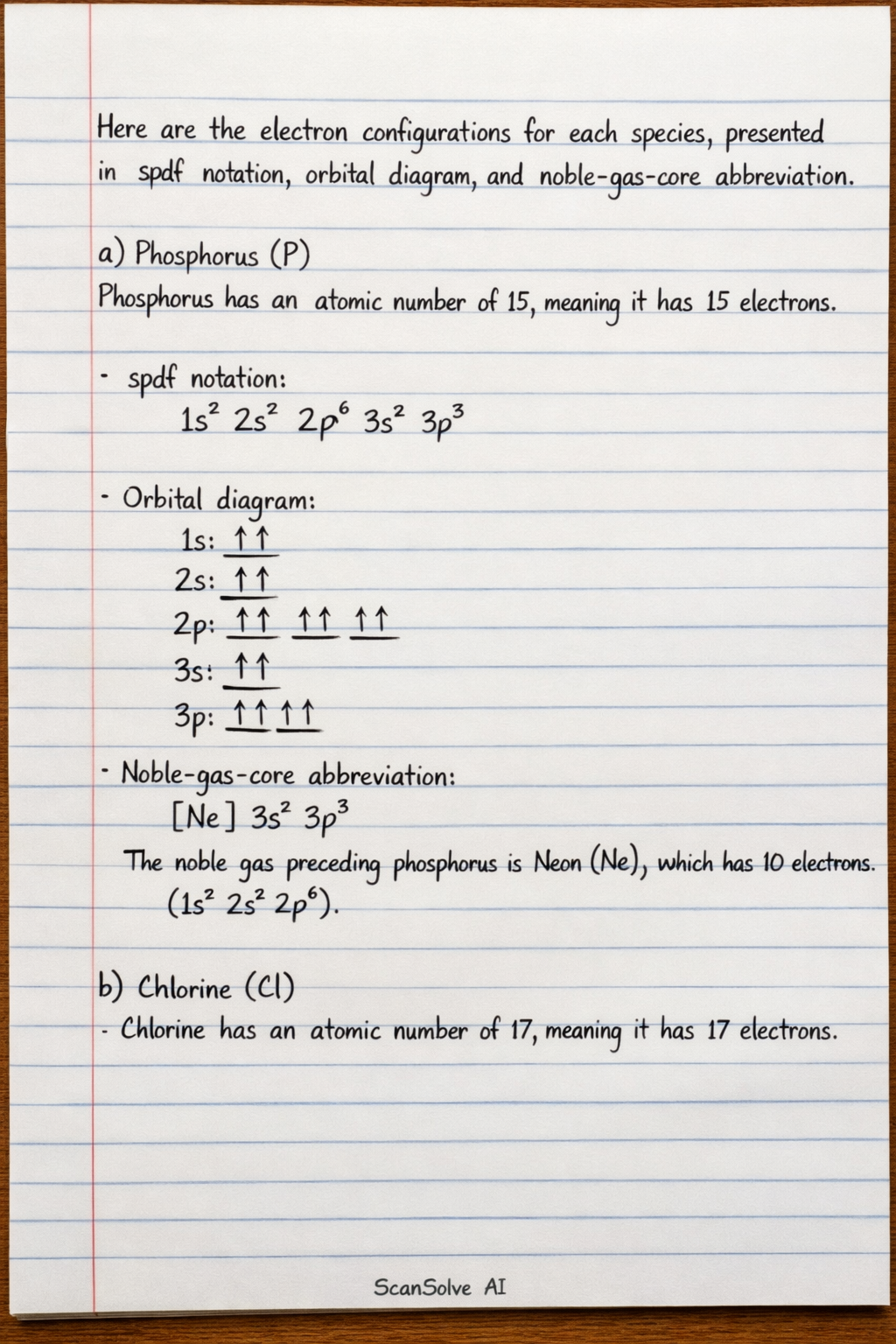
Here are the electron configurations for each species, presented in spdf notation, orbital diagram, and noble-gas-core abbreviation.
-
a) Phosphorus (P) Phosphorus has an atomic number of 15, meaning it has 15 electrons.
- spdf notation:
- Orbital diagram:
- Noble-gas-core abbreviation: The noble gas preceding phosphorus is Neon (Ne), which has 10 electrons ().
-
b) Chlorine (Cl) Chlorine has an atomic number of 17, meaning it has 17 electrons.
- spdf notation:
- Orbital diagram:
- Noble-gas-core abbreviation: The noble gas preceding chlorine is Neon (Ne), which has 10 electrons ().
-
c) Chloride ion () A chloride ion has gained one electron compared to a neutral chlorine atom. So, it has electrons.
- spdf notation:
- Orbital diagram:
- Noble-gas-core abbreviation: The noble gas preceding (with 18 electrons) is Neon (Ne). The configuration is also identical to that of Argon (Ar).
-
d) Aluminum ion () Aluminum has an atomic number of 13, meaning a neutral atom has 13 electrons. The ion has lost two electrons, so it has electrons. Electrons are removed from the highest principal quantum number shell first, and then from the subshell with the highest value within that shell. Neutral Al: . First electron removed from . Second electron removed from .
- spdf notation:
- Orbital diagram:
- Noble-gas-core abbreviation: The noble gas preceding (with 11 electrons) is Neon (Ne), which has 10 electrons ().
Still stuck on this one?
Ask a follow-up, and the answer starts from this question.
More Chemistry Questions
Handwritten Step-by-Step Solution
Get this as a handwritten image on WhatsApp — like a tutor wrote it for you.
Try on WhatsApp