
We read your photo as:
A woman is fully dilated and the fetus has reached the pelvic floor. She is asking if she can start to push. What is the most appropriate action?
ScanSolve AI Answer
Answer
The woman is fully dilated and the fetus has reached the pelvic floor, indicating she is in the second stage of labor. She is asking if she can start to push. The most appropriate actions involve supporting her physiological process and ensuring a safe delivery.
Let's evaluate the options:
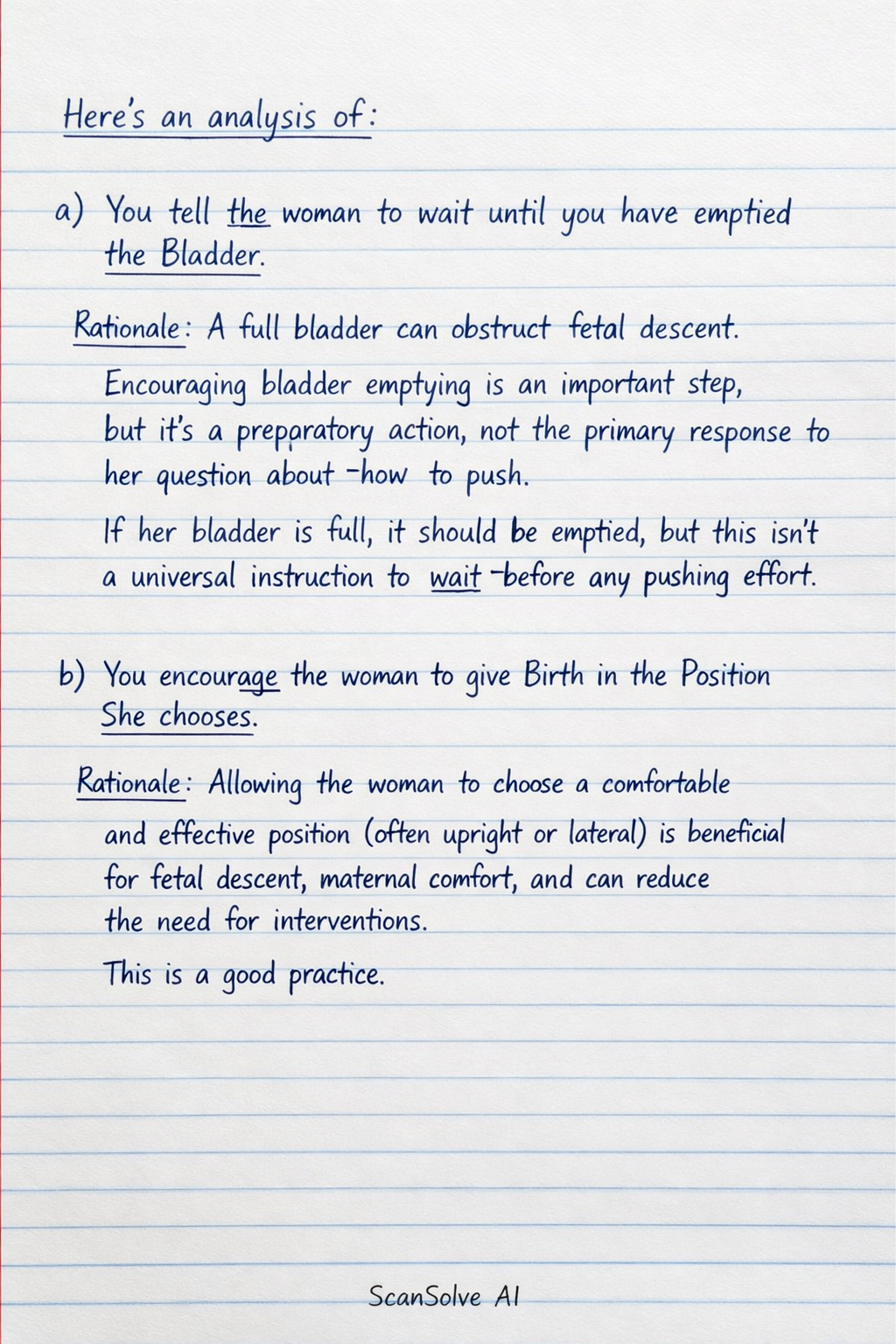
- a) You tell the woman to wait until you have emptied the Bladder.
- Rationale: A full bladder can obstruct fetal descent. Encouraging bladder emptying is an important step, but it's a preparatory action, not the primary response to her question about how to push. If her bladder is full, it should be emptied, but this isn't a universal instruction to wait before any pushing effort.
- b) You encourage the woman to give Birth in the Position She chooses.
- Rationale: Allowing the woman to choose a comfortable and effective position (often upright or lateral) is beneficial for fetal descent, maternal comfort, and can reduce the need for interventions. This is a good practice.
- c) You Instruct the Woman in How to Push and tell her to follow Your Instructions.
- Rationale: This describes directed pushing (Valsalva pushing), which is generally discouraged in favor of physiologic pushing. Directed pushing can lead to maternal exhaustion, increased perineal trauma, and potential fetal distress.
- d) You Instruct the Woman to lay down on her back before She started to Push, so you have a good overview of the Perineum.
- Rationale: Lying on her back (supine position) can hinder fetal descent, increase pain, and potentially increase the risk of perineal trauma. While it offers a good view for the attendant, it is not the optimal position for the woman or the baby.
- e) You support the woman to Push according to her own urge with leg relaxed and open to allow slow and progressive stretching of the Perineum.
- Rationale: This is the most evidence-based and physiological approach. Supporting spontaneous pushing (following her natural urges) reduces maternal exhaustion and perineal trauma. Allowing for slow, controlled stretching of the perineum is crucial for preventing tears. This option directly addresses how she should push.
- f) You set up on oxytocin drip to avoid Insufficient Contractions and to ensure that the Pushing stage will be as short as Possible.
- Rationale: Routine administration of oxytocin at the onset of the second stage is not recommended unless there is evidence of inadequate uterine contractions or a prolonged second stage. The goal is not necessarily to shorten the pushing stage but to ensure a safe and physiological birth.
Considering the woman is asking if she can start to push, the most comprehensive and appropriate response that guides her on how to push effectively and safely, while promoting a physiological birth, is option e). While b) is also a good practice, e) provides more specific guidance on the pushing effort itself and perineal protection.
The correct option is e).
e) You support the woman to Push according to her own urge with leg relaxed and open to allow slow and progressive stretching of the Perineum.
Try one yourself
A new problem that tests the same skill.
Still stuck on this one?
Ask a follow-up, and the answer starts from this question.
More Biology Questions
Handwritten Step-by-Step Solution
Get this as a handwritten image on WhatsApp — like a tutor wrote it for you.
Try on WhatsApp