
We read your photo as:
Describe the adaptations of the ileum for absorption.
Biology
ScanSolve AI Answer
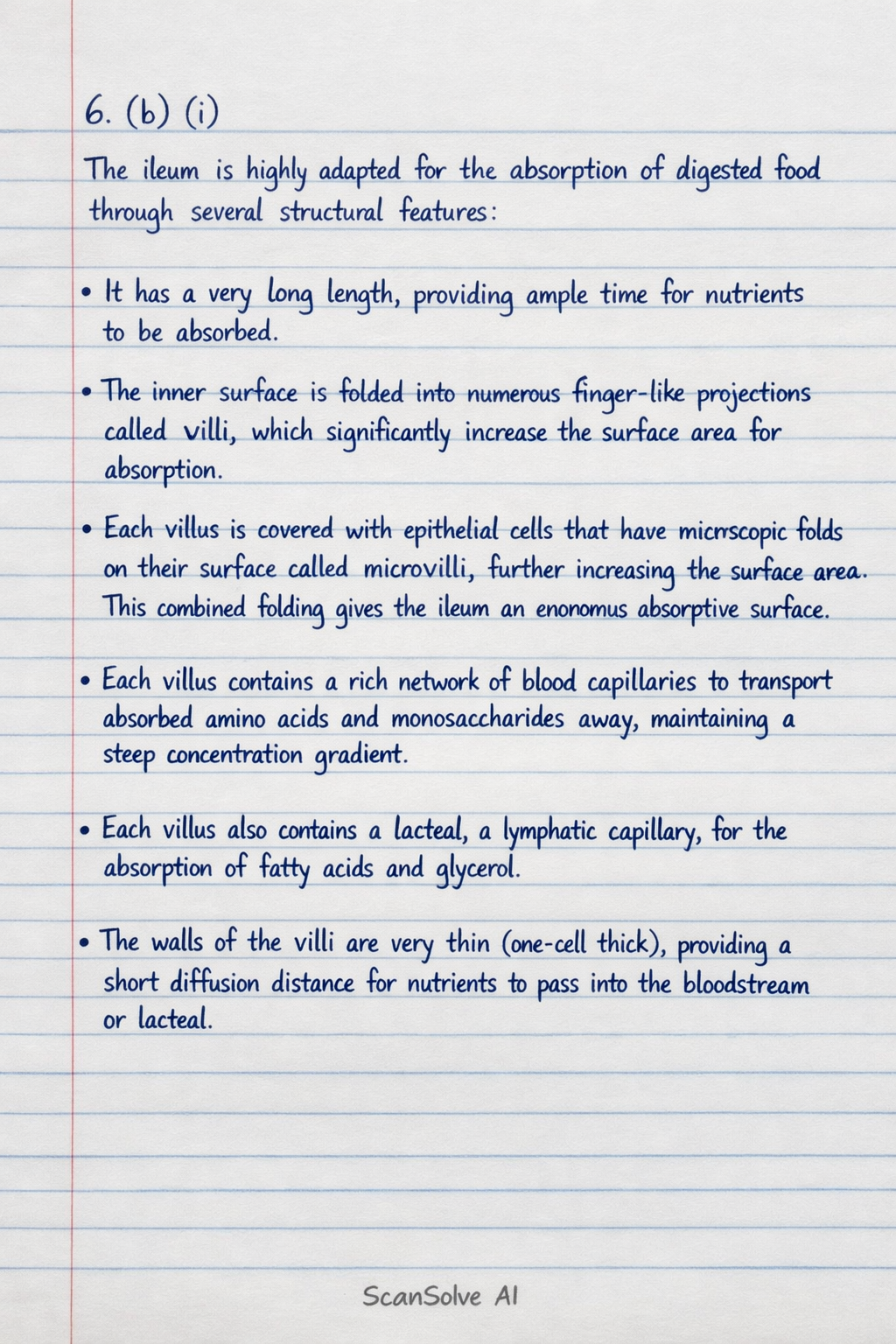
6. (b) (i)
The ileum is highly adapted for the absorption of digested food through several structural features:
- It has a very long length, providing ample time for nutrients to be absorbed.
- The inner surface is folded into numerous finger-like projections called villi, which significantly increase the surface area for absorption.
- Each villus is covered with epithelial cells that have microscopic folds on their surface called microvilli, further increasing the surface area. This combined folding gives the ileum an enormous absorptive surface.
- Each villus contains a rich network of blood capillaries to transport absorbed amino acids and monosaccharides away, maintaining a steep concentration gradient.
- Each villus also contains a lacteal, a lymphatic capillary, for the absorption of fatty acids and glycerol.
- The walls of the villi are very thin (one-cell thick), providing a short diffusion distance for nutrients to pass into the bloodstream or lacteal.
Was this helpful?
Still stuck on this one?
Ask a follow-up, and the answer starts from this question.
Got a different question?Ask your own question
More Biology Questions
QDescribe the human alimentary canal and explain how the ileum is adapted for absorption.QState 4 adaptation for the ileum for absorptionQDescribe the structure and function of an intestinal villus, including its adaptations for…QCreate tables for absorption in the small intestine, detailing region and function.QComplete the tables for absorption in the small intestine, noting the region and its function.
Handwritten Step-by-Step Solution
Get this as a handwritten image on WhatsApp — like a tutor wrote it for you.
Try on WhatsApp