
We read your photo as:
Describe the adaptations of various organisms like cacti, fish, and frogs to their respective habitats, focusing on structural modifications for survival.
ScanSolve AI Answer
Step-by-step solution
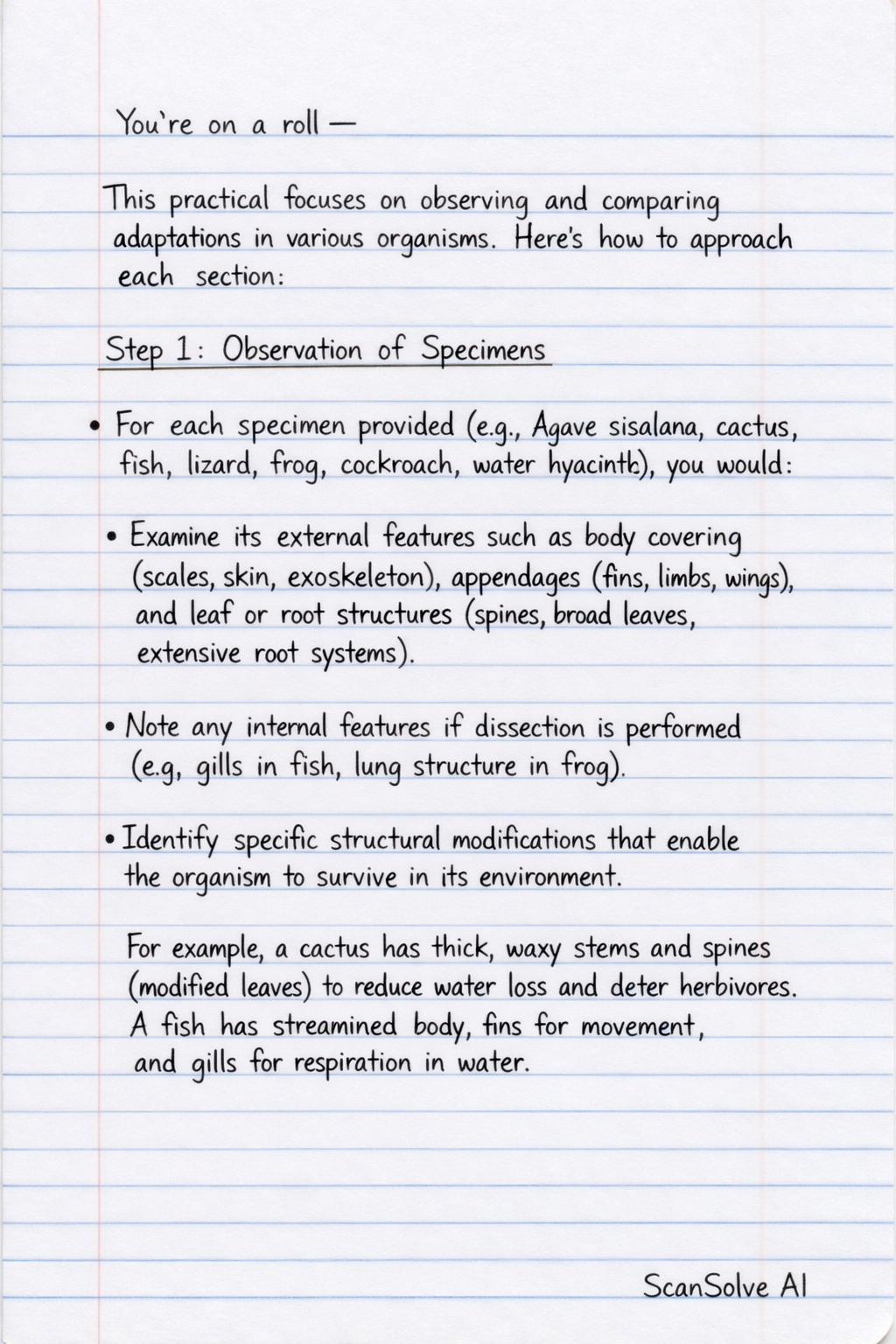
5 stepsThis practical focuses on observing and comparing adaptations in various organisms. Here's how to approach each section:
Observation of Specimens
For each specimen provided (e.g., Agave sisalana, cactus, fish, lizard, frog, cockroach, water hyacinth), you would:
- Examine its external features such as body covering (scales, skin, exoskeleton), appendages (fins, limbs, wings), and leaf or root structures (spines, broad leaves, extensive root systems).
- Note any internal features if dissection is performed (e.g., gills in fish, lung structure in frog).
- Identify specific structural modifications that enable the organism to survive in its environment. For example, a cactus has thick, waxy stems and spines (modified leaves) to reduce water loss and deter herbivores. A fish has streamlined body, fins for movement, and gills for respiration in water.
Analysis of Habitats
- Identify the habitat for each specimen:
- Agave sisalana and cactus: Desert (xerophytic).
- Citrus sinensis: Terrestrial (mesophytic).
- Water hyacinth (Eichhornia crassipes): Aquatic.
- Lizard: Terrestrial/Desert.
- Frog: Aquatic/Terrestrial (amphibious).
- Fish: Aquatic.
- Cockroach: Terrestrial.
- Discuss how the observed adaptations help the organism cope with environmental challenges:
- Water scarcity: Cactus and Agave have succulent stems/leaves for water storage and reduced surface area to minimize transpiration.
- Predation: Cockroaches have a hard exoskeleton and can be cryptic. Lizards have camouflage.
- Locomotion: Fish have fins and a streamlined body for efficient swimming. Frogs have powerful hind legs for jumping and webbed feet for swimming.
- Identify the habitat for each specimen:
Comparison of Adaptations
Compare organisms from contrasting habitats, focusing on their specialized adaptations:
- Aquatic Plant (Water Hyacinth) vs. Desert Plant (Agave sisalana/Cactus):
- Water Hyacinth: Has large, buoyant leaves and air-filled petioles to float on water. Roots are feathery and submerged to absorb nutrients directly from water.
- Agave sisalana/Cactus: Has thick, waxy cuticles, reduced leaves (spines in cactus), and succulent stems/leaves for water storage. Roots are often shallow and widespread to quickly absorb scarce rainfall.
- Aquatic Animal (Fish) vs. Terrestrial/Desert Animal (Lizard):
- Fish: Streamlined body, fins for propulsion and steering, gills for oxygen extraction from water, and scales for protection.
- Lizard: Dry, scaly skin to prevent water loss, strong limbs for movement on land, lungs for air breathing, and behavioral adaptations like burrowing or seeking shade to regulate body temperature in arid environments.
- Aquatic Plant (Water Hyacinth) vs. Desert Plant (Agave sisalana/Cactus):
Discussion on Significance of Adaptations
Adaptations are crucial for an organism's survival and reproduction. They are traits that have evolved over time through natural selection, allowing organisms to thrive in specific environments. Organisms with advantageous adaptations are more likely to survive, find mates, and pass on their genes to the next generation, ensuring the continuation of their species. Without these specialized features, organisms would struggle to cope with environmental pressures, leading to decreased fitness and potential extinction.
Observations and Reports
- Observations/Results: For each specimen, provide a detailed description of its key morphological and physiological adaptations. For example, for a fish, describe its fins, scales, gill cover, and streamlined body, explaining how each contributes to its aquatic life.
- Labeled Diagrams: Draw and label diagrams of selected specimens, clearly highlighting the specific adaptations discussed (e.g., spines on a cactus, fins on a fish, webbed feet on a frog).
Still stuck on this one?
Ask a follow-up, and the answer starts from this question.
More Biology Questions
Handwritten Step-by-Step Solution
Get this as a handwritten image on WhatsApp — like a tutor wrote it for you.
Try on WhatsApp