
We read your photo as:
Answer questions 9.1, 9.2, 10.1, and 10.2 regarding plant transpiration and vascular tissue.
Biology
ScanSolve AI Answer
Step-by-step solution
5 stepsHere are the answers to the questions:
Answer question 9.1.
- 9.1:
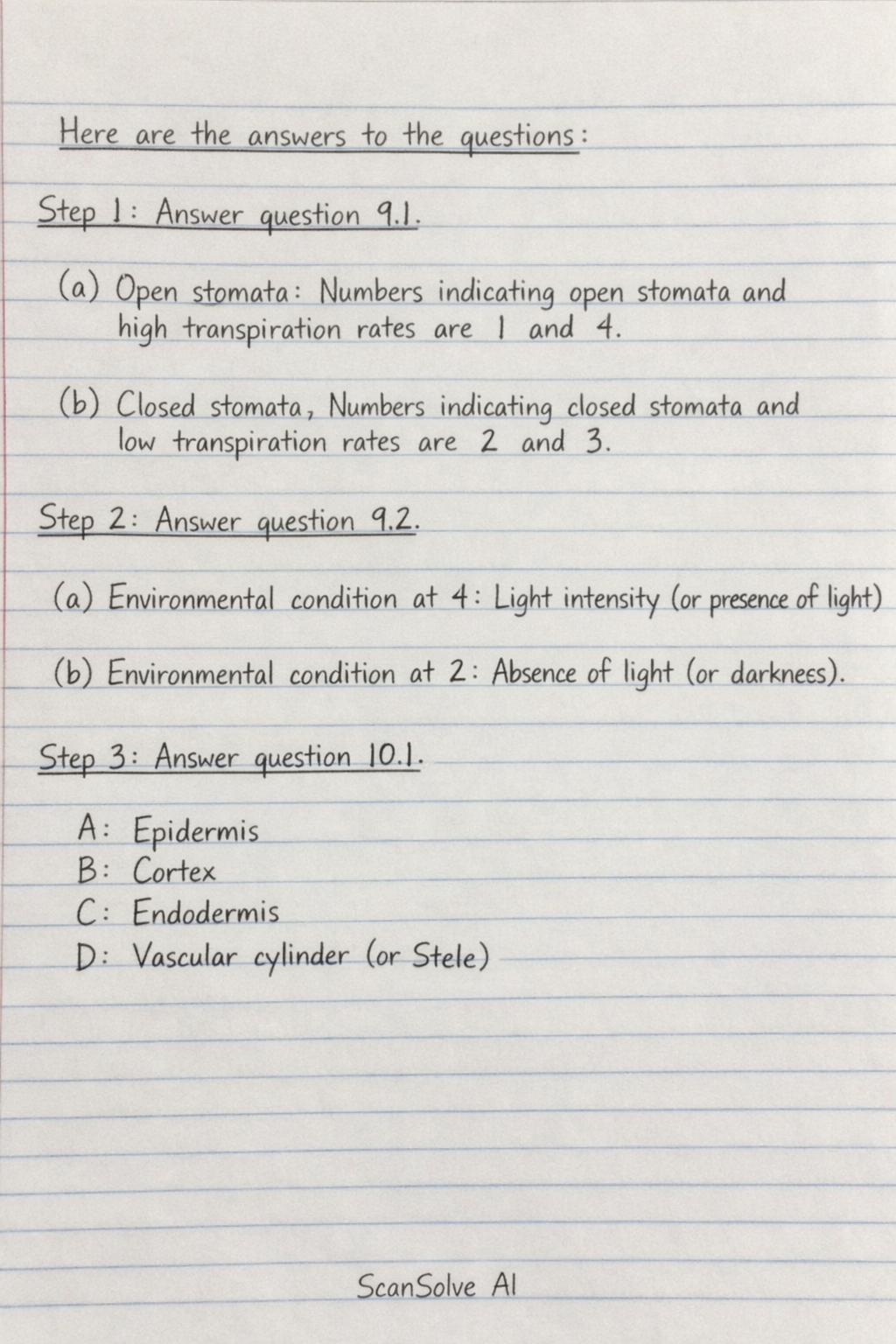
- (a) Open stomata: The numbers indicating open stomata and thus high rates of transpiration during the day are 1 and 4.
- (b) Closed stomata: The numbers indicating closed stomata and thus very low rates of transpiration during the night are 2 and 3.
- 9.1:
Answer question 9.2.
- 9.2:
- (a) One environmental condition responsible for the change at 4 (high transpiration during the day) is light intensity (or presence of light).
- (b) One environmental condition responsible for the change at 2 (low transpiration during the night) is the absence of light (or darkness).
- 9.2:
Answer question 10.1.
- 10.1:
- A: Epidermis
- B: Cortex
- C: Endodermis
- D: Vascular cylinder (or Stele)
- 10.1:
Answer question 10.2.
- 10.2: Part D (vascular cylinder) contains xylem and phloem for transport.
- Xylem adaptations:
- It consists of hollow, continuous tubes (vessels and tracheids) to allow for efficient, uninterrupted flow of water.
- Its walls are lignified (thickened with lignin) to provide structural support and prevent the vessels from collapsing under tension.
- Phloem adaptations:
- It consists of sieve tubes with perforated sieve plates, allowing for the efficient transport of sugars.
- Companion cells are associated with sieve tube elements, providing metabolic support for the active transport of sugars.
- Xylem adaptations:
- 10.2: Part D (vascular cylinder) contains xylem and phloem for transport.
Answer question 10.3.
- 10.3: The collective name of the tissues that transport water and food in the structure shown above is vascular tissues.
Was this helpful?
Still stuck on this one?
Ask a follow-up, and the answer starts from this question.
Got a different question?Ask your own question
More Biology Questions
QSECTION B: Answer any 2 questions. (a) What is transpiration? (ii) List the environmental factors…QIdentify the plant tissues described and explain their adaptations and functions, including…QThe sites through which transpiration takes place in a plant are:QAnswer the following questions about angiosperm root cross-section anatomy and water transport.QThis solution appears to be answering a set of questions about excretion and plant grafting. What…
Browse by topic:Anatomy
Handwritten Step-by-Step Solution
Get this as a handwritten image on WhatsApp — like a tutor wrote it for you.
Try on WhatsApp