
We read your photo as:
Answer the following questions about angiosperm root cross-section anatomy and water transport.
ScanSolve AI Answer
Here are the answers to the questions about the angiosperm root cross-section.
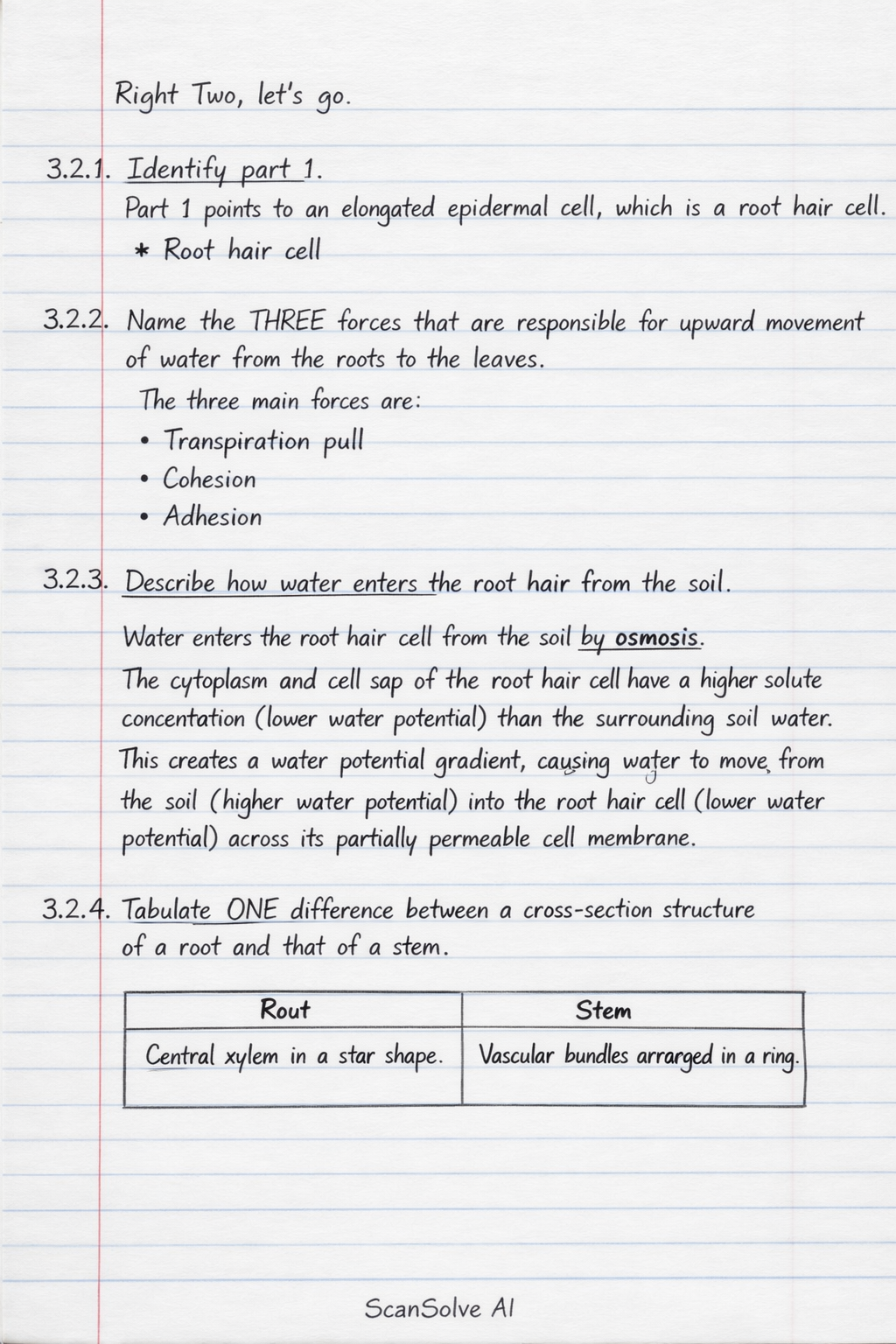
3.2.1. Identify part 1.
Part 1 points to an elongated epidermal cell, which is a root hair cell.
- Root hair cell
3.2.2. Name the THREE forces that are responsible for upward movement of water from the roots to the leaves.
The three main forces are:
- Transpiration pull
- Cohesion
- Adhesion
3.2.3. Describe how water enters the root hair from the soil.
Water enters the root hair cell from the soil by osmosis. The cytoplasm and cell sap of the root hair cell have a higher solute concentration (lower water potential) than the surrounding soil water. This creates a water potential gradient, causing water to move from the soil (higher water potential) into the root hair cell (lower water potential) across its partially permeable cell membrane.
3.2.4. Tabulate ONE differences between a cross-section structure of a root and that of a stem.
| Feature | Root | Stem |
|---|---|---|
| Vascular Bundles | Arranged radially, with xylem and phloem alternating. | Arranged in a ring (dicot) or scattered (monocot). |
Still stuck on this one?
Ask a follow-up, and the answer starts from this question.
More Biology Questions
Handwritten Step-by-Step Solution
Get this as a handwritten image on WhatsApp — like a tutor wrote it for you.
Try on WhatsApp