
We read your photo as:
This solution appears to be answering a set of questions about excretion and plant grafting. What were the specific questions asked?
ScanSolve AI Answer
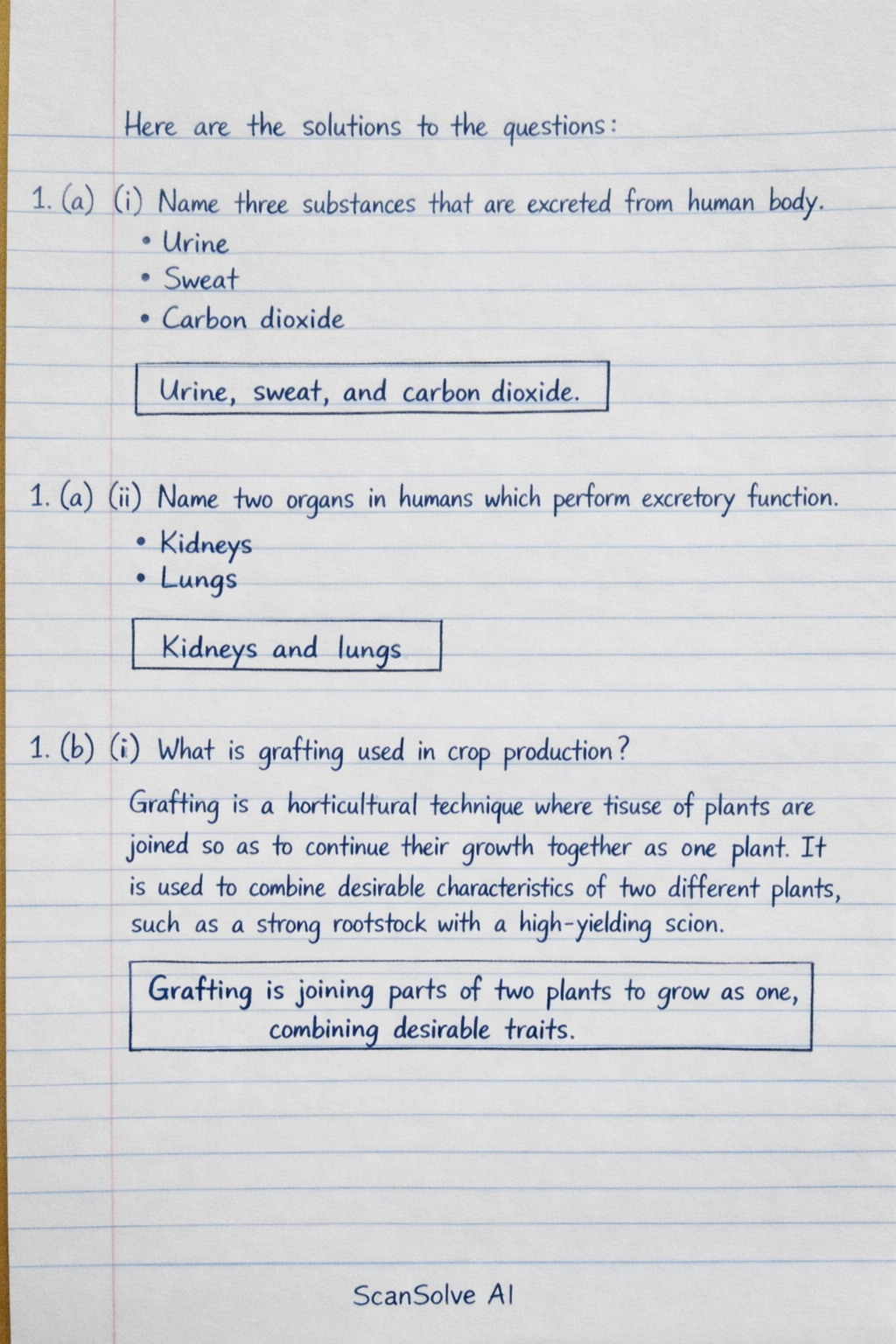
Here are the solutions to the questions:
1. (a) (i) Name three substances that are excreted from human body.
- Urine
- Sweat
- Carbon dioxide
1. (a) (ii) Name two organs in humans which perform excretory function.
- Kidneys
- Lungs
1. (b) (i) What is grafting used in crop production?
Grafting is a horticultural technique where tissues of plants are joined so as to continue their growth together as one plant. It is used to combine desirable characteristics of two different plants, such as a strong rootstock with a high-yielding scion.
1. (b) (ii) State three benefits of grafting.
- Combines desirable traits: Allows for combining the disease resistance of one plant with the high yield of another.
- Faster fruiting/flowering: Grafted plants often mature and produce fruits or flowers more quickly than plants grown from seed.
- Repair of damaged plants: Can be used to repair plants that have been damaged at the base.
1. (c) (i) State two ways in which scientific methods is important.
- Problem-solving: Provides a systematic approach to investigate and solve problems in various fields.
- Advancement of knowledge: Leads to new discoveries, technologies, and a deeper understanding of the natural world.
1. (c) (ii) Give one reason for each of the following laboratory rules:
() do not wear rubber slippers to the laboratory: Rubber slippers do not provide adequate protection against chemical spills, broken glass, or electrical hazards, which can cause injury.
() close all taps before leaving the laboratory: To conserve water and prevent flooding or water damage in the laboratory.
() spilled liquids must be cleaned immediately: To prevent slips and falls, avoid contamination, and prevent potential hazardous reactions with other substances.
1. (d) (i) Explain briefly the term earthing as used in household wiring.
Earthing (or grounding) in household wiring is a safety measure that connects the metal casing of electrical appliances to the earth via a low-resistance wire. In case of an electrical fault where a live wire touches the casing, the fault current flows safely to the earth, preventing electric shock and tripping the circuit breaker or blowing a fuse.
1. (d) (ii) Name two sources of electric power generation.
- Hydroelectric power
- Thermal power (e.g., coal, natural gas)
2. (a) Give four reasons why farmers should be discouraged from using chemical fertilizers.
- Environmental pollution: Chemical fertilizers can leach into groundwater or run off into rivers and lakes, causing eutrophication and contaminating water sources.
- Soil degradation: Overuse can reduce soil organic matter, alter soil pH, and harm beneficial soil microorganisms, leading to long-term soil infertility.
- Health risks: Farmers handling chemical fertilizers without proper protection can be exposed to harmful chemicals, posing health risks.
- Cost: Chemical fertilizers can be expensive, increasing production costs for farmers.
2. (b) (i) What is temporary hard water?
Temporary hard water is water that contains dissolved hydrogen carbonates (bicarbonates) of calcium and magnesium. It can be softened by simply boiling, which causes the bicarbonates to decompose and precipitate as insoluble carbonates.
2. (b) (ii) Write a chemical equation to show how temporary hard water can be softened by heating.
2. (c) (i) What is a lever?
A lever is a simple machine consisting of a rigid bar or beam that pivots around a fixed point called a fulcrum. It is used to multiply force or change the direction of force.
2. (c) (ii) Explain each of the following terms as applied to simple machines:
() mechanical advantage: Mechanical advantage is the ratio of the load (resistance force) to the effort (applied force). It indicates how much a machine multiplies the input force.
() velocity ratio: Velocity ratio (or ideal mechanical advantage) is the ratio of the distance moved by the effort to the distance moved by the load. It represents the theoretical advantage of a machine, assuming no energy loss.
2. (d) (i) What is food processing?
Food processing is the transformation of raw ingredients into food, or of food into other forms, through physical or chemical means. It involves various techniques like cooking, canning, freezing, drying, and fermentation to make food more palatable, digestible, safe, or extend its shelf life.
2. (d) (ii) State:
() two advantages of food processing:
- Food preservation: Extends the shelf life of food, reducing spoilage and waste.
- Increased variety and convenience: Provides a wider range of food products and makes them easier and quicker to prepare. () one disadvantage of food processing:
- Loss of nutrients: Some processing methods can reduce the nutritional content (e.g., vitamins) of food.
Still stuck on this one?
Ask a follow-up, and the answer starts from this question.
More Biology Questions
Handwritten Step-by-Step Solution
Get this as a handwritten image on WhatsApp — like a tutor wrote it for you.
Try on WhatsApp