
We read your photo as:
Answer the following True or False statements regarding fetal heart development:
ScanSolve AI Answer
Here are the answers to the True or False statements:
-
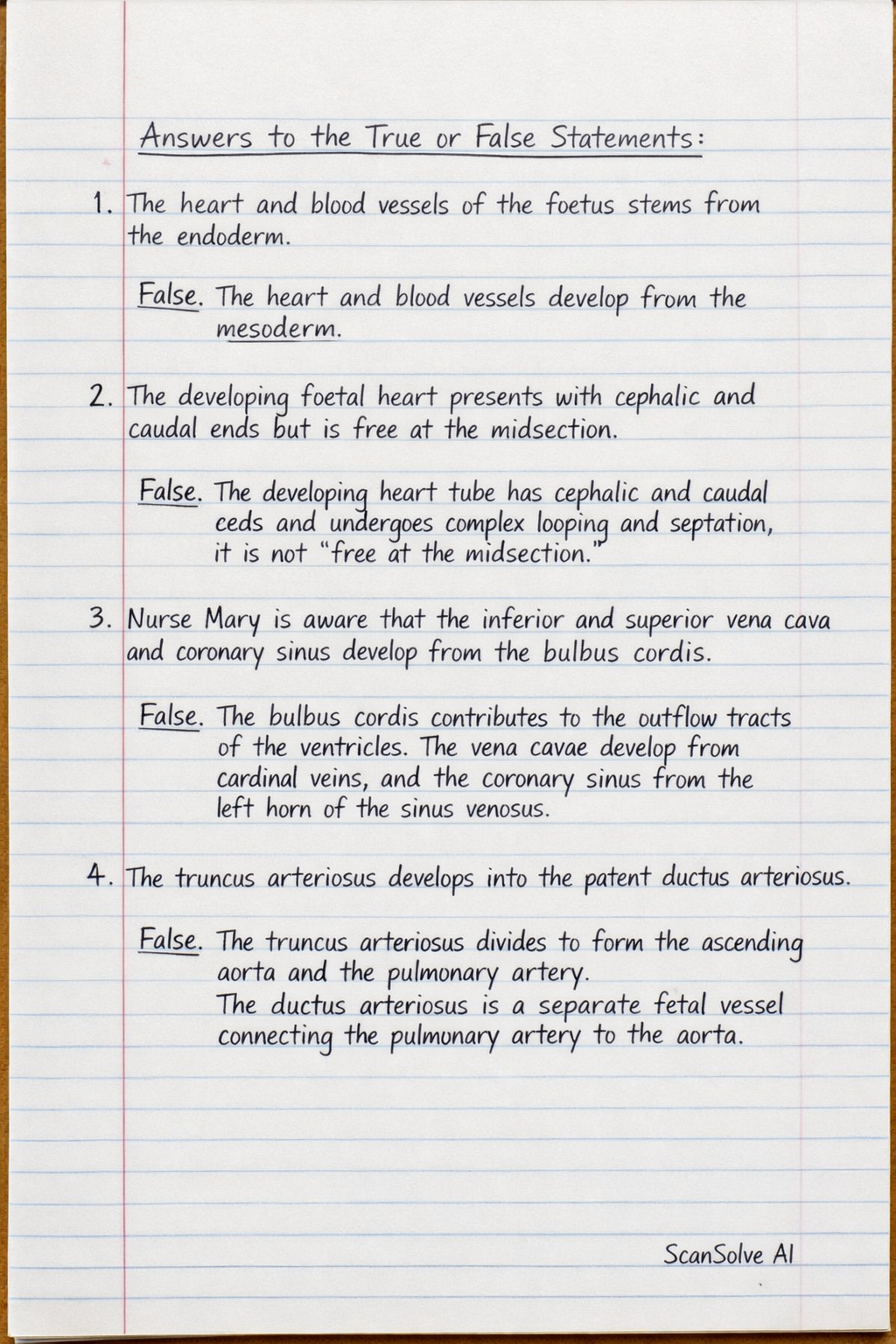
The heart and blood vessels of the foetus stems from the endoderm.
- False. The heart and blood vessels develop from the mesoderm.
-
The developing foetal heart presents with cephalic and caudal ends but is free at the midsection.
- False. The developing heart tube has cephalic and caudal ends and undergoes complex looping and septation, it is not "free at the midsection."
-
Nurse Mary is aware that the inferior and superior vena cava and coronary sinus develop from the bulbus cordis.
- False. The bulbus cordis contributes to the outflow tracts of the ventricles. The vena cavae develop from cardinal veins, and the coronary sinus from the left horn of the sinus venosus.
-
The truncus arteriosus develops into the patent ductus arteriosus.
- False. The truncus arteriosus divides to form the ascending aorta and the pulmonary artery. The ductus arteriosus is a separate fetal vessel connecting the pulmonary artery to the aorta.
-
The atrial septum is formed by the growth of both the septum primum and septum secundum.
- True. The atrial septum forms from the septum primum and septum secundum.
-
The ductus venosus shuts in to the superior vena cava.
- False. The ductus venosus shunts blood from the umbilical vein to the inferior vena cava.
-
In foetal circulation, the purpose of the circulatory bypasses is to increase blood flow to the heart chambers.
- False. The purpose of fetal circulatory bypasses (ductus venosus, foramen ovale, ductus arteriosus) is to bypass the non-functional fetal lungs and liver and direct oxygenated blood to vital organs like the brain and heart.
-
During foetal circulation the lungs is active.
- False. The fetal lungs are not active in gas exchange; they are filled with fluid, and gas exchange occurs via the placenta.
-
The heart is inactive in foetal circulation.
- False. The fetal heart is very active, pumping blood throughout the fetal body and to the placenta.
-
The Atrial septal defect presenting with opening near center of septum Sinus Ostium primum defect.
- False. An ostium primum defect is a type of atrial septal defect located in the lower part of the atrial septum, near the atrioventricular valves, not typically described as "near the center of the septum sinus."
-
Noisy, crowing respiratory sounds is termed aphonia.
- False. Aphonia is the inability to produce voice. Noisy, crowing respiratory sounds (like stridor) indicate upper airway obstruction.
-
The nurse managing a Two-year-old with club foot at the pediatric orthopedic ward knows that, Clubfoot primarily affects three bones: the calcaneus, talus and navicular.
- True. The calcaneus, talus, and navicular bones are centrally involved in the characteristic deformities of clubfoot (talipes equinovarus).
-
Hyperchloremic metabolic alkalosis in children Diagnosed with pyloric stenosis is as a result of loss of potassium ions.
- False. Pyloric stenosis causes hypochloremic metabolic alkalosis (due to loss of gastric acid) and hypokalemia (loss of potassium).
-
A child diagnosed with pyloric stenosis presents with Visible peristalsis, proceeding from the Right upper quadrant toward the right upper quadrant of the abdomen.
- False. Visible peristalsis in pyloric stenosis typically proceeds from left to right across the epigastrium.
-
The nurse reports that attempt to pass a rectal thermometer on a neonate is met with resistance, thus this is may be indicative of anal atresia.
- True. Resistance to passing a rectal thermometer can be a sign of anal atresia (imperforate anus).
-
Diameter for Major Exomphalus is greater than 5cm.
- True. A major exomphalos (omphalocele) typically involves a large defect, often greater than 5 cm.
-
Epispadias commonly occurs at the abdominal-penile junction.
- False. Epispadias is a congenital malformation where the urethra opens on the dorsal (upper) surface of the penis, not specifically at the abdominal-penile junction.
-
Complex syndactyly includes various degrees of osseous fusion.
- True. Complex syndactyly involves the fusion of bones (osseous fusion) or other complex structures, in addition to skin.
-
Oligosyndactyly is fusion of digits on a hand with excess of five possible digits.
- False. Oligosyndactyly refers to having fewer than the normal number of digits (oligodactyly) combined with fusion (syndactyly). "Excess of five possible digits" describes polydactyly.
-
Necator americanus, Anelyostoma duodenale. Anelyostoma ceylanicum are causal agents of strongyloidiasis.
- False. Necator americanus and Ancylostoma duodenale are human hookworms. Strongyloidiasis is caused by Strongyloides stercoralis.
Still stuck on this one?
Ask a follow-up, and the answer starts from this question.
More Biology Questions
Handwritten Step-by-Step Solution
Get this as a handwritten image on WhatsApp — like a tutor wrote it for you.
Try on WhatsApp