
We read your photo as:
The placenta has a fetal side and a maternal side. A. True B. False
ScanSolve AI Answer
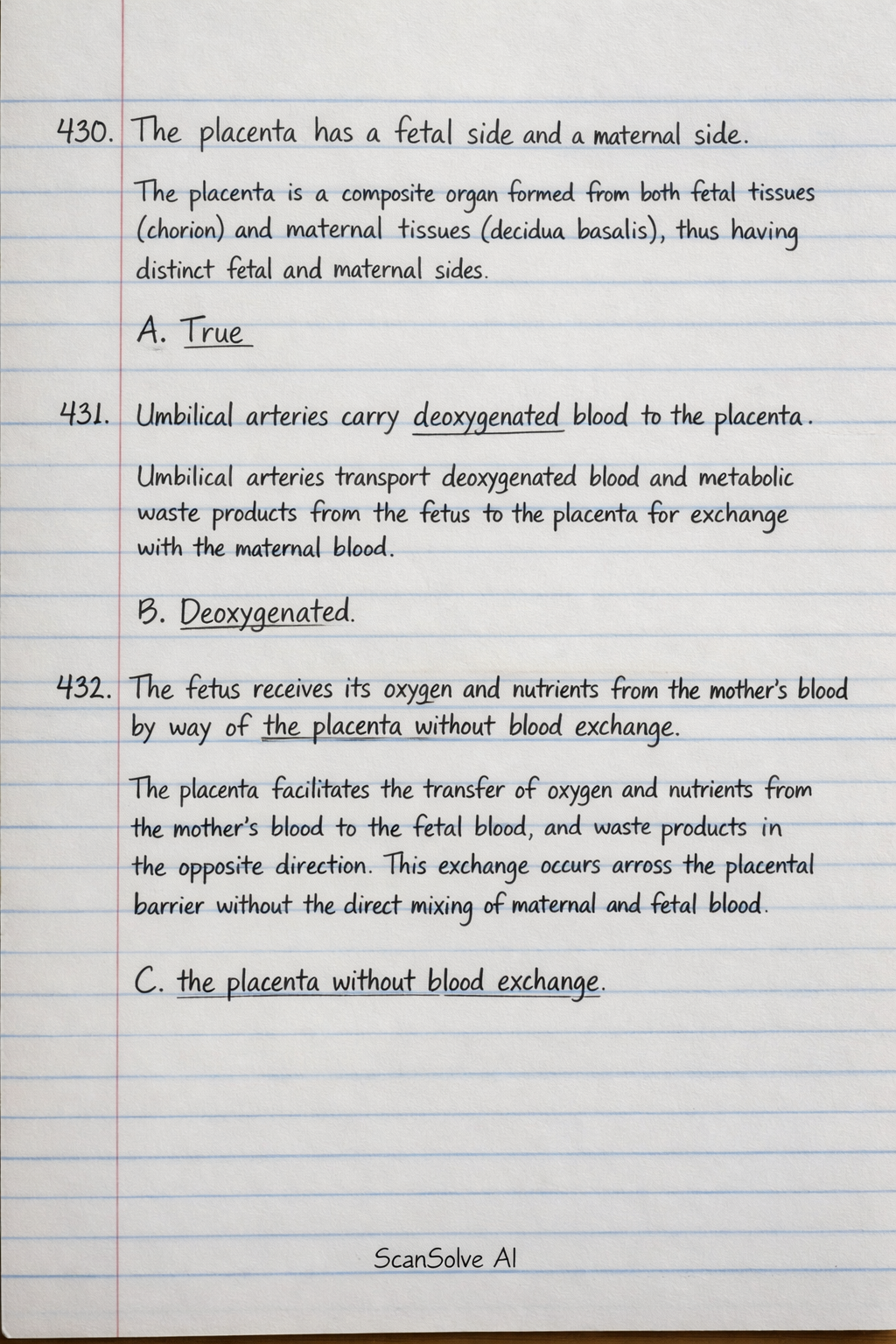
430. The placenta has a fetal side and a maternal side.
The placenta is a composite organ formed from both fetal tissues (chorion) and maternal tissues (decidua basalis), thus having distinct fetal and maternal sides.
- A. True
431. Umbilical arteries carry deoxygenated blood to the placenta.
Umbilical arteries transport deoxygenated blood and metabolic waste products from the fetus to the placenta for exchange with the maternal blood.
- B. Deoxygenated
432. The fetus receives its oxygen and nutrients from the mother's blood by way of the placenta without blood exchange.
The placenta facilitates the transfer of oxygen and nutrients from the mother's blood to the fetal blood, and waste products in the opposite direction. This exchange occurs across the placental barrier without the direct mixing of maternal and fetal blood.
- C. the placenta without blood exchange
433. In fungi, maturation is primarily a process of growth.
Maturation in fungi involves the development of the organism to a fully functional state, often including the ability to reproduce. This process fundamentally relies on extensive growth of hyphae and the formation of specialized structures.
- C. growth
434. The initial dorsal-ventral orientation of vertebrate embryos is determined by the point of entry of the sperm.
In some vertebrates, such as amphibians, the point of sperm entry into the egg can establish an asymmetry that helps determine the initial dorsal-ventral axis of the embryo.
- A. the point of entry of the sperm
435. Skeletal muscles, blood cells, and gametes are derived from cells from the somites.
Skeletal muscles are directly derived from the myotome region of somites (which are blocks of mesoderm). While blood cells and gametes (primordial germ cells) do not directly originate from somites, they are all ultimately linked to the mesodermal lineage. Somites are the only option provided that represents a mesodermal derivative.
- B. somites
Still stuck on this one?
Ask a follow-up, and the answer starts from this question.
More Biology Questions
Handwritten Step-by-Step Solution
Get this as a handwritten image on WhatsApp — like a tutor wrote it for you.
Try on WhatsApp