
We read your photo as:
Which statement regarding anatomical position and body positions (supine, prone) is incorrect? a) Body is erect, eyes forward. b) Upper limbs hang by side, palms anterior. c) Body is in fetal position
ScanSolve AI Answer
I will answer the objective questions from the image provided.
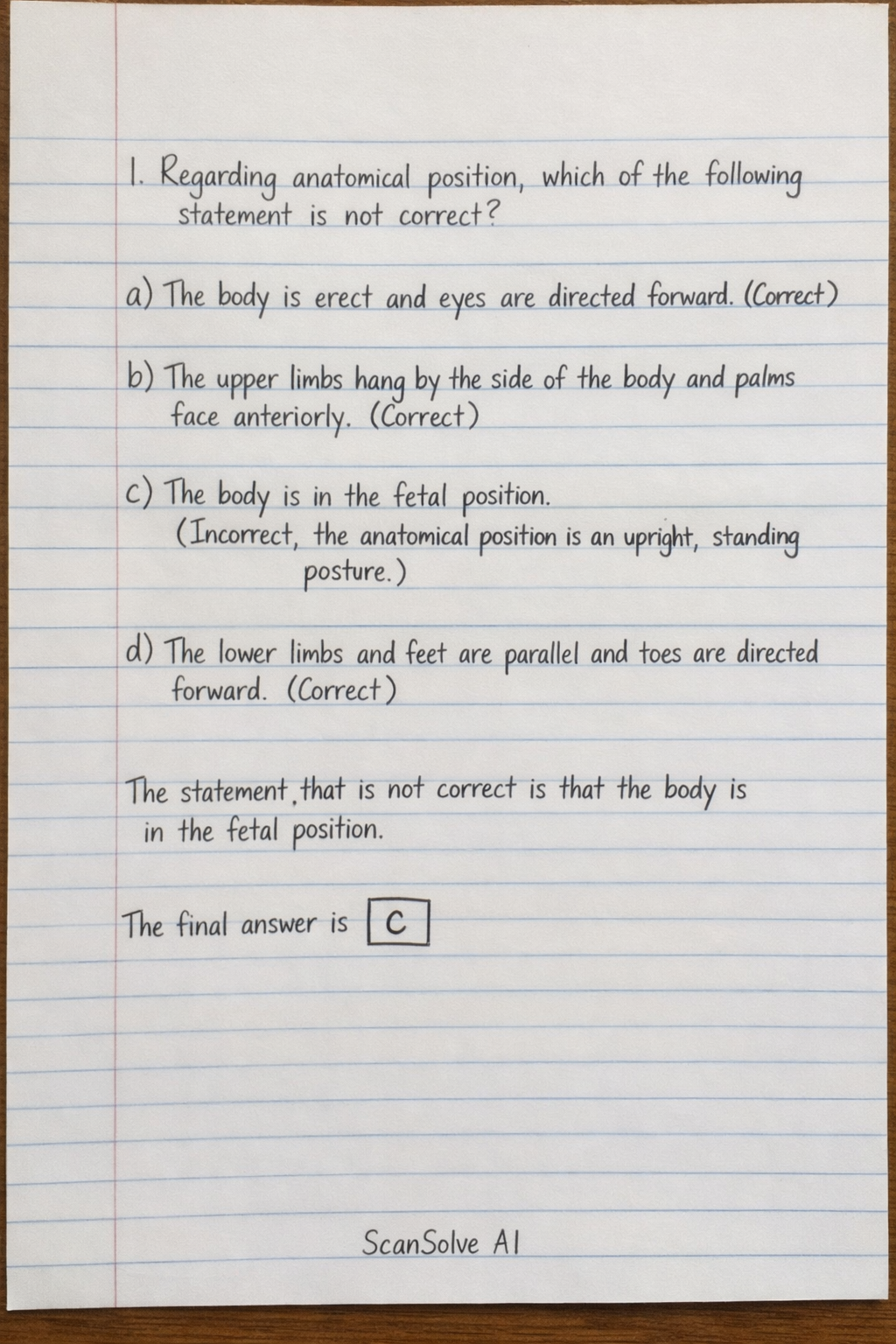
1. Regarding anatomical position, which of the following statement is not correct?
- a) The body is erect and eyes are directed forward. (Correct)
- b) The upper limbs hang by the side of the body and palms face anteriorly. (Correct)
- c) The body is in the fetal position. (Incorrect, the anatomical position is an upright, standing posture.)
- d) The lower limbs and feet are parallel and toes are directed forward. (Correct)
The statement that is not correct is that the body is in the fetal position.
The final answer is
2. Select the correct statement:
- a) In the supine position the person lies on the back with face directed upwards. (Correct definition of supine position)
- b) In the prone position the person lies on his back with face directed upwards. (Incorrect, prone means lying on the belly.)
- c) In prone position the person lies on his belly with face directed to the left side. (Partially correct for prone, but the face direction is not a defining characteristic of prone position itself, and "to the left side" is not universally true.)
- d) In the supine position the person lies on the back with face directed to the right side. (Incorrect, face is directed upwards in supine, not necessarily to the side.)
The most accurate and complete correct statement is option a.
The final answer is
3. Regarding fundamental position, select the correct statement:
- b) The body is erect and palms face medially. (Correct, this is the key difference from anatomical position where palms face anteriorly.)
- c) The body is erect and palms face anteriorly. (This describes the anatomical position, not the fundamental position.)
- d) The arms are extended away from the body. (Incorrect, arms hang by the sides in both positions.)
The correct statement is that the body is erect and palms face medially.
The final answer is
4. Regarding movement at a joint, which of the following statement is not correct?
- a) Flexion approximate the flexor surface of the adjoining parts. (Correct, flexion brings flexor surfaces closer.)
- b) Extension approximate the extensor surface of the adjoining parts. (Incorrect, extension separates extensor surfaces as the angle increases.)
- c) In abduction limb moves away to the body. (This phrasing is ambiguous. If it means "away from the body", it's correct. If it means "to the body", it's incorrect.)
- d) In abduction limb moves towards the body. (Incorrect, abduction is movement away from the midline of the body. Movement towards the body is adduction.)
Both b and d are incorrect statements. However, d is a direct and unambiguous misdefinition of abduction.
The final answer is
5. The sectional plane that divides the body into anterior and posterior portions is:
- a) Transverse plane (Divides into superior and inferior parts)
- b) Sagittal plane (Divides into left and right parts)
- c) Coronal plane (Divides into anterior (front) and posterior (back) parts)
- d) Oblique plane (A diagonal cut)
The plane that divides the body into anterior and posterior portions is
Still stuck on this one?
Ask a follow-up, and the answer starts from this question.
More Biology Questions
Handwritten Step-by-Step Solution
Get this as a handwritten image on WhatsApp — like a tutor wrote it for you.
Try on WhatsApp