
We read your photo as:
Below is a diagram of a specialised animal cell. Identify the enzyme and describe its role. Also, explain the advantages of carbon (IV) oxide transportation and the role of calcium ions in blood clott
Biology
ScanSolve AI Answer
Here are the answers to your questions:
-
The diagram below represents a specialised animal cell (red blood cell).
- a) Identify the enzyme present in the above cell. (1mk)
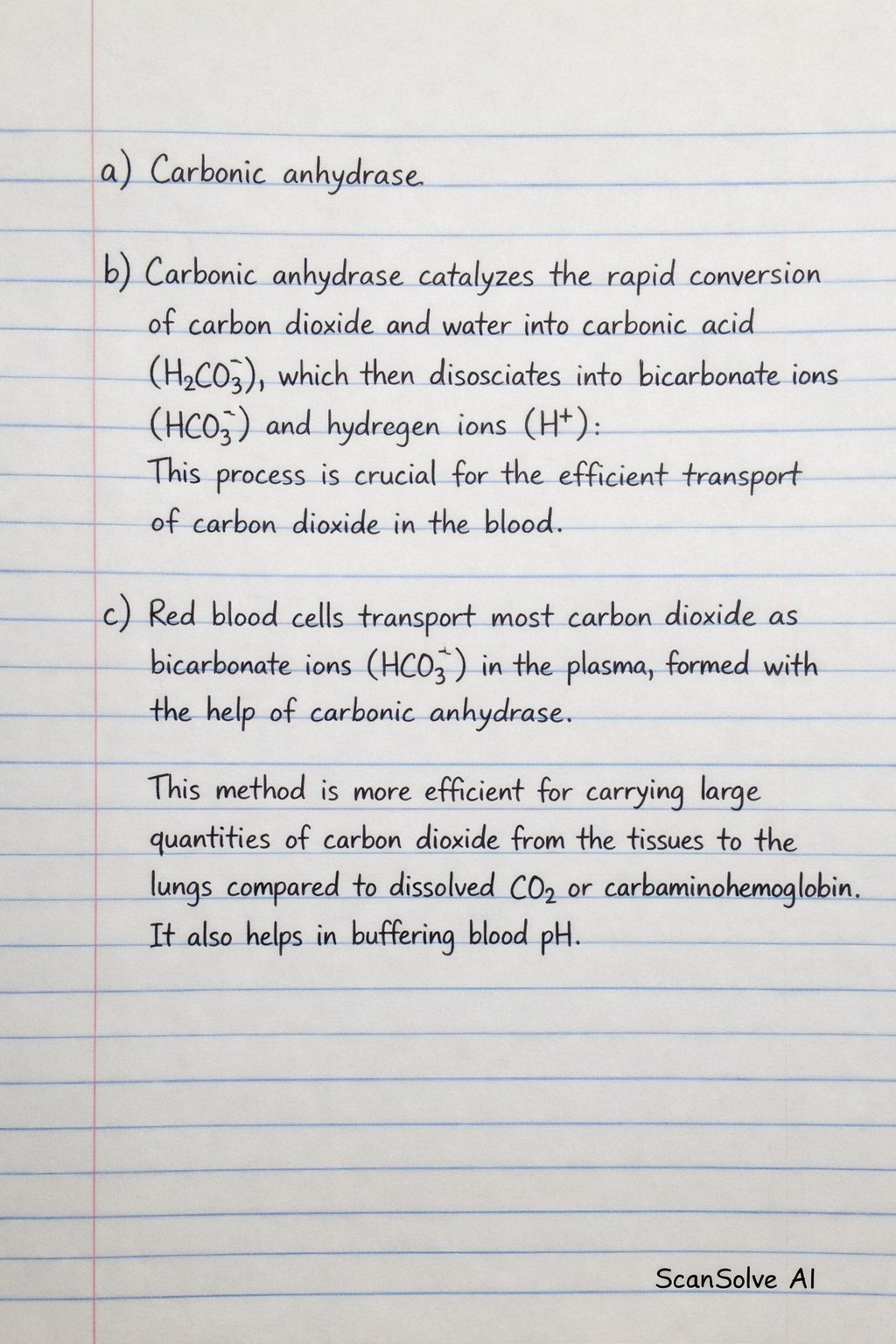
- Carbonic anhydrase
- b) Describe the role of the enzyme named in (a) above. (2mks) Carbonic anhydrase catalyzes the rapid conversion of carbon dioxide and water into carbonic acid (), which then dissociates into bicarbonate ions () and hydrogen ions (). This process is crucial for the efficient transport of carbon dioxide in the blood.
- c) Explain why transportation of carbon (IV) oxide in the above cell is advantageous. (3mks) Red blood cells transport most carbon dioxide as bicarbonate ions () in the plasma, formed with the help of carbonic anhydrase. This method is more efficient for carrying large quantities of carbon dioxide from the tissues to the lungs compared to dissolved or carbaminohemoglobin. It also helps in buffering blood pH.
- d) Describe the role of calcium ions in blood clotting. (2mks) Calcium ions () are essential cofactors for several steps in the blood coagulation cascade. They are required for the activation of various clotting factors, including the conversion of prothrombin to thrombin and fibrinogen to fibrin, which ultimately forms the blood clot.
- a) Identify the enzyme present in the above cell. (1mk)
-
The diagram below represents a seedling.
- a) Name the structure labeled X. (1mk)
- Plumule (or Epicotyl)
- b) State the functions of the parts labeled A and C. (2mks)
- A (Cotyledon): Stores food reserves for the developing embryo/seedling.
- C (Root): Absorbs water and mineral salts from the soil and anchors the seedling.
- c) Name the type of germination exhibited by the seedling. (1mk)
- Hypogeal germination
- d) State three conditions within the seed necessary for germination. (3mks)
- i) Optimum temperature
- ii) Oxygen
- iii) Water
- a) Name the structure labeled X. (1mk)
-
Ascaris lumbricoides is an endoparasite.
- a) Name the genus to which it belongs. (1mk)
- Ascaris
- b) State the habitat of the organism. (1mk)
- Small intestine (of humans)
- a) Name the genus to which it belongs. (1mk)
Was this helpful?
Still stuck on this one?
Ask a follow-up, and the answer starts from this question.
Got a different question?Ask your own question
More Biology Questions
QThe diagram below shows the structural layout of a specialized animal cell. (a) Identify the…QWhat type of cell is it? Name the parts labeled A, B and C on the diagram. State one function for…QIdentify organelle A and list three of its functions. Identify the process and enzyme in the…QIdentify the labeled parts of the animal cell in the provided diagram.QStudy the diagram of some organelles below. a) Identify the organelle marked A. b) Give three…
Browse by topic:Biochemistry
Handwritten Step-by-Step Solution
Get this as a handwritten image on WhatsApp — like a tutor wrote it for you.
Try on WhatsApp