
We read your photo as:
Define biological molecules, biostatistics, succession, carrying capacity, and aestivation. Name the bonds formed between monomers of starch and protein.
Biology
ScanSolve AI Answer
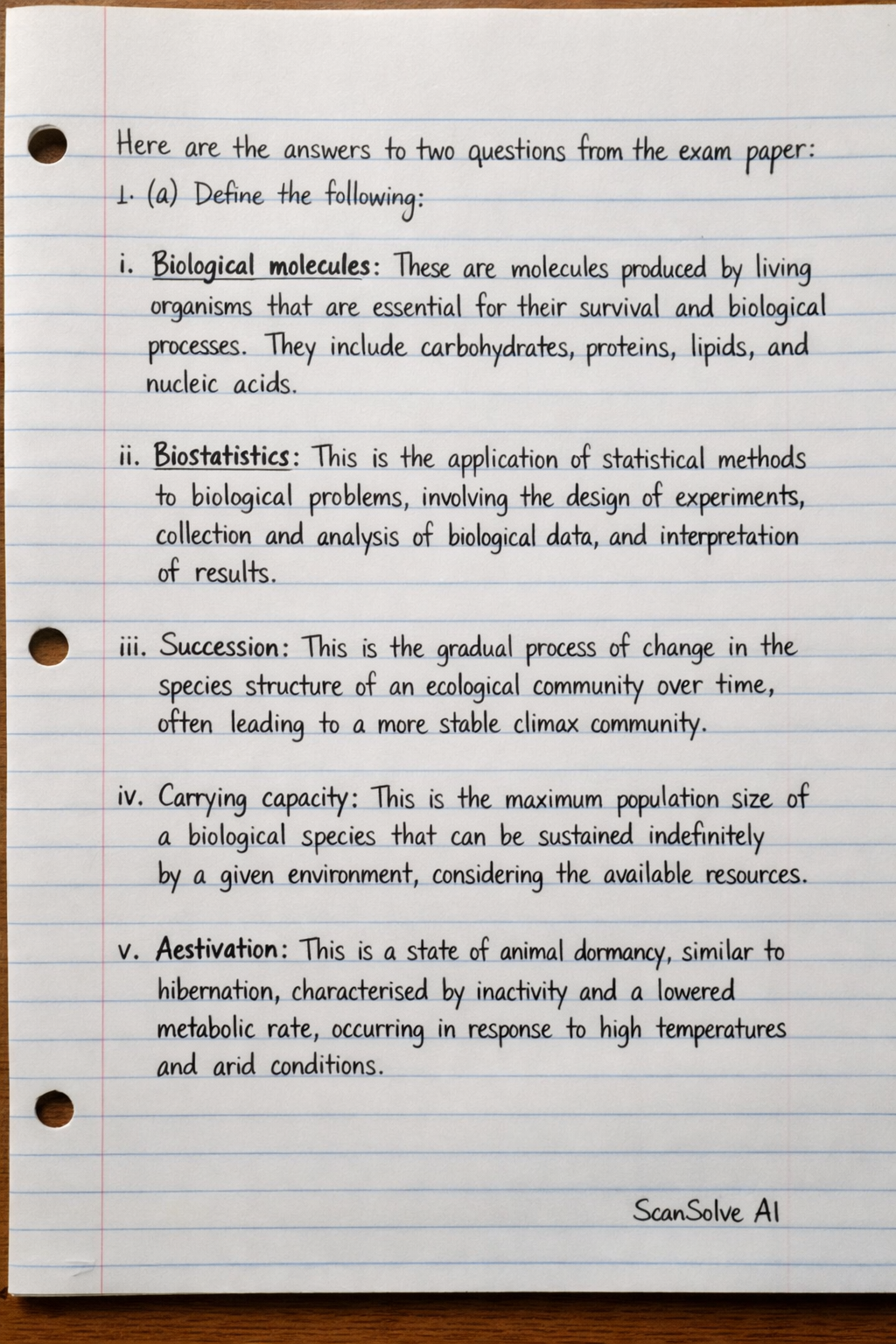
Here are the answers to two questions from the exam paper:
1. (a) Define the following:
- i. Biological molecules: These are molecules produced by living organisms that are essential for their survival and biological processes. They include carbohydrates, proteins, lipids, and nucleic acids.
- ii. Biostatistics: This is the application of statistical methods to biological problems, involving the design of experiments, collection and analysis of biological data, and interpretation of results.
- iii. Succession: This is the gradual process of change in the species structure of an ecological community over time, often leading to a more stable climax community.
- iv. Carrying capacity: This is the maximum population size of a biological species that can be sustained indefinitely by a given environment, considering the available resources.
- v. Aestivation: This is a state of animal dormancy, similar to hibernation, characterized by inactivity and a lowered metabolic rate, occurring in response to high temperatures and arid conditions.
2. (a) Name the bonds that are formed between monomers of the following biological molecules:
- i. Starch: The bonds formed between glucose monomers in starch are glycosidic bonds.
- ii. Protein: The bonds formed between amino acid monomers in proteins are peptide bonds.
- iii. Lipid: For common lipids like triglycerides, the bonds formed between glycerol and fatty acids are ester bonds.
- iv. Nucleic acid: The bonds formed between nucleotide monomers in nucleic acids are phosphodiester bonds.
Was this helpful?
Still stuck on this one?
Ask a follow-up, and the answer starts from this question.
Got a different question?Ask your own question
More Biology Questions
QDescribe the Watson and Crick structure of DNA, why starch is a good storage form, and differentiate…QClassify carbohydrates and define polysaccharides. What bonds are in disaccharides? How are…QNeed help with biological molecules summary alsoQGIVE the name or monomers of the following polymers: (I) Protein (II) natural rubber (III) Nylon 6,6…QHere are some questions on Carbohydrates: What is the general formula for a monosaccharide? Name the…
Browse by topic:Biochemistry
Handwritten Step-by-Step Solution
Get this as a handwritten image on WhatsApp — like a tutor wrote it for you.
Try on WhatsApp