
We read your photo as:
Describe the Watson and Crick structure of DNA, why starch is a good storage form, and differentiate between glycogen and starch.
ScanSolve AI Answer
Here are the answers to your questions:
-
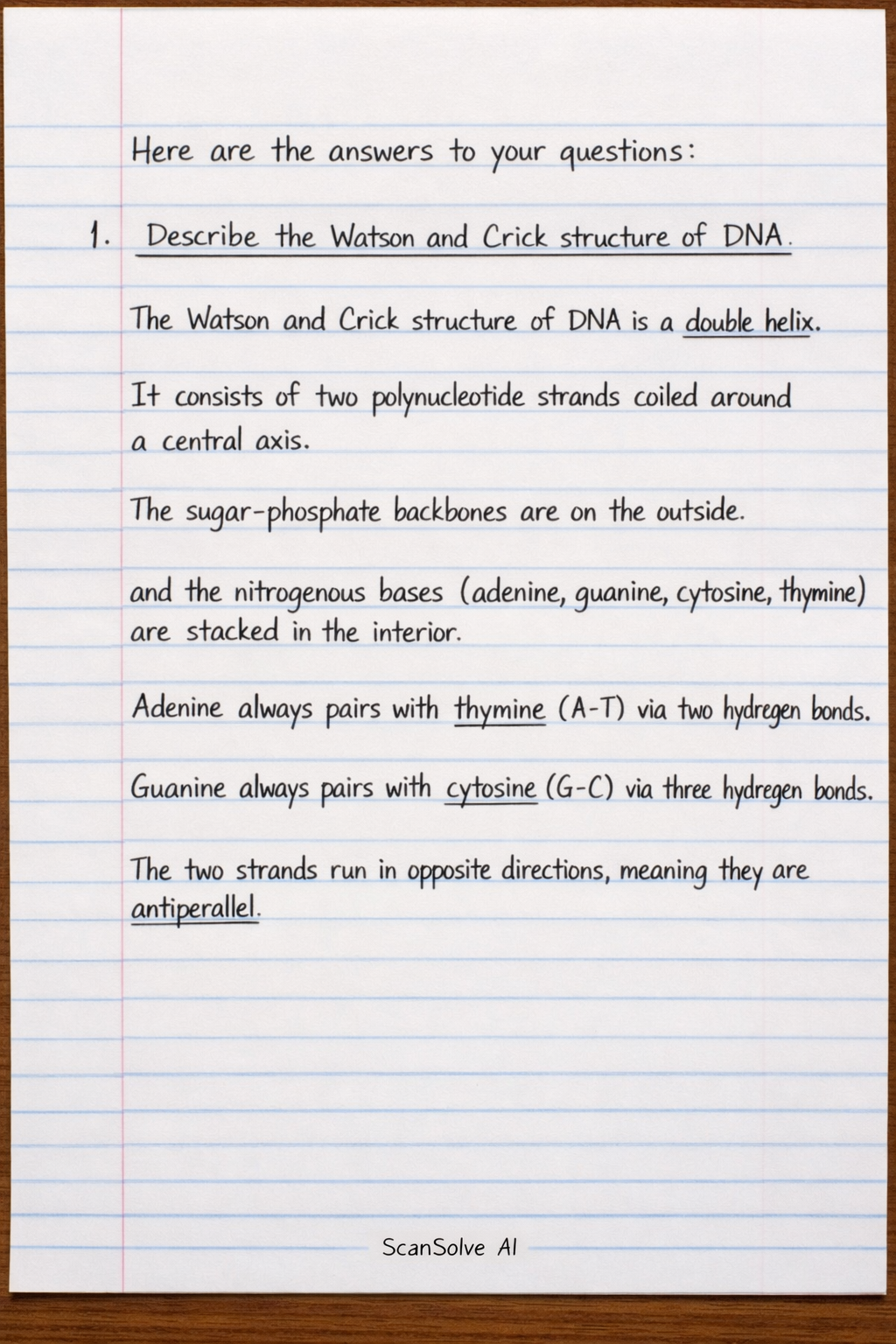
Describe the Watson and Crick structure of DNA. The Watson and Crick structure of DNA is a double helix. It consists of two polynucleotide strands coiled around a central axis. The sugar-phosphate backbones are on the outside, and the nitrogenous bases (adenine, guanine, cytosine, thymine) are stacked in the interior. Adenine always pairs with thymine (A-T) via two hydrogen bonds, and guanine always pairs with cytosine (G-C) via three hydrogen bonds. The two strands run in opposite directions, meaning they are antiparallel.
-
Why is the starch molecule a convenient storage form of carbohydrates in plants? Starch is a convenient storage form because it is a large, insoluble polysaccharide. Its insolubility prevents it from affecting the water potential of the plant cell, and its large size means it cannot easily diffuse out of cells. Starch can also be compactly stored due to its branched structure (amylopectin) and coiled structure (amylose), allowing plants to store a significant amount of glucose in a small space for later energy release.
-
Differentiate between Glycogen and Starch:
- Glycogen is the primary storage polysaccharide in animals and fungi. It is highly branched, allowing for rapid glucose release.
- Starch is the primary storage polysaccharide in plants. It consists of two components: amylose (unbranched, coiled) and amylopectin (branched).
-
Differentiate between Phospholipids and Triglycerides:
- Triglycerides are composed of one glycerol molecule esterified to three fatty acid molecules. They are primarily used for long-term energy storage and insulation.
- Phospholipids are composed of one glycerol molecule esterified to two fatty acid molecules and one phosphate group (often with an additional polar head group). They are the main components of cell membranes, forming a bilayer due to their amphipathic nature (having both hydrophilic and hydrophobic parts).
Still stuck on this one?
Ask a follow-up, and the answer starts from this question.
More Biology Questions
Handwritten Step-by-Step Solution
Get this as a handwritten image on WhatsApp — like a tutor wrote it for you.
Try on WhatsApp