
We read your photo as:
Classify carbohydrates and define polysaccharides. What bonds are in disaccharides? How are monosaccharides classified?
ScanSolve AI Answer
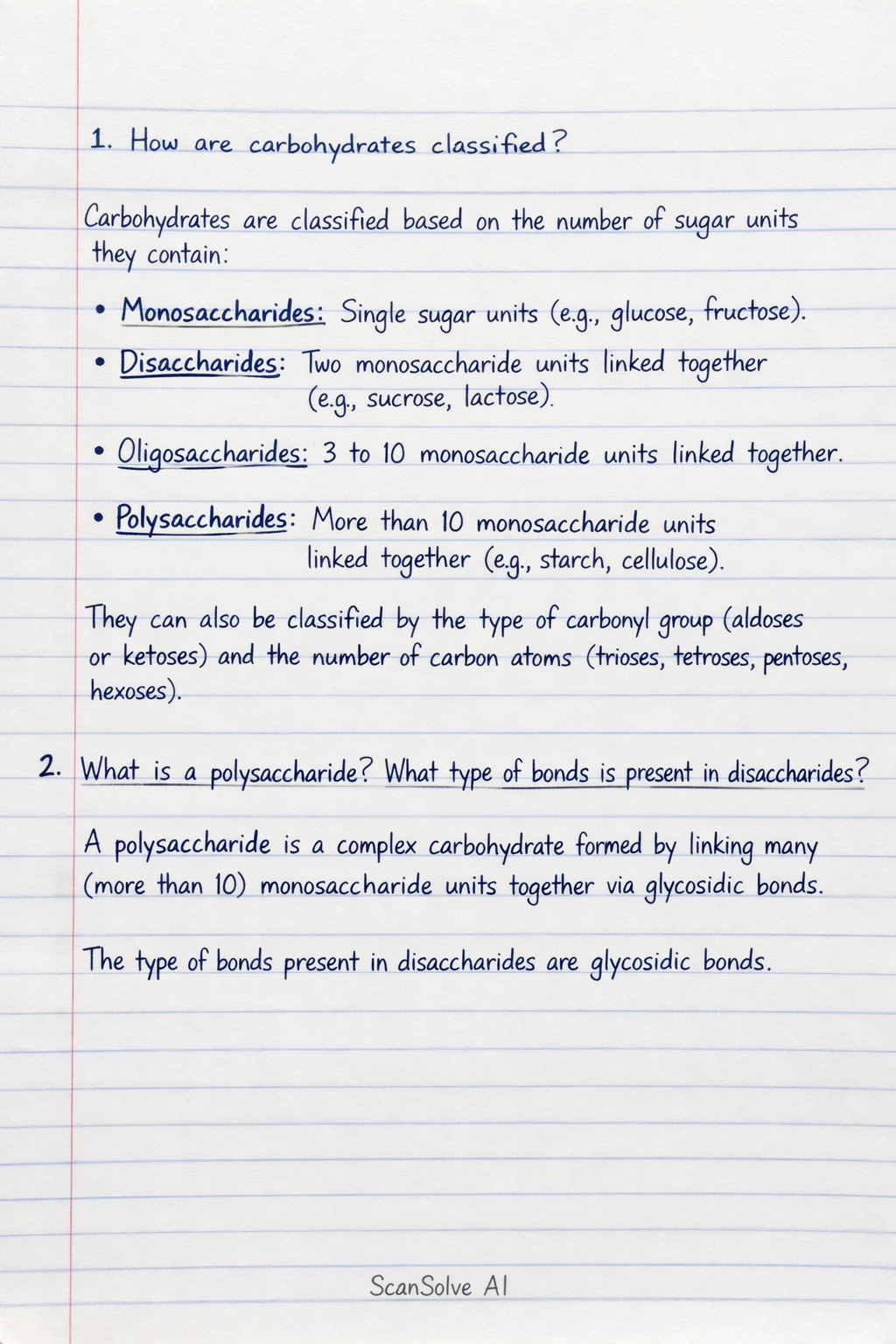
1. How are carbohydrates classified?
Carbohydrates are classified based on the number of sugar units they contain:
- Monosaccharides: Single sugar units (e.g., glucose, fructose).
- Disaccharides: Two monosaccharide units linked together (e.g., sucrose, lactose).
- Oligosaccharides: 3 to 10 monosaccharide units linked together.
- Polysaccharides: More than 10 monosaccharide units linked together (e.g., starch, cellulose). They can also be classified by the type of carbonyl group (aldoses or ketoses) and the number of carbon atoms (trioses, tetroses, pentoses, hexoses).
2. What is a polysaccharide? What type of bonds is present in disaccharides?
A polysaccharide is a complex carbohydrate formed by linking many (more than 10) monosaccharide units together via glycosidic bonds.
The type of bonds present in disaccharides are glycosidic bonds.
3. How are monosaccharides further classified?
Monosaccharides are further classified based on two main criteria:
- Type of carbonyl group:
- Aldoses: Contain an aldehyde group ().
- Ketoses: Contain a ketone group ().
- Number of carbon atoms:
- Trioses: 3 carbons (e.g., glyceraldehyde).
- Tetroses: 4 carbons (e.g., erythrose).
- Pentoses: 5 carbons (e.g., ribose).
- Hexoses: 6 carbons (e.g., glucose, fructose).
4. What is the difference between D and L sugars?
D and L sugars refer to the stereochemical configuration of a monosaccharide. The designation is based on the configuration of the chiral carbon atom furthest from the carbonyl group.
- D-sugar: The hydroxyl group on the chiral carbon furthest from the carbonyl group is on the right side in the Fischer projection. Most naturally occurring sugars are D-sugars.
- L-sugar: The hydroxyl group on the chiral carbon furthest from the carbonyl group is on the left side in the Fischer projection.
5. What is the difference between glucose and galactose?
Glucose and galactose are epimers. They differ in the configuration of the hydroxyl group at a single chiral carbon atom. Specifically, glucose and galactose differ in the orientation of the hydroxyl group at carbon-4 (C-4).
6. What is epimerism? Give an example.
Epimerism is a type of stereoisomerism where two monosaccharides differ in the configuration (orientation of -H and -OH groups) around only one specific chiral carbon atom, excluding the anomeric carbon.
Example: Glucose and galactose are C-4 epimers. Glucose and mannose are C-2 epimers.
7. Anomerism is produced concerning which carbon atom?
Anomerism is produced concerning the anomeric carbon atom. This is the carbonyl carbon (C-1 in aldoses, C-2 in ketoses) that becomes a new chiral center when a monosaccharide cyclizes to form a hemiacetal or hemiketal.
8. Keto group is non-reducing, but fructose reduces Benedict's solution, what is the cause of this anomaly?
Although fructose contains a ketone group, which is typically non-reducing, it can reduce Benedict's solution because, in the alkaline conditions of the Benedict's reagent, fructose undergoes tautomerization (specifically, an enediol rearrangement). This process converts fructose (a ketose) into an aldose (glucose or mannose), which then has a free aldehyde group capable of reducing the copper(II) ions in Benedict's solution.
9. What are the products of the oxidation of glucose? What are the products of its reduction?
- Products of oxidation of glucose:
- Oxidation of the aldehyde group (C-1) yields an aldonic acid (e.g., gluconic acid).
- Oxidation of the primary alcohol group (C-6) yields a uronic acid (e.g., glucuronic acid).
- Oxidation of both the aldehyde and primary alcohol groups yields an aldaric acid (e.g., glucaric acid).
- Products of reduction of glucose:
- Reduction of the aldehyde group (C-1) yields a sugar alcohol or alditol (e.g., sorbitol).
10. What is the glycosidic linkage between lactose and sucrose?
- Lactose: The glycosidic linkage is a -1,4-glycosidic bond between galactose and glucose.
- Sucrose: The glycosidic linkage is an -1,2-glycosidic bond between glucose and fructose.
11. Which disaccharide has no free aldehyde or ketone group?
Sucrose has no free aldehyde or ketone group. This is because the anomeric carbon of glucose (C-1) and the anomeric carbon of fructose (C-2) are both involved in forming the glycosidic bond, making it a non-reducing sugar.
12. Glucose and fructose are reducing sugars, but sucrose (containing glucose and fructose) is a non-reducing sugar, why?
Glucose and fructose are reducing sugars because they both possess a free anomeric carbon that can open to form an aldehyde or ketone group, which can be oxidized.
Sucrose is a non-reducing sugar because its glycosidic bond (-1,2-glycosidic bond) is formed between the anomeric carbon of glucose (C-1) and the anomeric carbon of fructose (C-2). This means that neither of the anomeric carbons is free to open into an aldehyde or ketone form, thus preventing sucrose from acting as a reducing agent.
13. What is the reserve carbohydrate in the plant kingdom?
The reserve carbohydrate in the plant kingdom is starch.
14. What is the end product of the action of pancreatic amylase on starch?
The end products of the action of pancreatic amylase on starch are primarily maltose, maltotriose, and -dextrins (also known as limit dextrins).
15. Cellulose and starch are polysaccharides made of glucose, but cellulose cannot be digested by human beings, why?
Both cellulose and starch are polymers of glucose, but they differ in the type of glycosidic linkage:
- Starch consists of glucose units linked by -1,4-glycosidic bonds (and -1,6-glycosidic bonds in amylopectin).
- Cellulose consists of glucose units linked by -1,4-glycosidic bonds. Human digestive enzymes, specifically amylase, can hydrolyze -1,4-glycosidic bonds but lack the enzyme cellulase required to break down the -1,4-glycosidic bonds in cellulose. Therefore, humans cannot digest cellulose.
16. What is the difference between glycoproteins and mucoproteins?
- Glycoproteins: Proteins that have carbohydrate chains (glycans) covalently attached to their polypeptide backbone. The carbohydrate component is typically smaller (often less than 15% by weight) and can be linear or branched. They play roles in cell recognition, signaling, and immune response.
- Mucoproteins (or proteoglycans): A specific type of glycoprotein where the carbohydrate component is much larger (often more than 50% by weight) and consists mainly of long, unbranched chains of repeating disaccharide units called glycosaminoglycans (GAGs). These GAGs often contain acidic sugars and amino sugars. Mucoproteins are key components of connective tissue, providing structural support and lubrication.
Still stuck on this one?
Ask a follow-up, and the answer starts from this question.
More Chemistry Questions
Handwritten Step-by-Step Solution
Get this as a handwritten image on WhatsApp — like a tutor wrote it for you.
Try on WhatsApp