
We read your photo as:
Biology students keep yourself busy while waiting, just for revision, Advance level
ScanSolve AI Answer
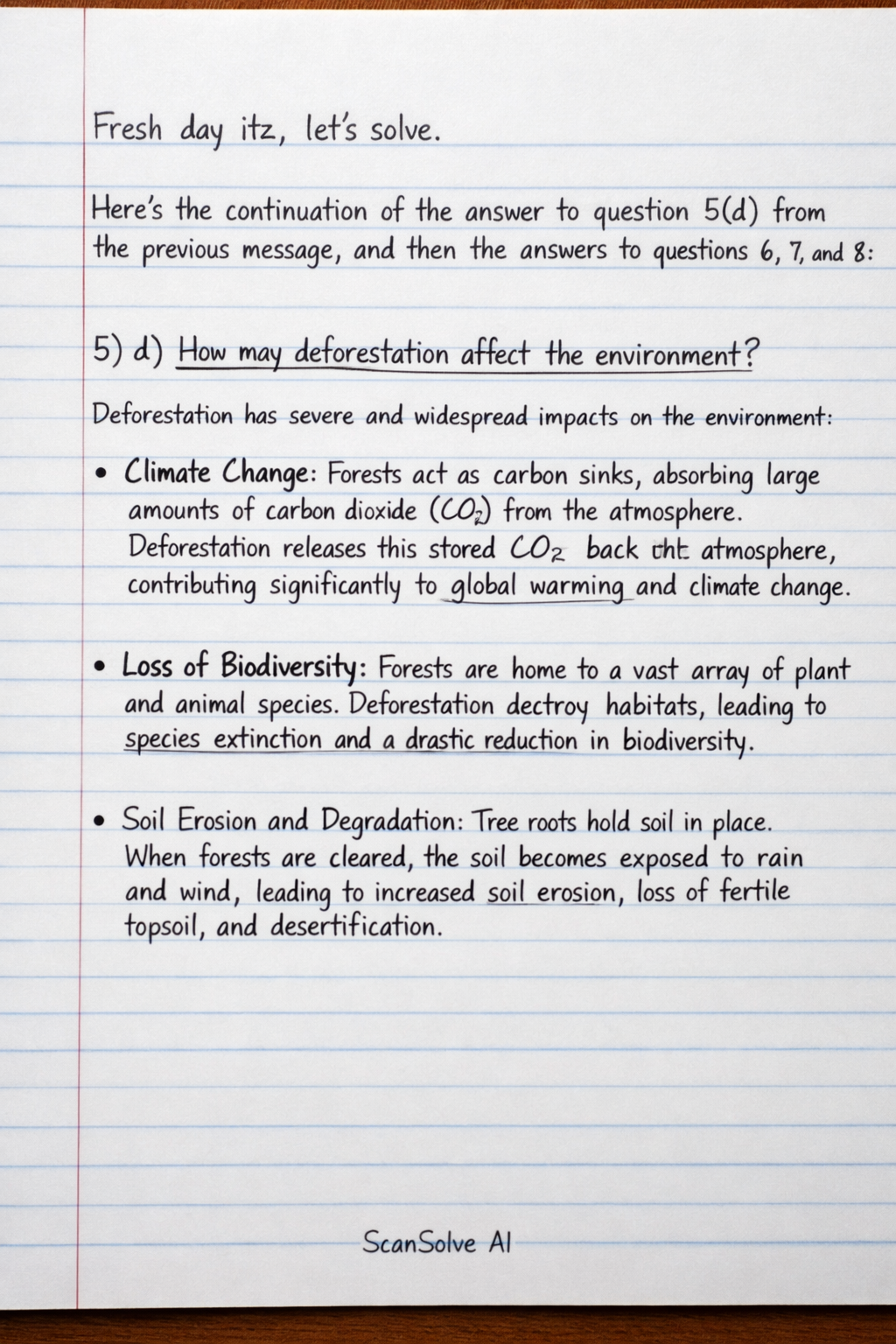
Here's the continuation of the answer to question 5(d) from the previous message, and then the answers to questions 6, 7, and 8:
5) d) How may deforestation affect the environment?
Deforestation has severe and widespread impacts on the environment:
- Climate Change: Forests act as carbon sinks, absorbing large amounts of carbon dioxide () from the atmosphere. Deforestation releases this stored back into the atmosphere, contributing significantly to global warming and climate change.
- Loss of Biodiversity: Forests are home to a vast array of plant and animal species. Deforestation destroys habitats, leading to species extinction and a drastic reduction in biodiversity.
- Soil Erosion and Degradation: Tree roots hold soil in place. When forests are cleared, the soil becomes exposed to rain and wind, leading to increased soil erosion, loss of fertile topsoil, and desertification.
- Disruption of Water Cycle: Forests play a crucial role in the water cycle through transpiration. Deforestation reduces local rainfall, increases surface runoff, and can lead to droughts and altered river flows.
- Increased Flooding: With less vegetation to absorb rainwater, deforested areas experience increased surface runoff, which can lead to more frequent and severe flooding downstream.
- Impact on Indigenous Communities: Deforestation often displaces indigenous communities who rely on forests for their livelihoods, culture, and resources.
6) a) Write short notes on the following:
i. Ozone layer depletion:
Ozone layer depletion refers to the thinning of the Earth's ozone layer in the stratosphere, primarily caused by the release of chlorofluorocarbons (CFCs) and other ozone-depleting substances. The ozone layer protects life on Earth by absorbing harmful ultraviolet (UV) radiation from the sun. Depletion leads to increased UV radiation reaching the surface, which can cause skin cancer, cataracts, and harm to ecosystems.
ii. Global warming:
Global warming is the long-term increase in Earth's average surface temperature due to the buildup of greenhouse gases (like carbon dioxide, methane, and nitrous oxide) in the atmosphere. These gases trap heat, leading to a gradual warming of the planet, which in turn causes climate change, including rising sea levels, extreme weather events, and disruptions to ecosystems.
iii. Deforestation:
Deforestation is the permanent removal of forests for other land uses, such as agriculture, urbanization, or logging, without sufficient reforestation. It is a major environmental issue contributing to climate change, loss of biodiversity, soil erosion, and disruption of water cycles.
b) What is the importance of conservation of wild life?
Conservation of wildlife is important for:
- Maintaining Biodiversity: Preserving the variety of life on Earth, which is essential for healthy and resilient ecosystems.
- Ecosystem Services: Wildlife plays crucial roles in pollination, seed dispersal, pest control, and nutrient cycling, all of which are vital for human well-being.
- Economic Benefits: Wildlife supports industries like tourism (ecotourism), fishing, and hunting, providing livelihoods and revenue.
- Scientific and Medical Research: Many species provide insights into biological processes and are sources of potential new medicines and genetic resources.
- Ethical and Aesthetic Value: Many believe that wildlife has an intrinsic right to exist, and its presence enriches human life culturally and aesthetically.
c) What measures can the government take to conserve wild life?
Governments can take several measures to conserve wildlife:
- Establishment and Enforcement of Protected Areas: Creating and effectively managing national parks, wildlife sanctuaries, and reserves to protect habitats and species.
- Legislation and Policy: Enacting and enforcing strong laws against poaching, illegal wildlife trade, and habitat destruction, as well as developing policies for sustainable resource use.
- International Cooperation: Participating in international treaties and agreements (e.g., CITES) to regulate cross-border wildlife trade and address global conservation challenges.
- Funding and Research: Allocating resources for wildlife research, monitoring, and conservation programs, including captive breeding and reintroduction initiatives.
- Public Awareness and Education: Launching campaigns to educate the public about the importance of wildlife conservation and promoting responsible tourism and consumption.
- Sustainable Land Use Planning: Integrating wildlife conservation into broader land-use planning, including agriculture, urban development, and infrastructure projects.
7) a) What is a nerve impulse?
A nerve impulse (or action potential) is an electrical signal that travels rapidly along the axon of a neuron. It is a brief, rapid, and reversible change in the electrical potential across the neuron's membrane, caused by the movement of ions (primarily sodium and potassium) across the membrane.
b) Describe how it is transmitted along a neuron.
Transmission of a nerve impulse along a neuron occurs through a series of events:
- Resting Potential: The neuron maintains a resting potential (typically around -70 mV) with a higher concentration of sodium ions () outside the cell and potassium ions () inside, maintained by the sodium-potassium pump.
- Depolarization: When a stimulus reaches a threshold, voltage-gated sodium channels open, allowing ions to rush into the cell. This causes the membrane potential to become positive (depolarization).
- Repolarization: Shortly after, voltage-gated sodium channels close, and voltage-gated potassium channels open, allowing ions to flow out of the cell. This restores the negative charge inside the cell (repolarization).
- Hyperpolarization: Potassium channels may remain open slightly longer, causing a brief period of hyperpolarization where the membrane potential becomes more negative than the resting potential.
- Refractory Period: During repolarization and hyperpolarization, the neuron enters a refractory period where it cannot generate another action potential, ensuring unidirectional impulse transmission.
- Propagation: This sequence of depolarization and repolarization propagates as a wave along the axon, regenerating the action potential at successive points. In myelinated neurons, the impulse saltates (jumps) between Nodes of Ranvier, speeding up transmission.
c) How can this impulse be transmitted across a synapse?
A nerve impulse is transmitted across a synapse (the junction between two neurons or a neuron and an effector cell) via neurotransmitters:
- Arrival of Action Potential: When an action potential arrives at the presynaptic terminal of the axon, it depolarizes the membrane.
- Calcium Influx: This depolarization opens voltage-gated calcium channels, allowing calcium ions () to flow into the presynaptic terminal.
- Neurotransmitter Release: The influx of triggers the fusion of synaptic vesicles (containing neurotransmitters) with the presynaptic membrane, releasing neurotransmitters into the synaptic cleft.
- Binding to Receptors: Neurotransmitters diffuse across the synaptic cleft and bind to specific receptors on the postsynaptic membrane.
- Postsynaptic Potential: This binding causes ion channels on the postsynaptic membrane to open, leading to a change in the postsynaptic neuron's membrane potential. This can be an excitatory postsynaptic potential (EPSP), making the neuron more likely to fire, or an inhibitory postsynaptic potential (IPSP), making it less likely to fire.
- Neurotransmitter Removal: Neurotransmitters are quickly removed from the synaptic cleft by enzymatic degradation, reuptake into the presynaptic terminal, or diffusion, ensuring the signal is brief and precise.
d) Differentiate between a nervous and hormonal responses.
| Feature | Nervous Response | Hormonal Response |
|---|---|---|
| Nature of Signal | Electrical (nerve impulses) and chemical (neurotransmitters) | Chemical (hormones) |
| Speed of Action | Very fast (milliseconds) | Slower (seconds to days) |
| Duration of Effect | Short-lived | Long-lasting |
| Pathway | Neurons (nerves) | Bloodstream |
| Target Cells | Specific cells/organs innervated by neurons | Widespread target cells with specific receptors |
| Specificity | Highly specific | Specific to cells with receptors for the hormone |
| Control | Brain and spinal cord (central nervous system) | Endocrine glands |
8) a) Explain the terms:
i. Biotechnology:
Biotechnology is the application of biological organisms, systems, or processes to create or modify products or processes for specific uses. It encompasses a wide range of techniques, from traditional fermentation to modern genetic engineering, used in fields like medicine, agriculture, and industry.
ii. Genetic engineering:
Genetic engineering is a subset of biotechnology that involves the direct manipulation of an organism's genes using recombinant DNA technology. It allows for the introduction, deletion, or modification of specific genes to alter the characteristics of an organism or produce desired products.
b) What are the differences between a batch fermentation process and continuous fermentation process?
| Feature | Batch Fermentation Process | Continuous Fermentation Process |
|---|---|---|
| Operation | Closed system; all nutrients added at start; product harvested at end. | Open system; nutrients continuously added, product continuously removed. |
| Growth Phase | Distinct lag, exponential, stationary, and death phases. | Aims to maintain cells in exponential or stationary phase. |
| Productivity | Lower overall productivity due to downtime between batches. | Higher overall productivity due to uninterrupted operation. |
| Control | Less control over nutrient concentration during the run. | Better control over nutrient concentration and environmental conditions. |
| Sterility | Easier to maintain sterility for a single batch. | More challenging to maintain sterility over long periods. |
| Labor | More labor-intensive per unit of product due to setup/cleanup. | Less labor-intensive once established. |
| Application | Often used for high-value products, or when product inhibits growth. | Preferred for large-scale production of bulk products. |
c) Describe the biological role of microorganisms in:
i. Bread and wine production:
- Bread Production: Yeast (Saccharomyces cerevisiae) ferments sugars in dough, producing carbon dioxide () gas, which causes the dough to rise and gives bread its porous texture. Ethanol is also produced but evaporates during baking.
- Wine Production: Yeast (Saccharomyces cerevisiae) ferments sugars (glucose and fructose) present in grape juice into ethanol (alcohol) and carbon dioxide. This process is anaerobic and is crucial for the alcoholic content and flavor development of wine.
ii. Production of hormones:
Microorganisms, particularly bacteria like E. coli and yeast, are widely used in genetic engineering to produce human hormones such as insulin and growth hormone (somatotrophin). The gene for the human hormone is inserted into the microorganism's DNA, which then expresses the gene and synthesizes the hormone in large quantities. This provides a safe and efficient way to produce therapeutic hormones.
iii. Monoclonal antibodies:
Microorganisms are not directly involved in the production of monoclonal antibodies themselves, but they are crucial in the hybridoma technology used to produce them. Specifically, viruses (e.g., Sendai virus or polyethylene glycol) are used to induce the fusion of antibody-producing B lymphocytes with myeloma (cancer) cells to create hybridoma cells. These hybridoma cells are then cultured to produce large quantities of specific monoclonal antibodies.
iv. Fermentation process:
Microorganisms are the central agents in the fermentation process. They possess the enzymes necessary to break down organic compounds (typically sugars) in the absence of oxygen, converting them into various products like alcohols (e.g., ethanol), organic acids (e.g., lactic acid, acetic acid), and gases (e.g., carbon dioxide). This process is vital for energy generation for the microorganisms and is exploited in industries for food and beverage production, biofuel production, and pharmaceutical synthesis.
Still stuck on this one?
Ask a follow-up, and the answer starts from this question.
More Biology Questions
Handwritten Step-by-Step Solution
Get this as a handwritten image on WhatsApp — like a tutor wrote it for you.
Try on WhatsApp