

This biology question covers important biological concepts and processes. The step-by-step explanation below helps you understand the underlying mechanisms and reasoning.
ScanSolve AI Answer
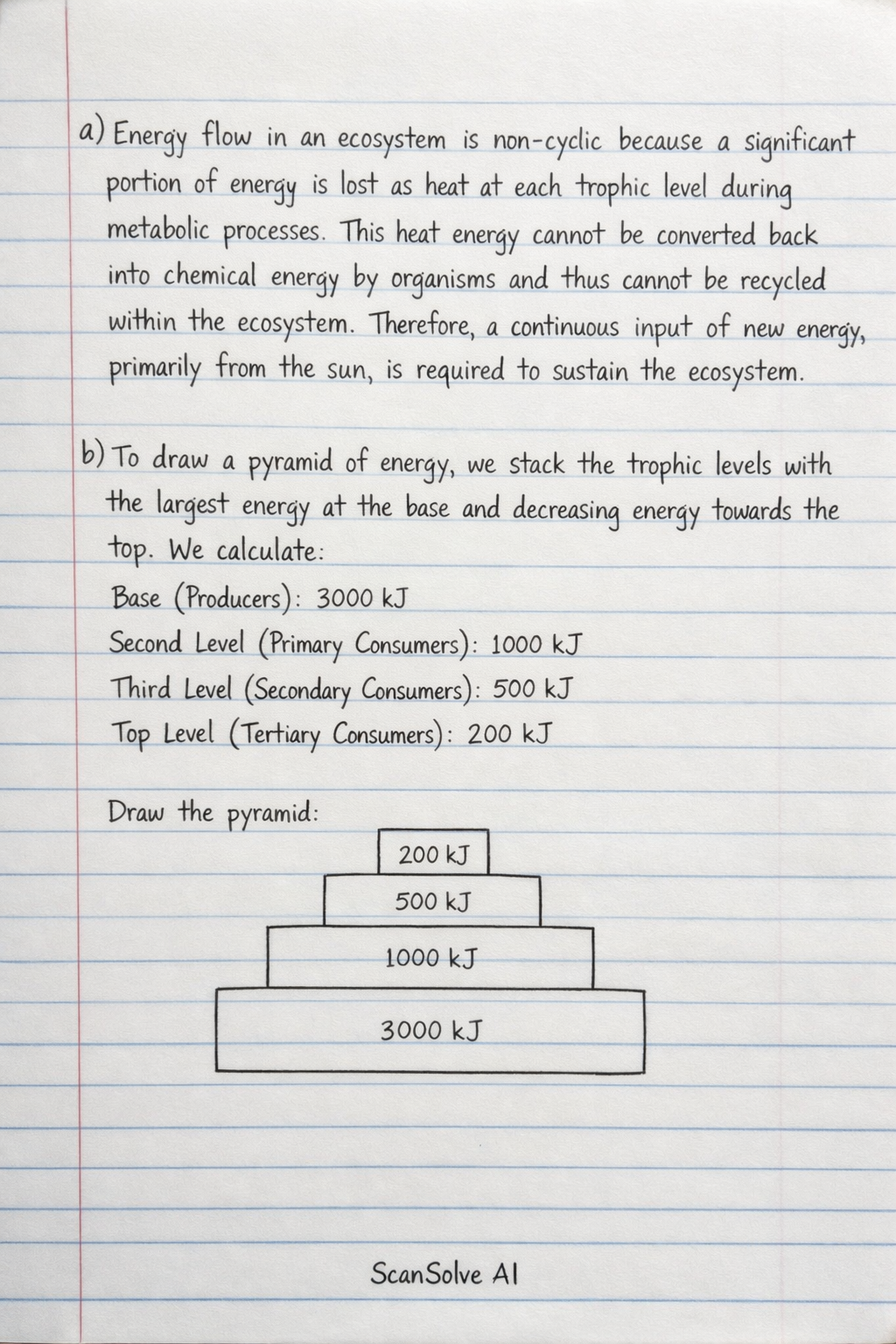
Here's the breakdown of question 5: a) Energy flow in an ecosystem is non-cyclic because a significant portion of energy is lost as heat at each trophic level during metabolic processes. This heat energy cannot be converted back into chemical energy by organisms and thus cannot be recycled within the ecosystem. Therefore, a continuous input of new energy, primarily from the sun, is required to sustain the ecosystem. b) To draw a pyramid of energy, you would stack the trophic levels with the largest energy content at the base and decreasing energy content towards the top. Each level should be proportional to its energy value. Base (Producers): 3000 kJ (widest block) Second Level (Primary Consumers): 1000 kJ Third Level (Secondary Consumers): 500 kJ Top Level (Tertiary Consumers): 200 kJ (narrowest block) The pyramid would look like this, with the base being the widest and the top being the narrowest: c Tertiary consumer (200 kJ) \\ Secondary consumer (500 kJ) \\ Primary consumer (1000 kJ) \\ Producer (3000 kJ) c) Here are three differences between a pyramid of energy and a pyramid of numbers: | Pyramid of Energy | Pyramid of Numbers | | :---------------------------------------------- | :--------------------------------------------------- | | 1. Always upright. | 1. Can be upright, inverted, or spindle-shaped. | | 2. Represents the total energy at each trophic level. | 2. Represents the number of individual organisms at each trophic level. | | 3. Accounts for the energy content (e.g., kJ). | 3. Does not account for biomass or energy content. | d) The first law of thermodynamics states that energy cannot be created or destroyed in an isolated system; it can only be transformed from one form to another. 3 done, 2 left today. You're making progress.