
We read your photo as:
Can investigate into the rate of breathing before and after exercise.
ScanSolve AI Answer
Answer
This project involves measuring and comparing a person's breathing rate at rest and after physical activity.
Step-by-step solution
5 stepsMeasure resting breathing rate*.
Have the subject sit quietly for a few minutes. Count the number of breaths they take in one minute. Repeat this measurement a few times and calculate the average to get a reliable baseline.
Perform exercise*.
Have the subject engage in a moderate-intensity exercise, such as jogging in place, jumping jacks, or climbing stairs, for a set period (e.g., 3-5 minutes).
Measure post-exercise breathing rate*.
Immediately after the exercise, have the subject sit down and count their breaths for one minute. Repeat this measurement a few times as their breathing rate returns to normal, noting the rate immediately after exercise.
Compare and analyze data*.
Compare the average resting breathing rate with the breathing rate immediately after exercise. You should observe a significant increase in breathing rate after exercise.
Explain the physiological reason*.
The body needs more oxygen during exercise to produce energy, and it also produces more carbon dioxide. Increased breathing rate helps to take in more oxygen and expel more carbon dioxide.
Still stuck on this one?
Ask a follow-up, and the answer starts from this question.
More Biology Questions
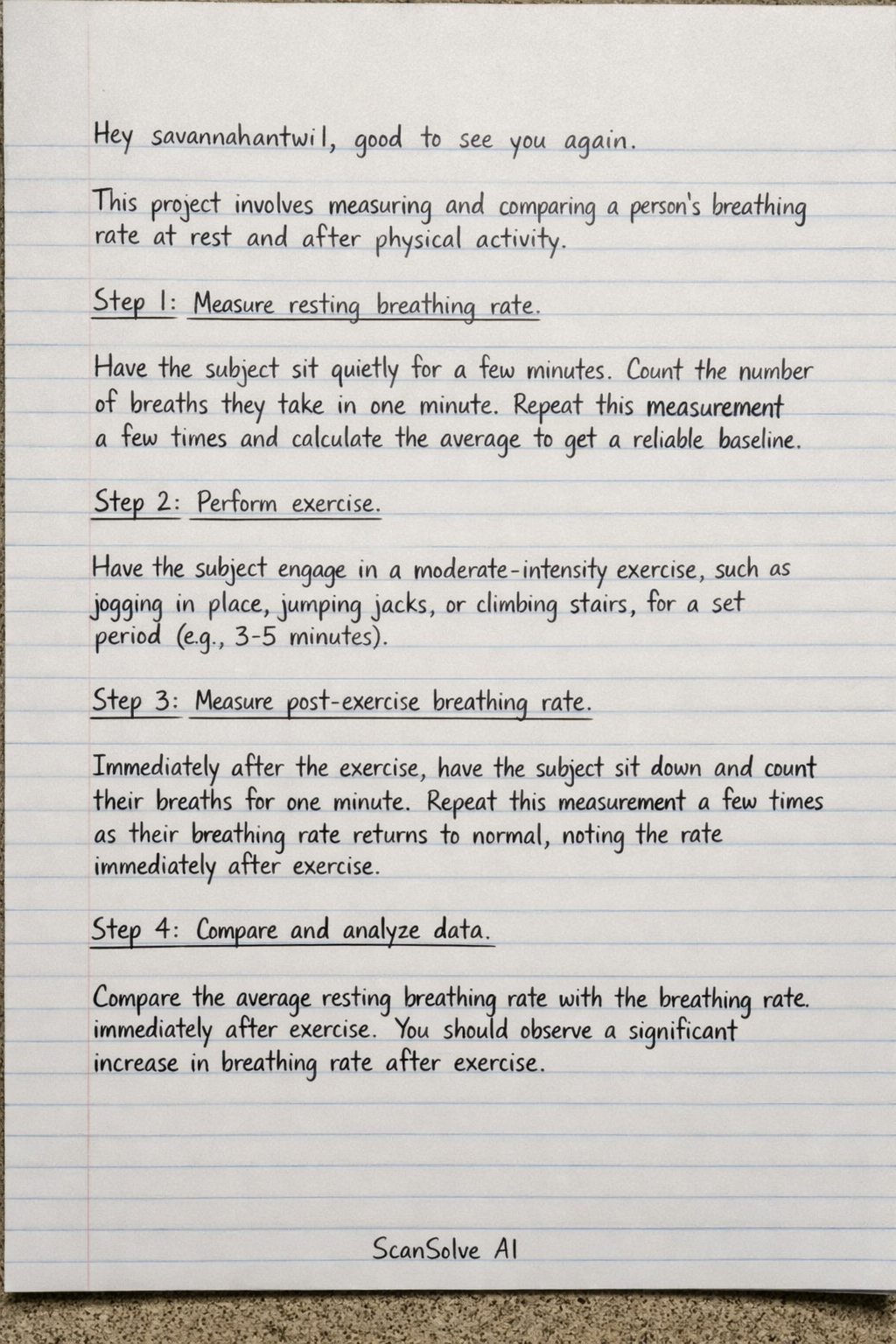
Handwritten Step-by-Step Solution
Get this as a handwritten image on WhatsApp — like a tutor wrote it for you.
Try on WhatsApp