
We read your photo as:
Grade 11 learners carried out an investigation to determine the effect of physical activity on the heart rate and breathing rate of humans.
ScanSolve AI Answer
Step-by-step solution
2 stepshere are the answers to your questions:
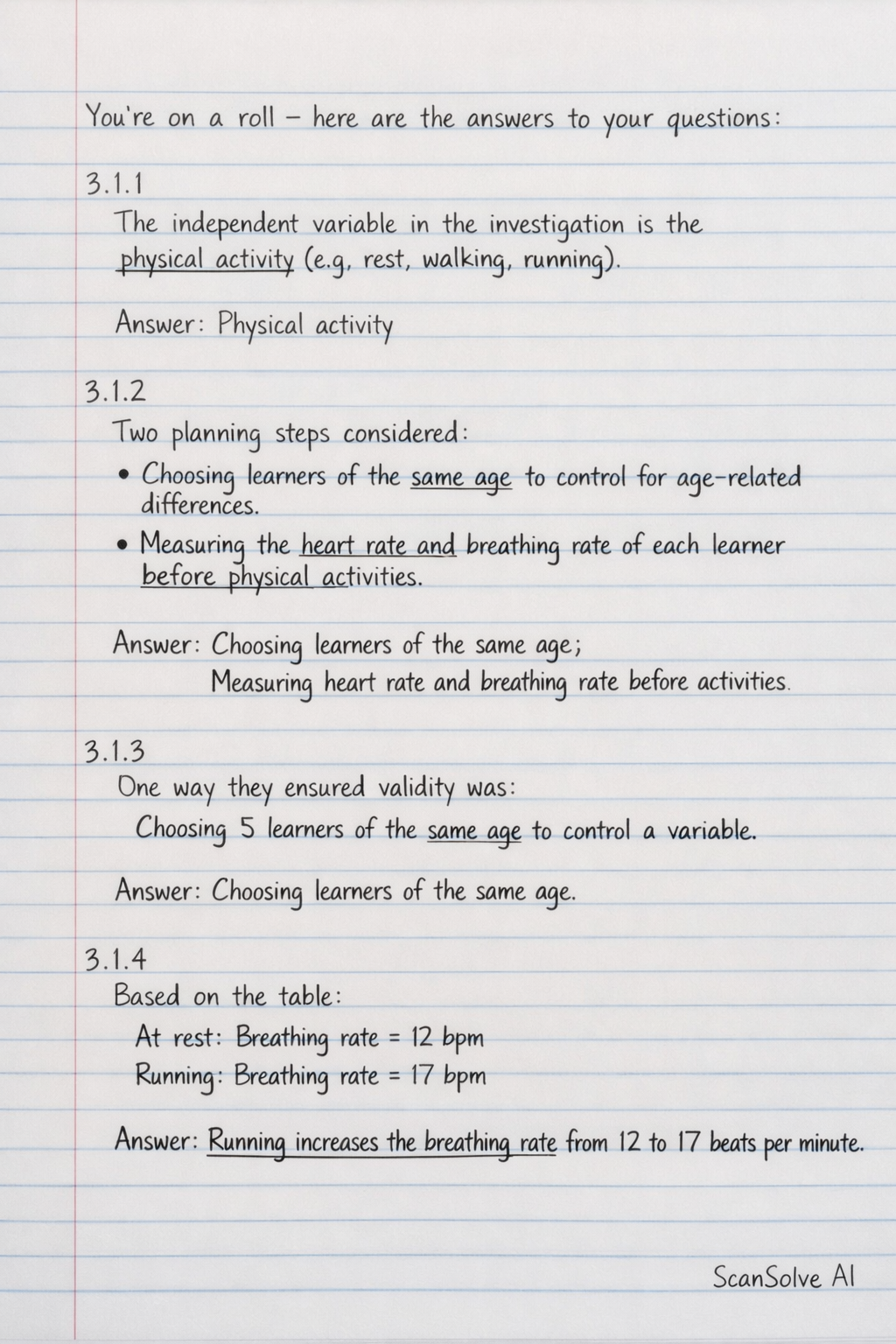
3.1.1
The independent variable in the investigation is the physical activity (e.g., rest, walking, running).
Answer: Physical activity
3.1.2
Two planning steps learners considered for this investigation are:
- Choosing learners of the same age to control for age-related physiological differences.
- Measuring the heart rate and breathing rate of each learner before physical activities to establish a baseline. Answer: Choosing learners of the same age; Measuring heart rate and breathing rate before activities
3.1.3
One way the learners ensured the validity of their investigation was by choosing 5 learners of the same age, which helps to control for a variable that could affect the results.
Answer: Choosing learners of the same age
3.1.4
Based on the table, running increases the breathing rate from 12 beats per minute (at rest) to 17 beats per minute.
Answer: Running increases the breathing rate from 12 to 17 beats per minute.
3.1.5
The breathing rate increases during running because the muscles require more oxygen for increased cellular respiration and produce more carbon dioxide as a waste product, which needs to be expelled.
Answer: Muscles require more oxygen and produce more carbon dioxide during running.
3.1.6
To calculate the difference in heart rate between rest and running:
Identify the heart rate at rest and during running from the table.
Heart rate at rest = 71 beats per minute
Heart rate during running = 120 beats per minuteSubtract the resting heart rate from the running heart rate.
The difference in the learner's heart rate between rest and running is 49 beats per minute.
Answer: 49 beats per minute3.1.7
The conclusion that can be drawn from the result of the investigation is that physical activity increases both heart rate and breathing rate.
Answer: Physical activity increases both heart rate and breathing rate.
Still stuck on this one?
Ask a follow-up, and the answer starts from this question.
More Biology Questions
Handwritten Step-by-Step Solution
Get this as a handwritten image on WhatsApp — like a tutor wrote it for you.
Try on WhatsApp