We read your photo as:

LP Grade 10 Physical Sciences...

Physics

ScanSolve AI Answer

Step-by-step solution

9 steps

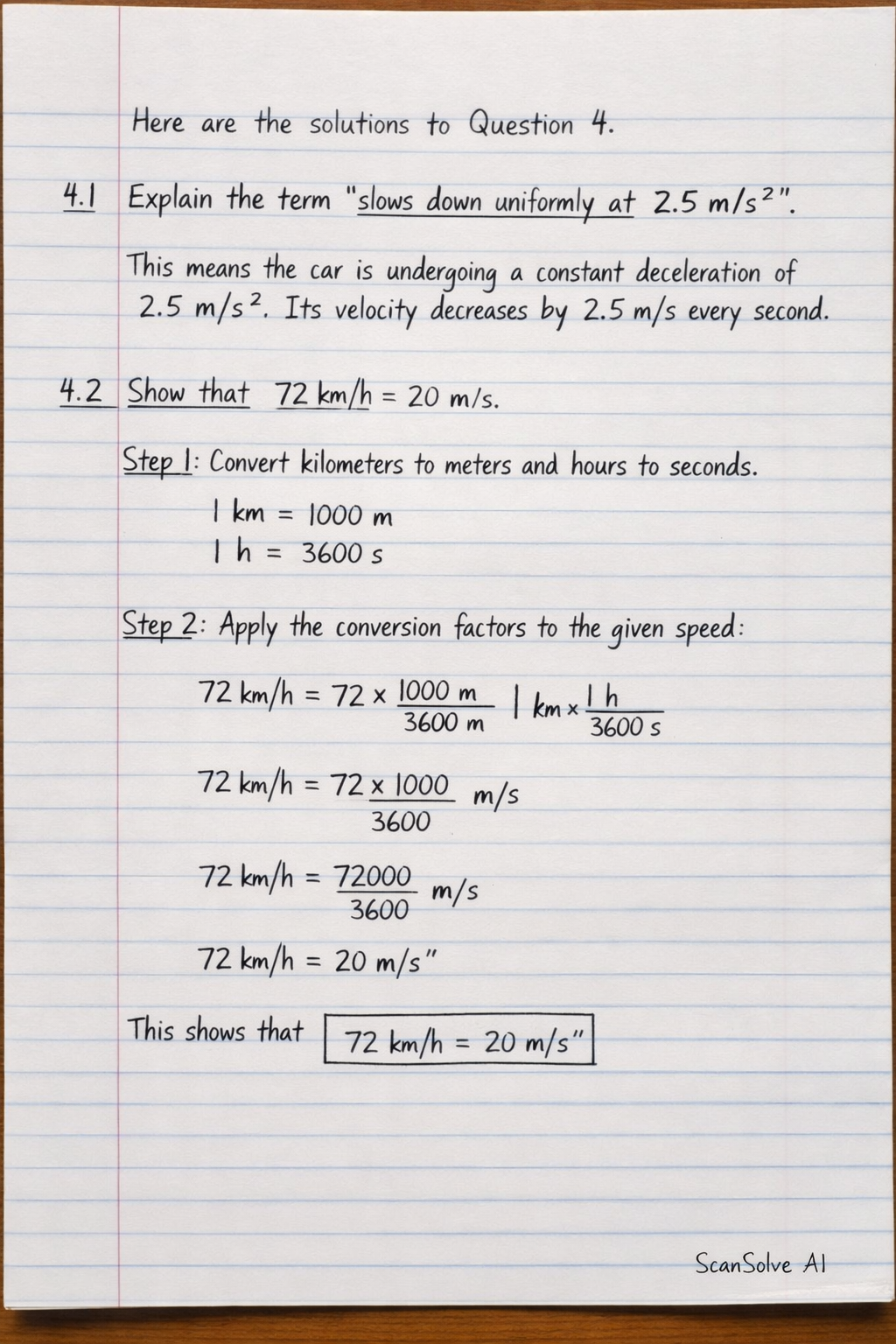
Here are the solutions to Question 4.

Part 4.1

Explain the term 'slows down uniformly at 2.5 m⋅s−22.5 \text{ m} \cdot \text{s}^{-2}'.

This means the car is undergoing a constant deceleration of 2.5 m⋅s−22.5 \text{ m} \cdot \text{s}^{-2}. Its velocity decreases by 2.5 m/s2.5 \text{ m/s} every second.

Part 4.2· 2 steps

Show that 72 km⋅h−1=20 m⋅s−172 \text{ km} \cdot \text{h}^{-1} = 20 \text{ m} \cdot \text{s}^{-1}.

  1. Convert kilometers to meters and hours to seconds.

    1 km=1000 m1 \text{ km} = 1000 \text{ m} 1 h=3600 s1 \text{ h} = 3600 \text{ s}
  2. Apply the conversion factors to the given speed.

    72 km⋅h−1=72×1000 m1 km×1 h3600 s72 \text{ km} \cdot \text{h}^{-1} = 72 \times \frac{1000 \text{ m}}{1 \text{ km}} \times \frac{1 \text{ h}}{3600 \text{ s}} 72 km⋅h−1=72×10003600 m⋅s−172 \text{ km} \cdot \text{h}^{-1} = \frac{72 \times 1000}{3600} \text{ m} \cdot \text{s}^{-1} 72 km⋅h−1=720003600 m⋅s−172 \text{ km} \cdot \text{h}^{-1} = \frac{72000}{3600} \text{ m} \cdot \text{s}^{-1} 72 km⋅h−1=20 m⋅s−172 \text{ km} \cdot \text{h}^{-1} = 20 \text{ m} \cdot \text{s}^{-1}

    This shows that 72 km⋅h−1=20 m⋅s−1\boxed{\text{72 km} \cdot \text{h}^{-1} = 20 \text{ m} \cdot \text{s}^{-1}}.

Part 4.3· 2 steps

Determine the distance travelled by the motor car during the 0.4 s0.4 \text{ s} reaction time.

During the reaction time, the car travels at a constant speed.

  1. Identify the constant speed and reaction time.

    Initial speed (vv) = 20 m⋅s−120 \text{ m} \cdot \text{s}^{-1} (from 4.2)
    Reaction time (Δt\Delta t) = 0.4 s0.4 \text{ s}

  2. Calculate the distance using the formula

    distance = speed ×\times time.

    Distancereaction=v×Δt\text{Distance}_{\text{reaction}} = v \times \Delta t Distancereaction=20 m⋅s−1×0.4 s\text{Distance}_{\text{reaction}} = 20 \text{ m} \cdot \text{s}^{-1} \times 0.4 \text{ s} Distancereaction=8 m\text{Distance}_{\text{reaction}} = 8 \text{ m}

    The distance travelled during the reaction time is 8 m\boxed{\text{8 m}}.

Part 4.4· 2 steps

Calculate the total time taken for the motor car to come to rest, from the instant that the driver saw the landmine exploding.

The total time consists of the reaction time and the braking time.

  1. Determine the time taken for the car to come to rest after applying brakes (braking time).

    Initial velocity (uu) = 20 m⋅s−120 \text{ m} \cdot \text{s}^{-1}
    Final velocity (vv) = 0 m⋅s−10 \text{ m} \cdot \text{s}^{-1} (car comes to rest)
    Acceleration (aa) = −2.5 m⋅s−2-2.5 \text{ m} \cdot \text{s}^{-2} (deceleration)
    Using the equation of motion: v=u+aΔtbrakingv = u + a \Delta t_{\text{braking}}

    0=20 m⋅s−1+(−2.5 m⋅s−2)Δtbraking0 = 20 \text{ m} \cdot \text{s}^{-1} + (-2.5 \text{ m} \cdot \text{s}^{-2}) \Delta t_{\text{braking}} 2.5Δtbraking=202.5 \Delta t_{\text{braking}} = 20 Δtbraking=202.5=8 s\Delta t_{\text{braking}} = \frac{20}{2.5} = 8 \text{ s}
  2. Calculate the total time.

    Total time=Reaction time+Braking time\text{Total time} = \text{Reaction time} + \text{Braking time} Total time=0.4 s+8 s\text{Total time} = 0.4 \text{ s} + 8 \text{ s} Total time=8.4 s\text{Total time} = 8.4 \text{ s}

    The total time taken for the motor car to come to rest is 8.4 s\boxed{\text{8.4 s}}.

Part 4.5· 3 steps

Will the motor car stop before reaching the wreck of the truck? Show all working in your answer.

To answer this, we need to calculate the total stopping distance of the car and compare it to the initial distance between the car and the truck.

  1. Calculate the distance travelled during braking.

    Initial velocity (uu) = 20 m⋅s−120 \text{ m} \cdot \text{s}^{-1}
    Final velocity (vv) = 0 m⋅s−10 \text{ m} \cdot \text{s}^{-1}
    Acceleration (aa) = −2.5 m⋅s−2-2.5 \text{ m} \cdot \text{s}^{-2}
    Using the equation of motion: v2=u2+2aΔxbrakingv^2 = u^2 + 2a \Delta x_{\text{braking}}

    (0 m⋅s−1)2=(20 m⋅s−1)2+2(−2.5 m⋅s−2)Δxbraking(0 \text{ m} \cdot \text{s}^{-1})^2 = (20 \text{ m} \cdot \text{s}^{-1})^2 + 2(-2.5 \text{ m} \cdot \text{s}^{-2}) \Delta x_{\text{braking}} 0=400−5Δxbraking0 = 400 - 5 \Delta x_{\text{braking}} 5Δxbraking=4005 \Delta x_{\text{braking}} = 400 Δxbraking=4005=80 m\Delta x_{\text{braking}} = \frac{400}{5} = 80 \text{ m}
  2. Calculate the total stopping distance.

    Total stopping distance=Distancereaction+Distancebraking\text{Total stopping distance} = \text{Distance}_{\text{reaction}} + \text{Distance}_{\text{braking}} Total stopping distance=8 m+80 m\text{Total stopping distance} = 8 \text{ m} + 80 \text{ m} Total stopping distance=88 m\text{Total stopping distance} = 88 \text{ m}
  3. Compare the total stopping distance to the initial distance between the car and the truck.

    The initial distance between the car and the truck is 100 m100 \text{ m}.
    Since 88 m<100 m88 \text{ m} < 100 \text{ m}, the motor car will stop before reaching the wreck of the truck.
    The motor car will stop before reaching the wreck of the truck\boxed{\text{before reaching the wreck of the truck}}.

Was this helpful?

Still stuck on this one?

Ask a follow-up, and the answer starts from this question.

Got a different question?Ask your own question
Handwritten step-by-step solution preview

Handwritten Step-by-Step Solution

Get this as a handwritten image on WhatsApp — like a tutor wrote it for you.

Try on WhatsApp