We read your photo as:

3 Will the motor car stop before reaching the wreck of the truck? Show all working in your answer.

Physics

ScanSolve AI Answer

Step-by-step solution

10 steps

here are the solutions to Question 5.

5.1 You are given 25 g25 \text{ g} of sodium sulphate (Na2SO4\text{Na}_2\text{SO}_4).

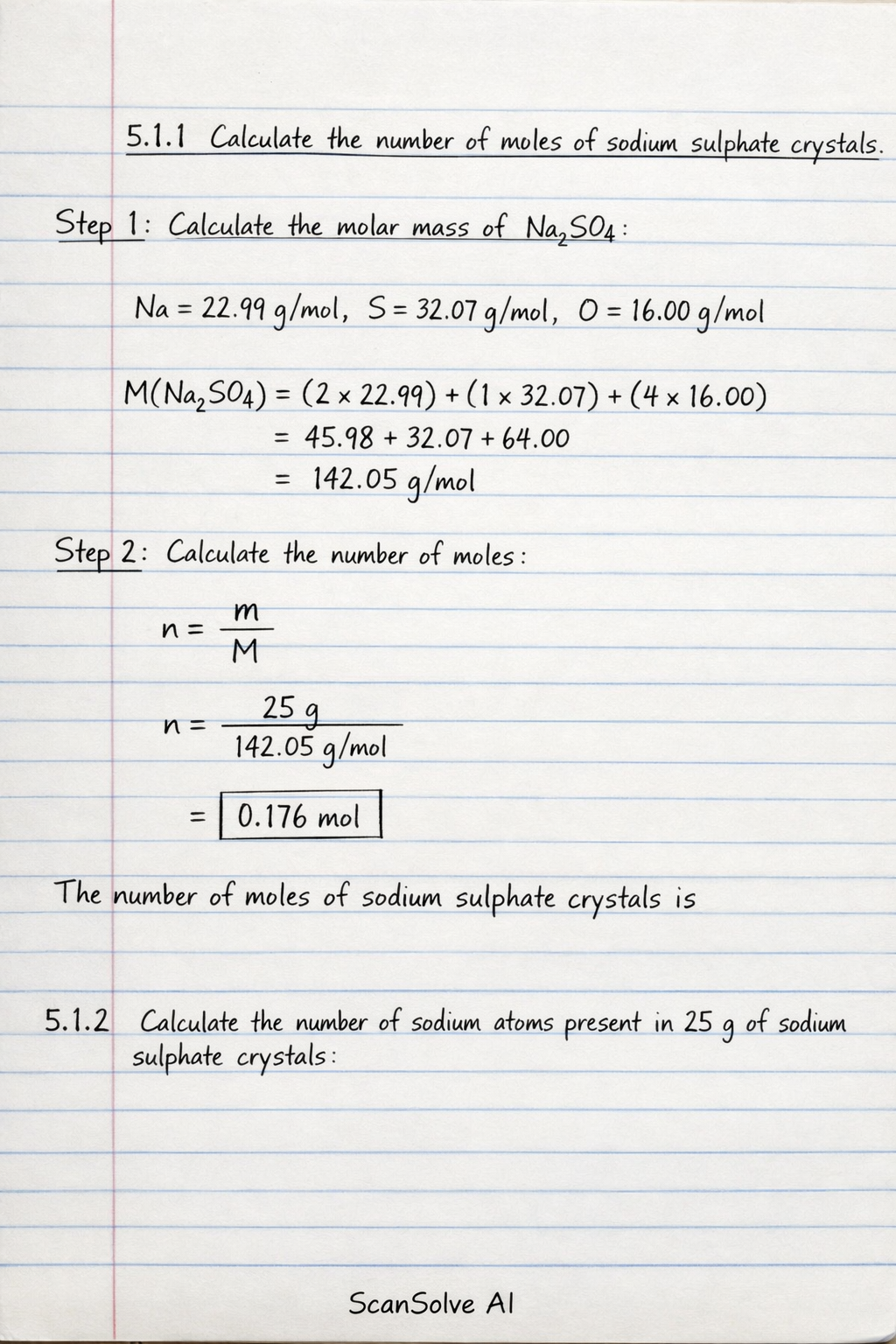
5.1.1 Calculate the number of moles of sodium sulphate crystals.

  1. Calculate the molar mass of Na2SO4\text{Na}_2\text{SO}_4.

    Atomic masses: Na=22.99 g/mol\text{Na} = 22.99 \text{ g/mol}, S=32.07 g/mol\text{S} = 32.07 \text{ g/mol}, O=16.00 g/mol\text{O} = 16.00 \text{ g/mol}.

    M(Na2SO4)=(2×22.99)+(1×32.07)+(4×16.00)M(\text{Na}_2\text{SO}_4) = (2 \times 22.99) + (1 \times 32.07) + (4 \times 16.00) M(Na2SO4)=45.98+32.07+64.00=142.05 g/molM(\text{Na}_2\text{SO}_4) = 45.98 + 32.07 + 64.00 = 142.05 \text{ g/mol}
  2. Calculate the number of moles using the given mass and molar mass.

    n=mMn = \frac{m}{M} n=25 g142.05 g/moln = \frac{25 \text{ g}}{142.05 \text{ g/mol}} n≈0.176 moln \approx 0.176 \text{ mol}

    The number of moles of sodium sulphate crystals is 0.176 mol\boxed{\text{0.176 mol}}.

    5.1.2 Calculate the number of sodium atoms present in 25 g25 \text{ g} of sodium sulphate crystals.

  3. Determine the moles of sodium atoms from the moles of Na2SO4\text{Na}_2\text{SO}_4.

    From the formula Na2SO4\text{Na}_2\text{SO}_4, there are 2 moles of Na atoms for every 1 mole of Na2SO4\text{Na}_2\text{SO}_4.

    Moles of Na atoms=0.176 mol Na2SO4×2 mol Na1 mol Na2SO4\text{Moles of Na atoms} = 0.176 \text{ mol Na}_2\text{SO}_4 \times \frac{2 \text{ mol Na}}{1 \text{ mol Na}_2\text{SO}_4} Moles of Na atoms=0.352 mol\text{Moles of Na atoms} = 0.352 \text{ mol}
  4. Use Avogadro's number to find the number of sodium atoms.

    Avogadro's number (NAN_A) = 6.022×10²³ atoms/mol6.022 \times 10^{23} \text{ atoms/mol}.

    Number of Na atoms=n×NA\text{Number of Na atoms} = n \times N_A Number of Na atoms=0.352 mol×6.022×1023 atoms/mol\text{Number of Na atoms} = 0.352 \text{ mol} \times 6.022 \times 10^{23} \text{ atoms/mol} Number of Na atoms≈2.12×10²³ atoms\text{Number of Na atoms} \approx 2.12 \times 10^{23} \text{ atoms}

    The number of sodium atoms present is 2.12×10²³ atoms\boxed{2.12 \times 10^{23} \text{ atoms}}.

    5.2 A substance contains 40% Carbon, 6.67% Hydrogen, and 53.53% Oxygen by mass.

    5.2.1 Define the term empirical formula.

    The empirical formula is the simplest whole-number ratio of atoms in a compound.

    5.2.2 Determine the empirical formula of the substance.

  5. Assume a 100 g100 \text{ g} sample and convert percentages to mass.

    Mass of C = 40 g40 \text{ g}
    Mass of H = 6.67 g6.67 \text{ g}
    Mass of O = 53.53 g53.53 \text{ g}

  6. Convert mass of each element to moles.

    Atomic masses: C=12.01 g/mol\text{C} = 12.01 \text{ g/mol}, H=1.01 g/mol\text{H} = 1.01 \text{ g/mol}, O=16.00 g/mol\text{O} = 16.00 \text{ g/mol}.

    Moles of C=40 g12.01 g/mol≈3.33 mol\text{Moles of C} = \frac{40 \text{ g}}{12.01 \text{ g/mol}} \approx 3.33 \text{ mol} Moles of H=6.67 g1.01 g/mol≈6.60 mol\text{Moles of H} = \frac{6.67 \text{ g}}{1.01 \text{ g/mol}} \approx 6.60 \text{ mol} Moles of O=53.53 g16.00 g/mol≈3.35 mol\text{Moles of O} = \frac{53.53 \text{ g}}{16.00 \text{ g/mol}} \approx 3.35 \text{ mol}
  7. Divide by the smallest number of moles to find the simplest ratio.

    The smallest number of moles is approximately 3.33 mol3.33 \text{ mol} (for Carbon).

    Ratio C=3.333.33=1\text{Ratio C} = \frac{3.33}{3.33} = 1 Ratio H=6.603.33≈1.98≈2\text{Ratio H} = \frac{6.60}{3.33} \approx 1.98 \approx 2 Ratio O=3.353.33≈1.006≈1\text{Ratio O} = \frac{3.35}{3.33} \approx 1.006 \approx 1

    The empirical formula of the substance is CH2O\boxed{\text{CH}_2\text{O}}.

    5.2.3 If the molecular mass of the substance is 60 g⋅mol−160 \text{ g} \cdot \text{mol}^{-1}, determine its molecular formula.

  8. Calculate the empirical formula mass.

    M(CH2O)=(1×12.01)+(2×1.01)+(1×16.00)M(\text{CH}_2\text{O}) = (1 \times 12.01) + (2 \times 1.01) + (1 \times 16.00) M(CH2O)=12.01+2.02+16.00=30.03 g/molM(\text{CH}_2\text{O}) = 12.01 + 2.02 + 16.00 = 30.03 \text{ g/mol}
  9. Determine the ratio (nn) between the molecular mass and the empirical formula mass.

    n=Molecular massEmpirical formula massn = \frac{\text{Molecular mass}}{\text{Empirical formula mass}} n=60 g/mol30.03 g/mol≈1.998≈2n = \frac{60 \text{ g/mol}}{30.03 \text{ g/mol}} \approx 1.998 \approx 2
  10. Multiply the subscripts in the empirical formula by nn to get the molecular formula.

    Molecular formula=(CH2O)2=C2H4O2\text{Molecular formula} = (\text{CH}_2\text{O})_2 = \text{C}_2\text{H}_4\text{O}_2

    The molecular formula of the substance is C2H4O2\boxed{\text{C}_2\text{H}_4\text{O}_2}.

Was this helpful?

Still stuck on this one?

Ask a follow-up, and the answer starts from this question.

Got a different question?Ask your own question
Handwritten step-by-step solution preview

Handwritten Step-by-Step Solution

Get this as a handwritten image on WhatsApp — like a tutor wrote it for you.

Try on WhatsApp