We read your photo as:

A truck A of mass 2000 kg is initially at rest. It is hit by another truck B of mass 1200 kg moving at 3 m/s. If electronic equipment of mass 300 kg is loaded onto truck B before the collision, what i

Physics

ScanSolve AI Answer

Answers

3 parts
6.1

19600 N upwards\text{19600 N upwards}

6.2

1.71 m⋅s−1 westwards\text{1.71 m}\cdot\text{s}^{-1} \text{ westwards}

6.3

5142.86 N\text{5142.86 N}

Step-by-step solution

9 steps

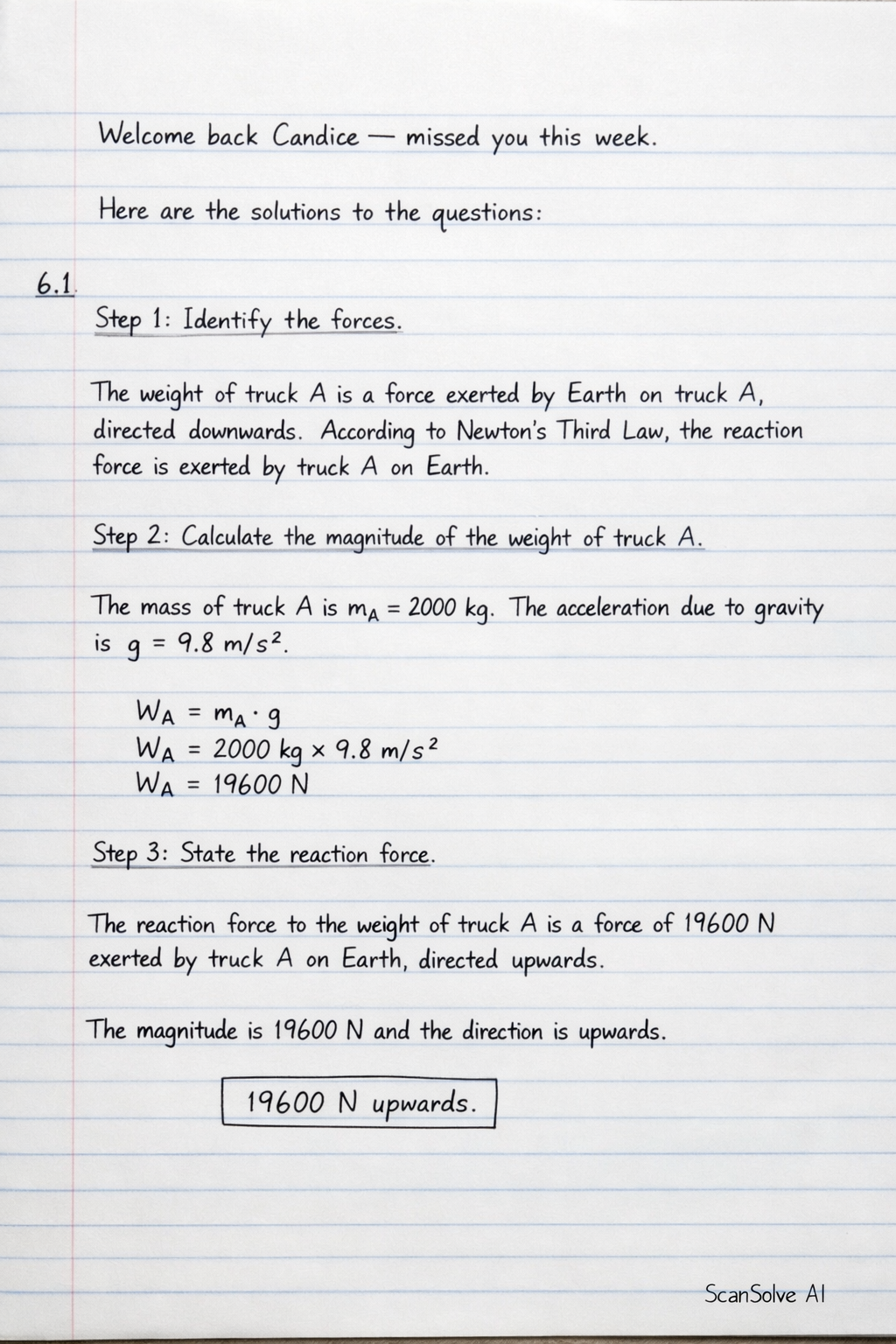
Here are the solutions to the questions:

Part 6.1· 3 steps

  1. Identify the forces.

    The weight of truck A is a force exerted by Earth on truck A, directed downwards. According to Newton's Third Law, the reaction force is exerted by truck A on Earth.

  2. Calculate the magnitude of the weight of truck A.

    The mass of truck A is mA=2000 kgm_A = 2000 \text{ kg}. The acceleration due to gravity is g=9.8 m⋅s−2g = 9.8 \text{ m} \cdot \text{s}^{-2}.

    WA=mA⋅gW_A = m_A \cdot g WA=2000 kg×9.8 m⋅s−2W_A = 2000 \text{ kg} \times 9.8 \text{ m} \cdot \text{s}^{-2} WA=19600 NW_A = 19600 \text{ N}
  3. State the reaction force.

    The reaction force to the weight of truck A is a force of 19600 N19600 \text{ N} exerted by truck A on Earth, directed upwards.
    The magnitude is 19600 N19600 \text{ N} and the direction is upwards.

    19600 N upwards\boxed{\text{19600 N upwards}}

Part 6.2

1.71 m⋅s−1 westwards\text{1.71 m}\cdot\text{s}^{-1} \text{ westwards}

  1. Identify the given values.

    Mass of truck A: mA=2000 kgm_A = 2000 \text{ kg}
    Initial velocity of truck A: uA=3 m⋅s−1u_A = 3 \text{ m} \cdot \text{s}^{-1} (westwards)
    Mass of truck B: mB=1200 kgm_B = 1200 \text{ kg}
    Mass of electronic equipment: meq=300 kgm_{eq} = 300 \text{ kg}
    Total mass of truck B (including equipment): MB=mB+meq=1200 kg+300 kg=1500 kgM_B = m_B + m_{eq} = 1200 \text{ kg} + 300 \text{ kg} = 1500 \text{ kg}
    Initial velocity of truck B: uB=0 m⋅s−1u_B = 0 \text{ m} \cdot \text{s}^{-1} (stationary)
    After the collision, the two trucks combine, meaning it is an inelastic collision. Let the final velocity of the combined system be vfv_f.

  2. Apply the principle of conservation of momentum.

    The total momentum before the collision equals the total momentum after the collision.

    mAuA+MBuB=(mA+MB)vfm_A u_A + M_B u_B = (m_A + M_B) v_f

    Let westwards be the positive direction.

    (2000 kg)(3 m⋅s−1)+(1500 kg)(0 m⋅s−1)=(2000 kg+1500 kg)vf(2000 \text{ kg})(3 \text{ m} \cdot \text{s}^{-1}) + (1500 \text{ kg})(0 \text{ m} \cdot \text{s}^{-1}) = (2000 \text{ kg} + 1500 \text{ kg}) v_f 6000 kg⋅m⋅s−1+0=(3500 kg)vf6000 \text{ kg} \cdot \text{m} \cdot \text{s}^{-1} + 0 = (3500 \text{ kg}) v_f 6000=3500vf6000 = 3500 v_f
  3. Calculate the final velocity.

    vf=60003500 m⋅s−1v_f = \frac{6000}{3500} \text{ m} \cdot \text{s}^{-1} vf=127 m⋅s−1v_f = \frac{12}{7} \text{ m} \cdot \text{s}^{-1} vf≈1.71 m⋅s−1v_f \approx 1.71 \text{ m} \cdot \text{s}^{-1}

    The final velocity of the combined trucks (which includes truck B) is 1.71 m⋅s−11.71 \text{ m} \cdot \text{s}^{-1} westwards.

    1.71 m⋅s−1 westwards\boxed{\text{1.71 m}\cdot\text{s}^{-1} \text{ westwards}}

Part 6.3

5142.86 N\text{5142.86 N}

  1. Identify the relevant quantities for truck B.

    Mass of truck B (with equipment): MB=1500 kgM_B = 1500 \text{ kg}
    Initial velocity of truck B: uB=0 m⋅s−1u_B = 0 \text{ m} \cdot \text{s}^{-1}
    Final velocity of truck B (from 6.2): vf=127 m⋅s−1v_f = \frac{12}{7} \text{ m} \cdot \text{s}^{-1}
    Duration of collision: Δt=0.5 s\Delta t = 0.5 \text{ s}

  2. Apply the impulse-momentum theorem to truck B.

    The impulse exerted on truck B is equal to the change in momentum of truck B.

    FΔt=ΔpBF \Delta t = \Delta p_B FΔt=MBvf−MBuBF \Delta t = M_B v_f - M_B u_B F(0.5 s)=(1500 kg)(127 m⋅s−1)−(1500 kg)(0 m⋅s−1)F (0.5 \text{ s}) = (1500 \text{ kg})\left(\frac{12}{7} \text{ m} \cdot \text{s}^{-1}\right) - (1500 \text{ kg})(0 \text{ m} \cdot \text{s}^{-1}) F(0.5 s)=180007 kg⋅m⋅s−1F (0.5 \text{ s}) = \frac{18000}{7} \text{ kg} \cdot \text{m} \cdot \text{s}^{-1}
  3. Calculate the magnitude of the force.

    F=180007×0.5 NF = \frac{18000}{7 \times 0.5} \text{ N} F=180003.5 NF = \frac{18000}{3.5} \text{ N} F≈5142.86 NF \approx 5142.86 \text{ N} 5142.86 N\boxed{\text{5142.86 N}}

Part 6.4

Bubble plastic increases the time of impact during a collision. According to the impulse-momentum theorem (FΔt=ΔpF \Delta t = \Delta p), if the change in momentum (Δp\Delta p) is constant, increasing the time of impact (Δt\Delta t) will decrease the average force (FF) exerted on the electronic equipment. This reduced force minimizes damage to the equipment.

Was this helpful?

Try one yourself

A new problem that tests the same skill.

Still stuck on this one?

Ask a follow-up, and the answer starts from this question.

Got a different question?Ask your own question
Handwritten step-by-step solution preview

Handwritten Step-by-Step Solution

Get this as a handwritten image on WhatsApp — like a tutor wrote it for you.

Try on WhatsApp