
We read your photo as:
Two cars A and B, of mass 1000 kg and 1200 kg respectively, are involved in a collision. Car A is initially stationary. Car B moves forward at 18 m/s. After the collision, Car A moves forward at 12 m/
ScanSolve AI Answer
Answer
Step-by-step solution
3 stepsHere are the solutions to the questions:
Part 5.1· 3 steps
Identify the given values and define the system.
Let the direction of Car B's initial motion be positive (forward).
Mass of Car A:
Initial velocity of Car A: (stationary)
Mass of Car B:
Initial velocity of Car B: (forward)After the collision:
Velocity of Car A: (forward)
Velocity of Car B:Apply the principle of conservation of linear momentum.
The total momentum before the collision equals the total momentum after the collision.
Calculate the speed of Car B.
The speed of Car B immediately after the collision is .
Part 5.2
The assumption that linear momentum is conserved requires the system to be isolated, meaning no net external forces act on it. In a real car collision, external forces such as friction between the tires and the road, or air resistance, can be significant. If these external forces are not negligible, the total momentum of the system (Car A + Car B) will not be perfectly conserved.
Part 5.3
In a head-on collision, a heavier car has more inertia. For a given impulse (change in momentum), a heavier car will experience a smaller change in velocity compared to a lighter car. Since the passengers experience the same change in velocity as the car, a smaller change in velocity for the car means a smaller change in velocity for the passengers. According to the impulse-momentum theorem (), a smaller change in velocity () for the passengers (for a similar impact time ) results in a smaller average force exerted on them, thus reducing the risk of injury.
Try one yourself
A new problem that tests the same skill.
Still stuck on this one?
Ask a follow-up, and the answer starts from this question.
More Physics Questions
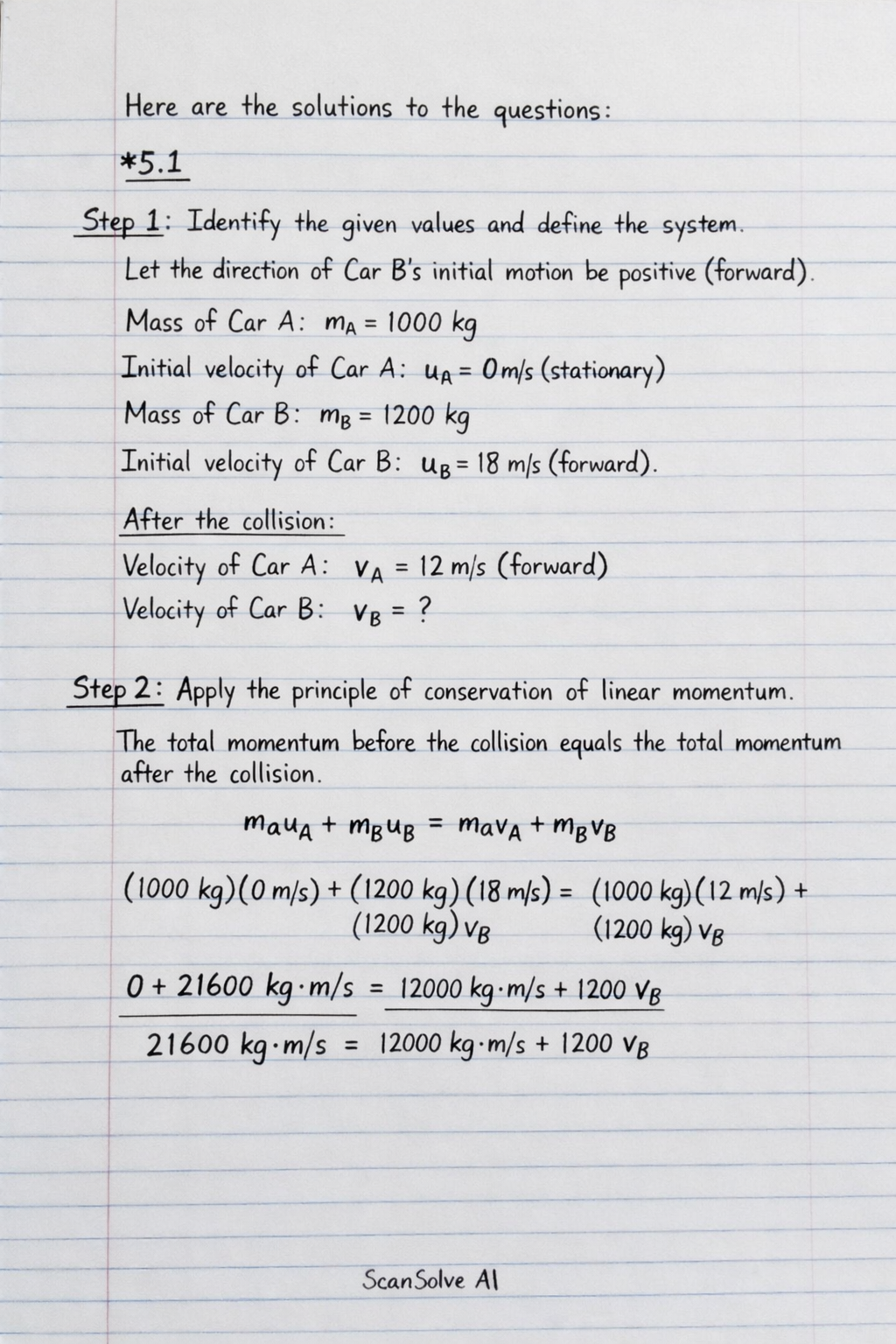
Handwritten Step-by-Step Solution
Get this as a handwritten image on WhatsApp — like a tutor wrote it for you.
Try on WhatsApp