
We read your photo as:
Two particles A and B collide. Particle A has mass 2m and velocity 40 m/s, while particle B has mass m and velocity 10 m/s. Calculate their velocities after a perfectly elastic collision and the impul
ScanSolve AI Answer
Answers
2 partsStep-by-step solution
4 stepsHere's the solution to your problem:
Part a· 2 steps
The velocity of A and B after the collision.
Apply the principle of conservation of momentum.
For a perfectly elastic collision, the total momentum before the collision equals the total momentum after the collision.
Given , , , .
Apply the relative velocity condition for a perfectly elastic collision.
For a perfectly elastic collision, the relative velocity of approach equals the negative of the relative velocity of separation.
From , we can express as . Substitute this into :
Now substitute back into :
The velocities after collision are:
Part b
The impulse on A and B and show that Newton's third law of motion is obeyed.
Calculate the impulse on body A and body B.
Impulse is the change in momentum ().
Impulse on A ():Impulse on B ():
The impulses are:
Show that Newton's third law of motion is obeyed.
Newton's third law states that for every action, there is an equal and opposite reaction. In terms of impulse, the impulse exerted by A on B is equal in magnitude and opposite in direction to the impulse exerted by B on A.
From our calculations:We can see that . This demonstrates that the impulse on body A due to body B is equal in magnitude and opposite in direction to the impulse on body B due to body A, thus obeying Newton's third law of motion.
Try one yourself
A new problem that tests the same skill.
Still stuck on this one?
Ask a follow-up, and the answer starts from this question.
More Physics Questions
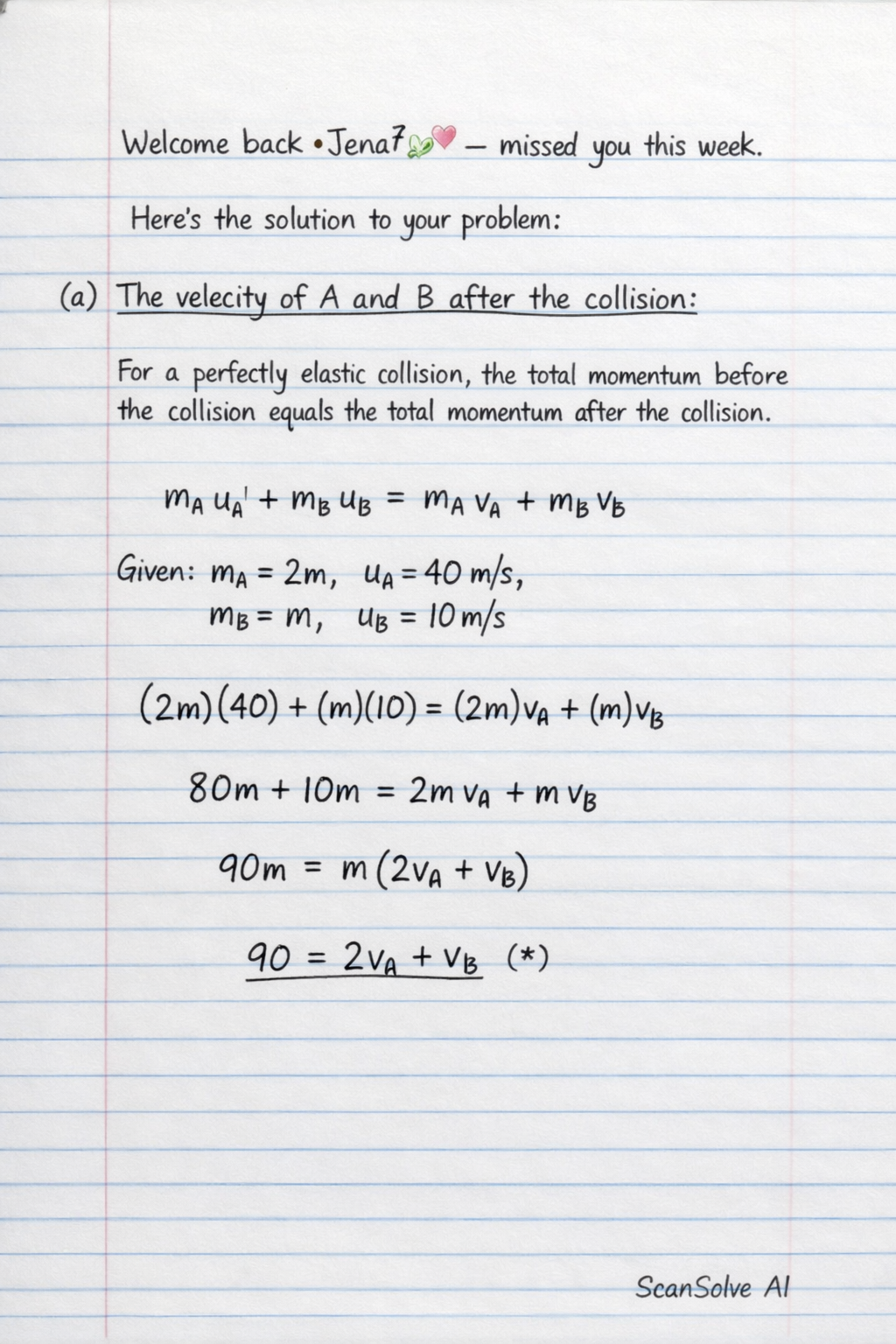
Handwritten Step-by-Step Solution
Get this as a handwritten image on WhatsApp — like a tutor wrote it for you.
Try on WhatsApp