We read your photo as:

Two spheres, A and B, with masses m and 2m respectively, are involved in a head-on collision. Sphere A has an initial velocity u, and sphere B is initially at rest. The coefficient of restitution is 1

Physics

ScanSolve AI Answer

Answers

2 parts
b

mu

c

14mu2\frac{1}{4} mu^2

Step-by-step solution

7 steps

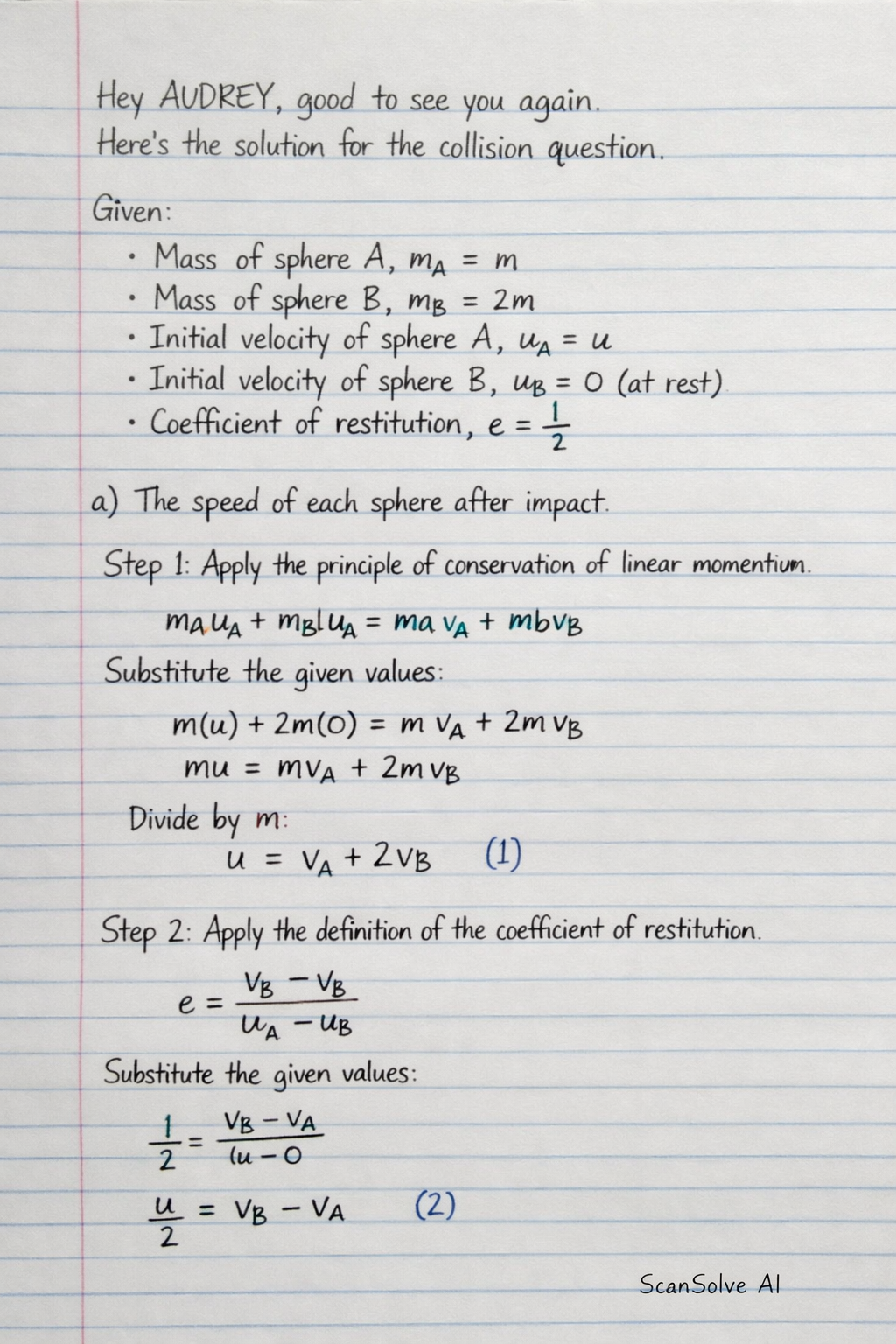
Here's the solution for the collision question.

Given:

  • Mass of sphere A, mA=mm_A = m
  • Mass of sphere B, mB=2mm_B = 2m
  • Initial velocity of sphere A, uA=uu_A = u
  • Initial velocity of sphere B, uB=0u_B = 0 (at rest)
  • Coefficient of restitution, e=12e = \frac{1}{2}

Part a· 3 steps

The speed of each sphere after impact

  1. Apply the principle of conservation of linear momentum.

    mAuA+mBuB=mAvA+mBvBm_A u_A + m_B u_B = m_A v_A + m_B v_B

    Substitute the given values:

    m(u)+2m(0)=mvA+2mvBm(u) + 2m(0) = m v_A + 2m v_B mu=mvA+2mvBmu = m v_A + 2m v_B

    Divide by mm:

    u=vA+2vB(1)u = v_A + 2v_B \quad (1)
  2. Apply the definition of the coefficient of restitution.

    e=vB−vAuA−uBe = \frac{v_B - v_A}{u_A - u_B}

    Substitute the given values:

    12=vB−vAu−0\frac{1}{2} = \frac{v_B - v_A}{u - 0} u2=vB−vA(2)\frac{u}{2} = v_B - v_A \quad (2)
  3. Solve equations (1) and (2) simultaneously for vAv_A and vBv_B.

    From (2), vA=vB−u2v_A = v_B - \frac{u}{2}. Substitute this into (1):

    u=(vB−u2)+2vBu = \left(v_B - \frac{u}{2}\right) + 2v_B u=3vB−u2u = 3v_B - \frac{u}{2} u+u2=3vBu + \frac{u}{2} = 3v_B 3u2=3vB\frac{3u}{2} = 3v_B vB=u2v_B = \frac{u}{2}

    Now substitute vBv_B back into (2) to find vAv_A:

    u2=u2−vA\frac{u}{2} = \frac{u}{2} - v_A vA=0v_A = 0

    The speeds of the spheres after impact are:

    • Speed of sphere A: vA=0v_A = 0
    • Speed of sphere B: vB=u2v_B = \frac{u}{2}

Part bmu

The magnitude of the impulse exerted by A on B

  1. Calculate the impulse using the change in momentum of sphere B.

    J=mBvB−mBuBJ = m_B v_B - m_B u_B

    Substitute the values:

    J=(2m)(u2)−(2m)(0)J = (2m)\left(\frac{u}{2}\right) - (2m)(0) J=mu−0J = mu - 0 J=muJ = mu

    The magnitude of the impulse exerted by A on B is mu\boxed{mu}.

Part c

14mu2\frac{1}{4} mu^2

The loss of kinetic energy due to the impact

  1. Calculate the initial total kinetic energy.

    KEinitial=12mAuA2+12mBuB2KE_{initial} = \frac{1}{2} m_A u_A^2 + \frac{1}{2} m_B u_B^2 KEinitial=12m(u)2+12(2m)(0)2KE_{initial} = \frac{1}{2} m (u)^2 + \frac{1}{2} (2m) (0)^2 KEinitial=12mu2KE_{initial} = \frac{1}{2} mu^2
  2. Calculate the final total kinetic energy.

    KEfinal=12mAvA2+12mBvB2KE_{final} = \frac{1}{2} m_A v_A^2 + \frac{1}{2} m_B v_B^2 KEfinal=12m(0)2+12(2m)(u2)2KE_{final} = \frac{1}{2} m (0)^2 + \frac{1}{2} (2m) \left(\frac{u}{2}\right)^2 KEfinal=0+12(2m)(u24)KE_{final} = 0 + \frac{1}{2} (2m) \left(\frac{u^2}{4}\right) KEfinal=mu24=14mu2KE_{final} = m \frac{u^2}{4} = \frac{1}{4} mu^2
  3. Calculate the loss of kinetic energy.

    Loss=KEinitial−KEfinalLoss = KE_{initial} - KE_{final} Loss=12mu2−14mu2Loss = \frac{1}{2} mu^2 - \frac{1}{4} mu^2 Loss=(12−14)mu2Loss = \left(\frac{1}{2} - \frac{1}{4}\right) mu^2 Loss=14mu2Loss = \frac{1}{4} mu^2

    The loss of kinetic energy due to the impact is 14mu2\boxed{\frac{1}{4} mu^2}.

Was this helpful?

Try one yourself

A new problem that tests the same skill.

Still stuck on this one?

Ask a follow-up, and the answer starts from this question.

Got a different question?Ask your own question
Handwritten step-by-step solution preview

Handwritten Step-by-Step Solution

Get this as a handwritten image on WhatsApp — like a tutor wrote it for you.

Try on WhatsApp