We read your photo as:

A car of mass 1600 kg traveling at 30 m/s collides with a minibus of mass 3000 kg traveling at 20 m/s in the opposite direction. They move together after the collision. Calculate their final velocity

Physics

ScanSolve AI Answer

Answers

2 parts
2.1

2.61 m/s to the right\text{}2.61 \text{ m/s} \text{ to the right}\text{}

2.2

inelastic\text{}inelastic\text{}

Step-by-step solution

3 steps

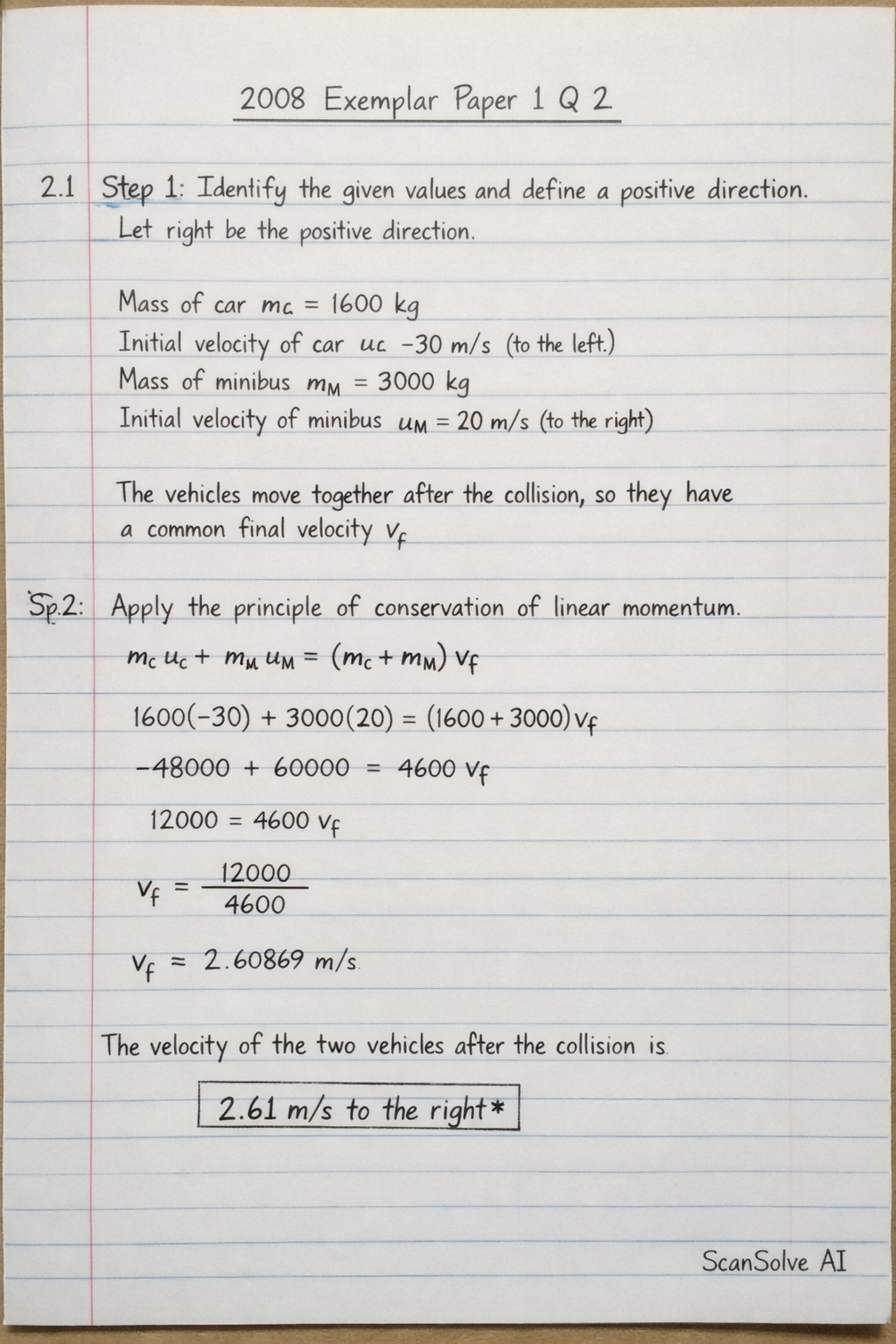
2008 Exemplar Paper 1 Q 2

Part 2.1· 1 step

Step 1: Identify the given values and define a positive direction.

Let right be the positive direction.
Mass of car mC=1600 kgm_C = 1600 \text{ kg}
Initial velocity of car uC=−30 m/su_C = -30 \text{ m/s} (to the left)
Mass of minibus mM=3000 kgm_M = 3000 \text{ kg}
Initial velocity of minibus uM=20 m/su_M = 20 \text{ m/s} (to the right)
The vehicles move together after the collision, so they have a common final velocity vfv_f.

  1. Apply the principle of conservation of linear momentum.

    mCuC+mMuM=(mC+mM)vfm_C u_C + m_M u_M = (m_C + m_M) v_f (1600 kg)(−30 m/s)+(3000 kg)(20 m/s)=(1600 kg+3000 kg)vf(1600 \text{ kg})(-30 \text{ m/s}) + (3000 \text{ kg})(20 \text{ m/s}) = (1600 \text{ kg} + 3000 \text{ kg}) v_f −48000 kg⋅m/s+60000 kg⋅m/s=(4600 kg)vf-48000 \text{ kg}\cdot\text{m/s} + 60000 \text{ kg}\cdot\text{m/s} = (4600 \text{ kg}) v_f 12000 kg⋅m/s=(4600 kg)vf12000 \text{ kg}\cdot\text{m/s} = (4600 \text{ kg}) v_f vf=12000 kg⋅m/s4600 kgv_f = \frac{12000 \text{ kg}\cdot\text{m/s}}{4600 \text{ kg}} vf≈2.60869 m/sv_f \approx 2.60869 \text{ m/s}

    The velocity of the two vehicles after the collision is 2.61 m/s to the right\boxed{\text{}2.61 \text{ m/s} \text{ to the right}\text{}}

Part 2.2

inelastic\text{}inelastic\text{}

Step 1: Calculate the total initial kinetic energy.

KEi=12mCuC2+12mMuM2KE_i = \frac{1}{2} m_C u_C^2 + \frac{1}{2} m_M u_M^2 KEi=12(1600 kg)(−30 m/s)2+12(3000 kg)(20 m/s)2KE_i = \frac{1}{2} (1600 \text{ kg})(-30 \text{ m/s})^2 + \frac{1}{2} (3000 \text{ kg})(20 \text{ m/s})^2 KEi=12(1600)(900)+12(3000)(400)KE_i = \frac{1}{2} (1600)(900) + \frac{1}{2} (3000)(400) KEi=800(900)+1500(400)KE_i = 800(900) + 1500(400) KEi=720000 J+600000 JKE_i = 720000 \text{ J} + 600000 \text{ J} KEi=1320000 JKE_i = 1320000 \text{ J}
  1. Calculate the total final kinetic energy.

    KEf=12(mC+mM)vf2KE_f = \frac{1}{2} (m_C + m_M) v_f^2

    Using the more precise value for vf=120004600 m/sv_f = \frac{12000}{4600} \text{ m/s}:

    KEf=12(1600 kg+3000 kg)(120004600 m/s)2KE_f = \frac{1}{2} (1600 \text{ kg} + 3000 \text{ kg})\left(\frac{12000}{4600} \text{ m/s}\right)^2 KEf=12(4600 kg)(12046 m/s)2KE_f = \frac{1}{2} (4600 \text{ kg})\left(\frac{120}{46} \text{ m/s}\right)^2 KEf=2300(144002116)KE_f = 2300 \left(\frac{14400}{2116}\right) KEf=331200002116KE_f = \frac{33120000}{2116} KEf≈15652.17 JKE_f \approx 15652.17 \text{ J}
  2. Compare initial and final kinetic energies.

    Since KEi=1320000 JKE_i = 1320000 \text{ J} and KEf≈15652.17 JKE_f \approx 15652.17 \text{ J},

    KEi≠KEfKE_i \neq KE_f

    Therefore, kinetic energy is not conserved, and the collision was inelastic\boxed{\text{}inelastic\text{}}

Was this helpful?

Try one yourself

A new problem that tests the same skill.

Still stuck on this one?

Ask a follow-up, and the answer starts from this question.

Got a different question?Ask your own question
Handwritten step-by-step solution preview

Handwritten Step-by-Step Solution

Get this as a handwritten image on WhatsApp — like a tutor wrote it for you.

Try on WhatsApp