
We read your photo as:
A trailer of mass 30000 kg moving at 20 m/s collides with a stationary train. They move together at 15 m/s for 15 s. Calculate the distance moved and the impulsive force.
ScanSolve AI Answer
Step-by-step solution
5 stepsHere are the solutions to your questions:
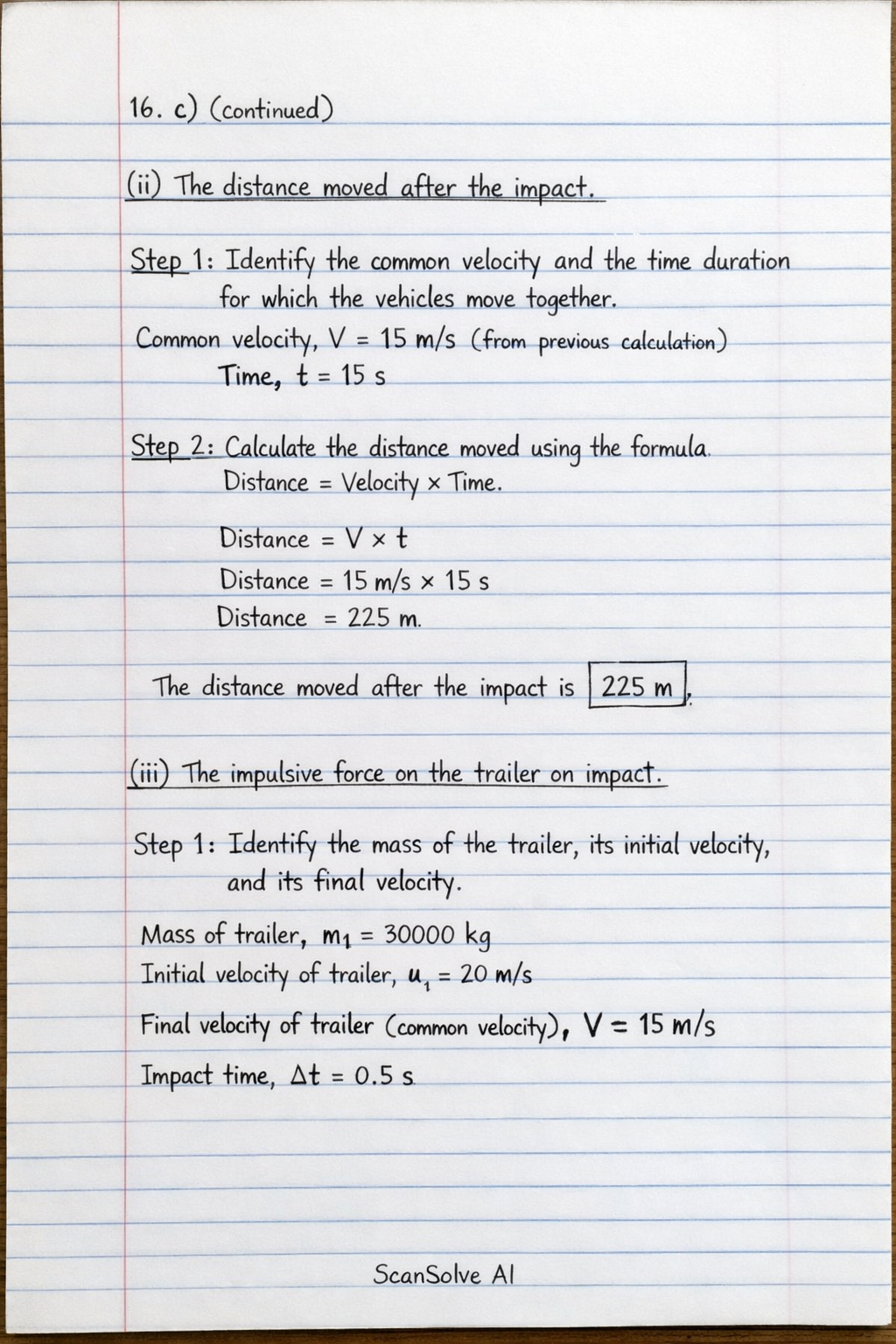
16. c) (continued)
- (ii) The distance moved after the impact.
Identify the common velocity and the time duration for which the vehicles move together.
Common velocity, $V = 15 \text{ m/s}$ (from previous calculation) Time, $t = 15 \text{ s}$Calculate the distance moved using the formula .
$$ Distance = V \times t $$ $$ Distance = 15 \text{ m/s} \times 15 \text{ s} $$ $$ Distance = 225 \text{ m} $$ The distance moved after the impact is $\boxed{225 \text{ m}}$.- (iii) The impulsive force on the trailer on impact.
Identify the mass of the trailer, its initial velocity, and its final velocity.
Mass of trailer, $m_1 = 30000 \text{ kg}$ Initial velocity of trailer, $u_1 = 20 \text{ m/s}$ Final velocity of trailer (common velocity), $V = 15 \text{ m/s}$ Impact time, $\Delta t = 0.5 \text{ s}$Calculate the change in momentum of the trailer.
$$ \Delta p = m_1 V - m_1 u_1 $$ $$ \Delta p = (30000 \text{ kg})(15 \text{ m/s}) - (30000 \text{ kg})(20 \text{ m/s}) $$ $$ \Delta p = 450000 \text{ kg m/s} - 600000 \text{ kg m/s} $$ $$ \Delta p = -150000 \text{ kg m/s} $$ The negative sign indicates the force is in the opposite direction to the initial motion.Calculate the impulsive force using the formula .
$$ F = \frac{-150000 \text{ kg m/s}}{0.5 \text{ s}} $$ $$ F = -300000 \text{ N} $$ The impulsive force on the trailer on impact is $\boxed{300000 \text{ N}}$ (magnitude).16. d) Give a reason why when a passenger jumps from a floating boat, the boat moves backwards.
This occurs due to the conservation of momentum. As the passenger jumps forward, they exert a force on the boat in the backward direction. By Newton's Third Law, the boat exerts an equal and opposite force on the passenger, propelling them forward. The total momentum of the passenger-boat system remains zero (assuming it was initially at rest).16. e) Give the reason why a safety seat belt used in a vehicle:
-
i) Should have a wide surface area. A wide surface area distributes the force of impact over a larger area of the body, thereby reducing the pressure exerted on the body and minimizing injury.
-
ii) Should be slightly extensible. Being slightly extensible allows the seat belt to stretch during an impact, which increases the time over which the stopping force acts. This increase in time reduces the magnitude of the force experienced by the occupant, thus reducing the risk of severe injury.
17. a) State Hooke's Law.
Hooke's Law states that the extension of a spring is directly proportional to the applied force, provided the elastic limit is not exceeded.-
Still stuck on this one?
Ask a follow-up, and the answer starts from this question.
More Physics Questions
Handwritten Step-by-Step Solution
Get this as a handwritten image on WhatsApp — like a tutor wrote it for you.
Try on WhatsApp