
We read your photo as:
Two trolleys of mass 3 kg and 5 kg are moving toward each other at 4 m/s. They collide and stick together. Find their common velocity after collision.
ScanSolve AI Answer
Answer
Step-by-step solution
9 stepsHere are the solutions to your physics questions:
10. Two trolleys of mass 3 kg and 5 kg are moving toward each other at 4 m/s. They collide and stick together. Find their common velocity after collision.
Identify the given values.
Mass of first trolley,
Mass of second trolley,
Initial velocity of first trolley,
Initial velocity of second trolley, (negative because it's moving in the opposite direction)
Since they stick together, this is an inelastic collision, and they will have a common final velocity, .Apply the principle of conservation of momentum.
The total momentum before collision equals the total momentum after collision.
Substitute the values into the equation.
Solve for .
The negative sign indicates that the trolleys move in the direction of the initially heavier trolley (or the direction of the second trolley's initial motion).
The common velocity after collision is .
11. Explain the concept of inertia and how it relates to mass. (3 marks)
Inertia is the fundamental property of an object to resist any change in its state of motion. This means an object at rest tends to stay at rest, and an object in motion tends to stay in motion with the same speed and in the same direction, unless acted upon by an external force. Mass is a quantitative measure of an object's inertia; the greater the mass of an object, the greater its inertia, and thus the more force is required to change its state of motion.
12. State Snell's Law of refraction. (2 marks)
Snell's Law states that for a light ray passing from one medium to another, the ratio of the sine of the angle of incidence () to the sine of the angle of refraction () is equal to the ratio of the refractive indices of the second medium () to the first medium (). Mathematically, it is expressed as:
13. A ray of light passes from air into glass of refractive index 1.5. The an Calculate the angle of refraction. (3 marks)
The question is incomplete as the angle of incidence is missing. I will assume an angle of incidence of for demonstration.
Identify the given values and assume the missing angle.
Refractive index of air,
Refractive index of glass,
Angle of incidence, (assumed)
Angle of refraction,Apply Snell's Law.
Substitute the values into the equation.
Solve for .
Calculate .
Assuming an angle of incidence of , the angle of refraction is .
14. Distinguish between real and apparent depth with reference to refraction.
Real depth is the actual physical distance of an object from the surface of a medium. Apparent depth is the perceived depth of an object when viewed from a different medium, which appears shallower than the real depth due to the bending of light rays (refraction) as they pass from the denser medium (where the object is) to the rarer medium (where the observer is).
15. Define the term critical angle. State the TWO conditions necessary for occur. (3 marks)
The critical angle is the specific angle of incidence in a denser optical medium for which the angle of refraction in the rarer optical medium is exactly . When light is incident at the critical angle, the refracted ray travels along the interface between the two media.
The two conditions necessary for total internal reflection (which is related to the critical angle) to occur are:
- Light must be traveling from a denser optical medium to a rarer optical medium.
- The angle of incidence in the denser medium must be greater than the critical angle.
Try one yourself
A new problem that tests the same skill.
Still stuck on this one?
Ask a follow-up, and the answer starts from this question.
More Physics Questions
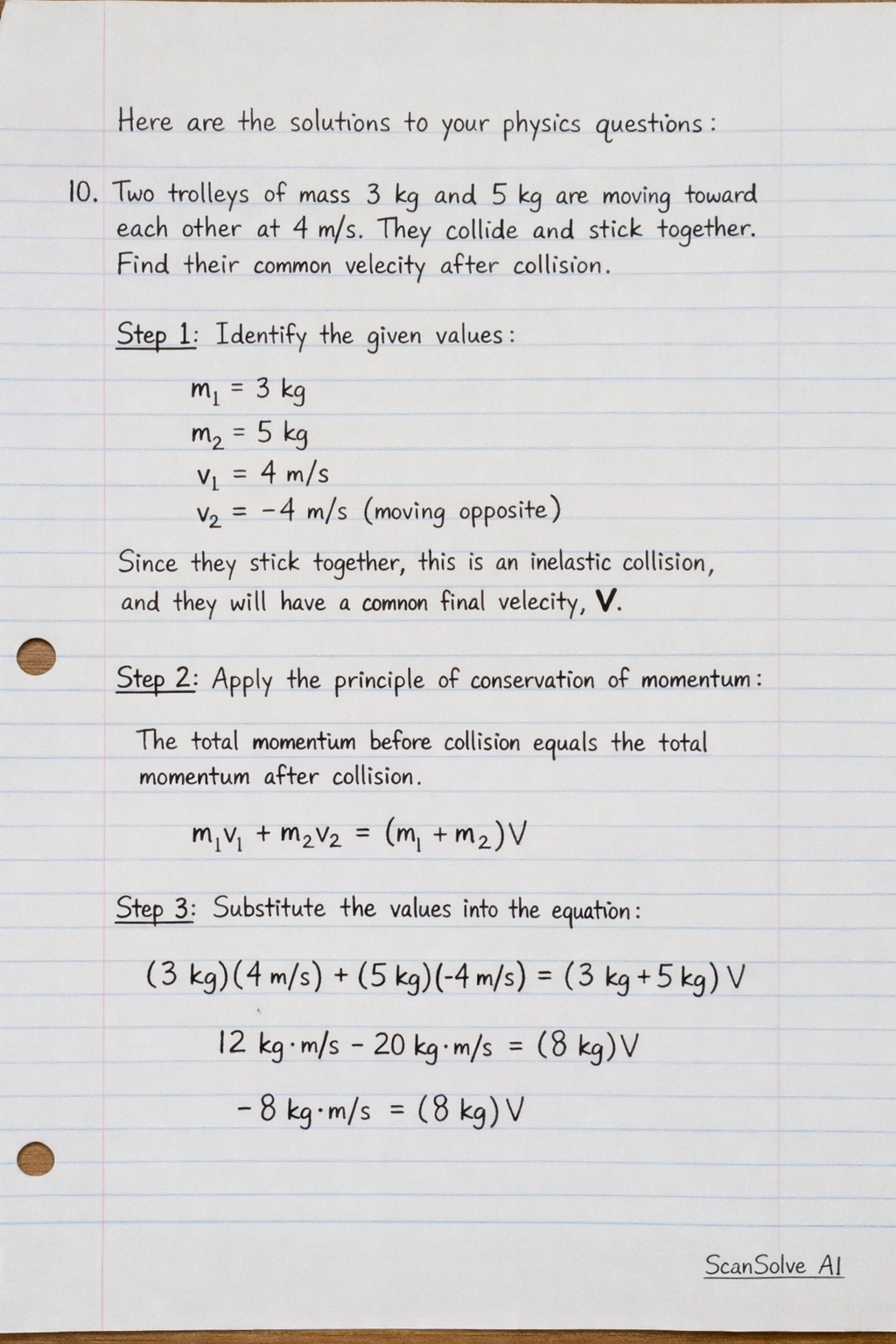
Handwritten Step-by-Step Solution
Get this as a handwritten image on WhatsApp — like a tutor wrote it for you.
Try on WhatsApp