

This physics problem tests your understanding of fundamental physical laws and their applications. The step-by-step solution below breaks down the problem using relevant equations and physical reasoning.
ScanSolve AI Answer
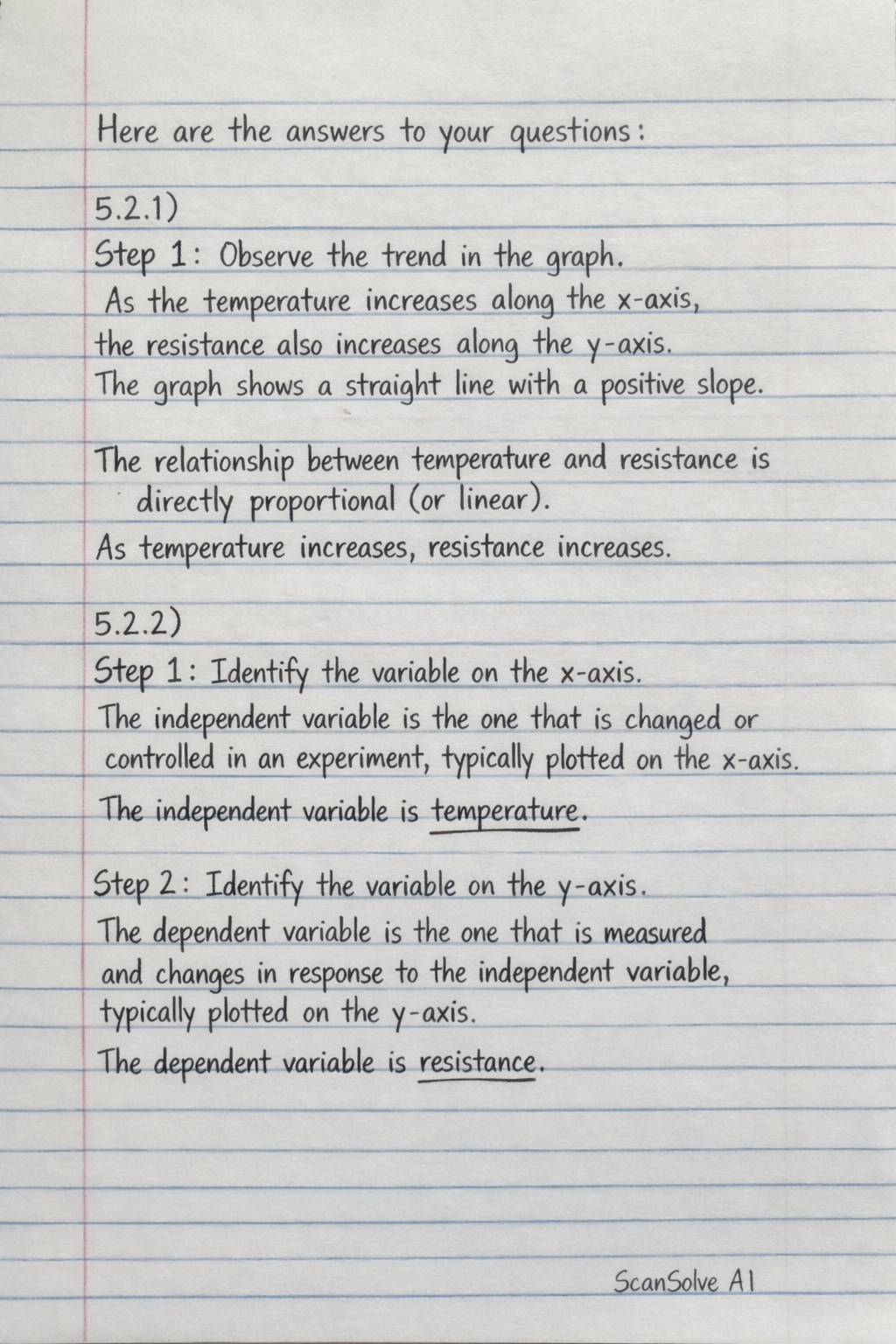
Here are the answers to your questions: 5.2.1) Step 1: Observe the trend in the graph. As the temperature increases along the x-axis, the resistance also increases along the y-axis. The graph shows a straight line with a positive slope. The relationship between temperature and resistance is directly proportional (or linear). As temperature increases, resistance increases. 5.2.2) Step 1: Identify the variable on the x-axis. The independent variable is the one that is changed or controlled in an experiment, typically plotted on the x-axis. The independent variable is temperature. Step 2: Identify the variable on the y-axis. The dependent variable is the one that is measured and changes in response to the independent variable, typically plotted on the y-axis. The dependent variable is resistance. 5.2.3) Step 1: Recall the relationship between resistance and cross-sectional area. The resistance of a conductor is inversely proportional to its cross-sectional area (R (1)/(A)). If the conductor is thicker, its cross-sectional area (A) increases. Therefore, the resistance would decrease. The resistance would decrease.