
We read your photo as:
A 12 V battery supplies a current of 0.5 A to a lamp for 2 minutes. Calculate (a) the charge passing through the battery, (b) the energy transferred by the battery, and (c) the resistance of the lamp.
ScanSolve AI Answer
Step-by-step solution
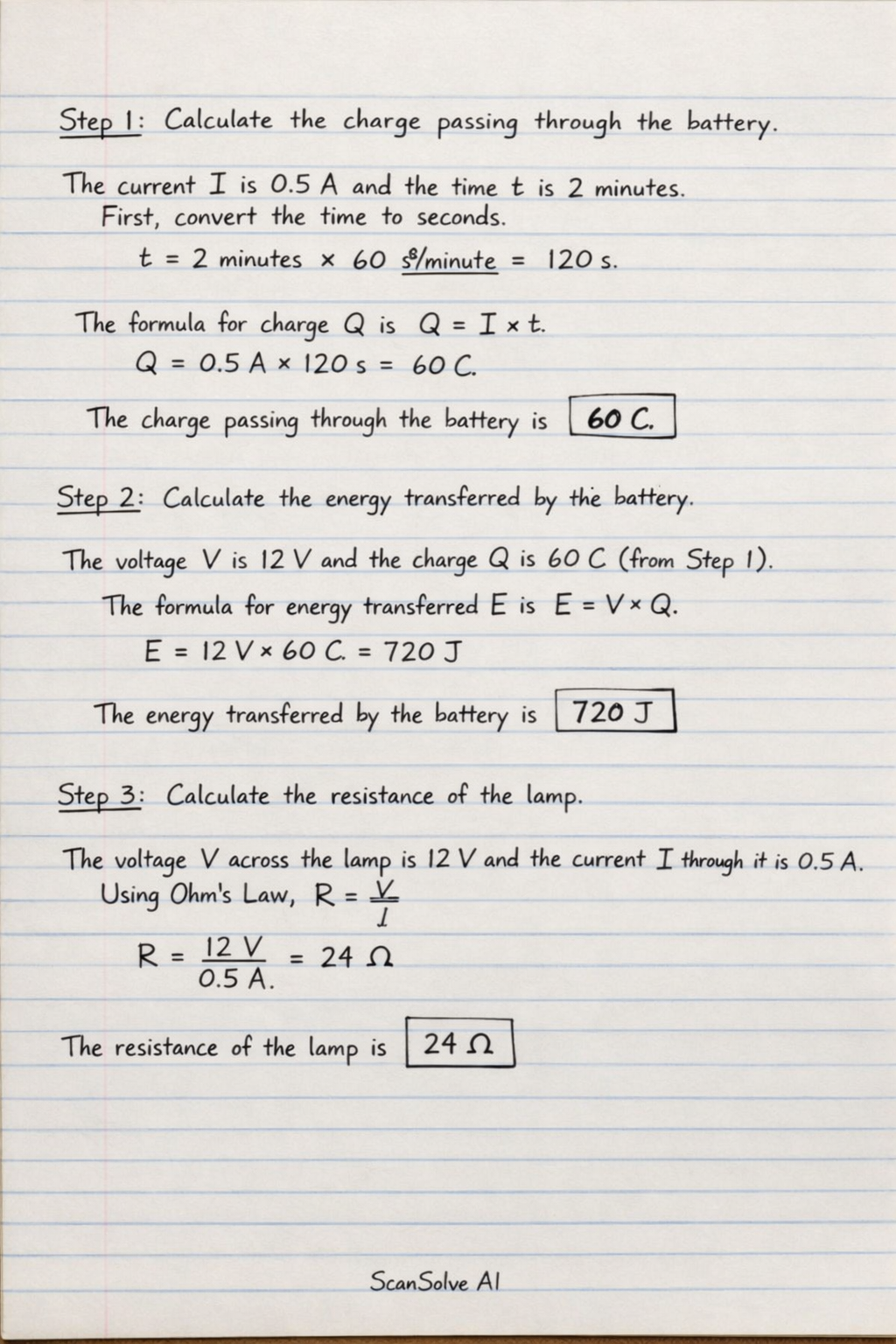
7 stepsCalculate the charge passing through the battery.
The current is and the time is . First, convert the time to seconds.
The formula for charge is .
The charge passing through the battery is .
Calculate the energy transferred by the battery.
The voltage is and the charge is (from Step 1).
The formula for energy transferred is .The energy transferred by the battery is .
Calculate the resistance of the lamp.
The voltage across the lamp is and the current through it is .
Using Ohm's Law, .The resistance of the lamp is .
Define radioactivity.
Radioactivity is the spontaneous emission of radiation (such as alpha particles, beta particles, or gamma rays) from the nucleus of an unstable atom. This process results in the transformation of the unstable nucleus into a more stable one.
Construct the decay equation for Thorium-232.
Thorium-232 () emits two beta particles ().
Let the daughter nucleus be .
The decay equation is:To conserve the mass number ():
To conserve the atomic number ():
The element with atomic number 92 is Uranium (U).
So the daughter nucleus is .
The decay equation is:Determine the number of protons and neutrons in the daughter element.
The daughter element is .
- The number of protons is equal to the atomic number ().
- The number of neutrons is equal to the mass number () minus the atomic number ().
The daughter element has and .
Describe how to draw the velocity-time graph.
To draw the velocity-time graph:
- Plot time (s) on the x-axis and velocity (m/s) on the y-axis.
- Use the given data points from Table C1.1: (0 s, 0 m/s) (5 s, 10 m/s) (10 s, 20 m/s) (15 s, 30 m/s) (20 s, 30 m/s) (25 s, 30 m/s) (30 s, 30 m/s) (35 s, 15 m/s) (40 s, 0 m/s)
- Connect the plotted points with straight lines. The graph will show an initial increase in velocity, followed by a period of constant velocity, and then a decrease in velocity back to zero.
Still stuck on this one?
Ask a follow-up, and the answer starts from this question.
More Physics Questions
Handwritten Step-by-Step Solution
Get this as a handwritten image on WhatsApp — like a tutor wrote it for you.
Try on WhatsApp