
We read your photo as:
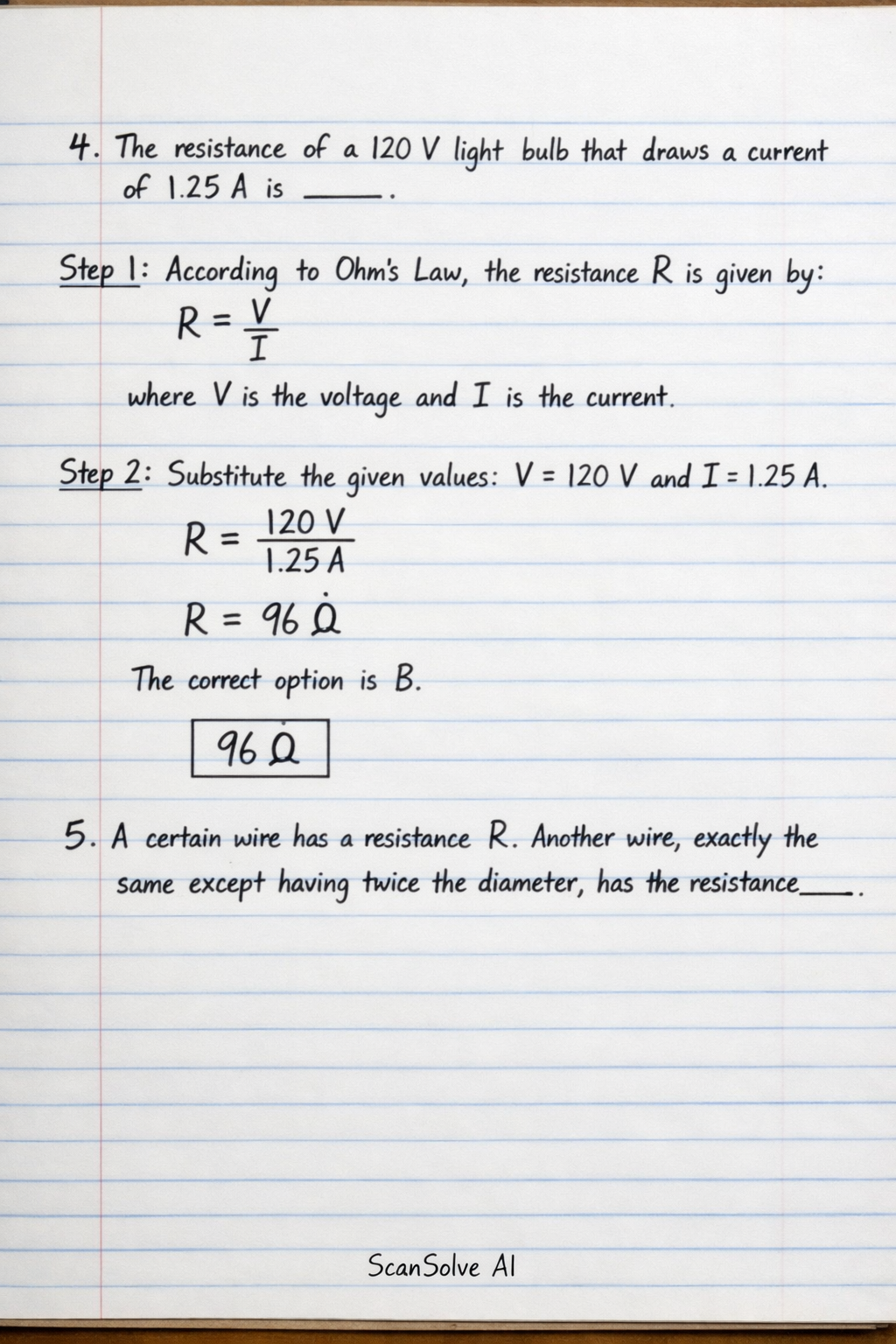
The resistance of a 120 V light bulb that draws a current of 1.25 A is .
ScanSolve AI Answer
Answer
Step-by-step solution
20 stepshere are the solutions to the questions you've provided:
4. The resistance of a 120 V light bulb that draws a current of 1.25 A is ________.
According to Ohm's Law, the resistance is given by
where is the voltage and is the current.
Substitute the given values
and .
The correct option is B.
5. A certain wire has a resistance R. Another wire, exactly the same except having twice the diameter, has the resistance ________.
The resistance of a wire is given by the formula
where is the resistivity of the material, is the length, and is the cross-sectional area.
The cross-sectional area of a circular wire is given by , where is the radius.
Since diameter , then , so .
Substitute the area into the resistance formula
For the second wire, the diameter is .
All other parameters (, ) are the same. Let its resistance be .
From Step 3, we know that .
So,
The correct option is D.
6. The current in the 5 Ω resistor is ________.
The resistors and are connected in series.
The total equivalent resistance for series resistors is the sum of individual resistances:
A potential difference is applied across the series combination.
According to Ohm's Law, the total current flowing through the circuit is:
In a series circuit, the current is the same through all components.
Therefore, the current in the resistor is .
The correct option is A.7. The potential difference across the 5 Ω resistor is ________.
From the previous question (Question 6), we found that the current flowing through the series circuit is .
To find the potential difference across the resistor (), we use Ohm's Law
Substitute the values
and .
The correct option is A.
8. A current of 9 A flows when a 120 V battery is connected across a 12 Ω resistor. The battery has an internal resistance of ________.
For a circuit with a battery having an electromotive force (EMF) and internal resistance , connected to an external resistor , the current flowing in the circuit is given by
We are given
, , and . We need to find .
Rearrange the formula to solve for :Substitute the values
Rounding to one decimal place, .
The correct option is A.9. A 10 Ω resistor and a 5 Ω resistor are connected in parallel. Their equivalent resistance is ________.
For two resistors connected in parallel, the equivalent resistance is given by the formula
Substitute the given values
and .
Find a common denominator and add the fractions
Invert the result to find
The correct option is B.
Try one yourself
A new problem that tests the same skill.
Still stuck on this one?
Ask a follow-up, and the answer starts from this question.
More Physics Questions
Handwritten Step-by-Step Solution
Get this as a handwritten image on WhatsApp — like a tutor wrote it for you.
Try on WhatsApp