
We read your photo as:
Given resistance R = 12.5 and current I = 10 A.
Physics
ScanSolve AI Answer
Answer
Step-by-step solution
3 stepsState Ohm's Law.
Ohm's Law states that the potential difference () across a resistor is directly proportional to the current () flowing through it, and the constant of proportionality is the resistance ().
Substitute the given values into the formula.
Given resistance and current .
Calculate the potential difference.
The potential difference across the resistor is 125 V.
Was this helpful?
Try one yourself
A new problem that tests the same skill.
Still stuck on this one?
Ask a follow-up, and the answer starts from this question.
Got a different question?Ask your own question
More Physics Questions
QCalculate the resistance and its uncertainty using Ohm's Law, given V = (18 ± 3) V and I = (5 ± 0.1)…QCalculate the potential difference across a 10 resistor carrying current of 2 A.QSet E1=24V, R1=12 oHMS, E2=12V, R2=8 ohms, R3=4 ohms. Solve for the currents using NODAL ANALYSIS.QOn basis of Kirchhoff's law determine the value for current given r = 0.5Ω, R = 0.5ΩQCalculate Resistance R = (V)/(I) for each data point.
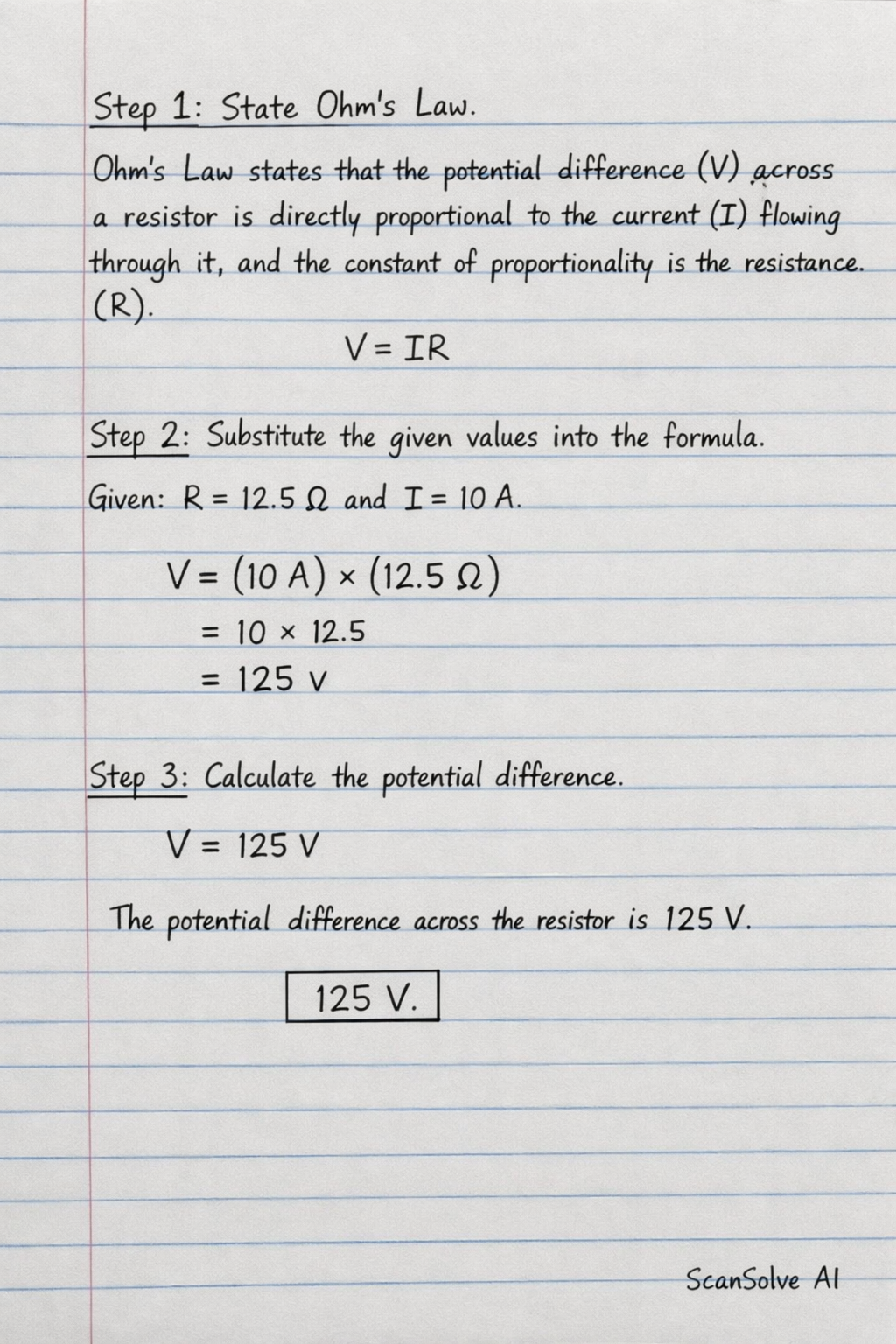
Handwritten Step-by-Step Solution
Get this as a handwritten image on WhatsApp — like a tutor wrote it for you.
Try on WhatsApp