
We read your photo as:
When there is a decrease in the concentration of oxygen in the blood, the breathing rate
ScanSolve AI Answer
Answer
Here are the solutions to the biology questions:
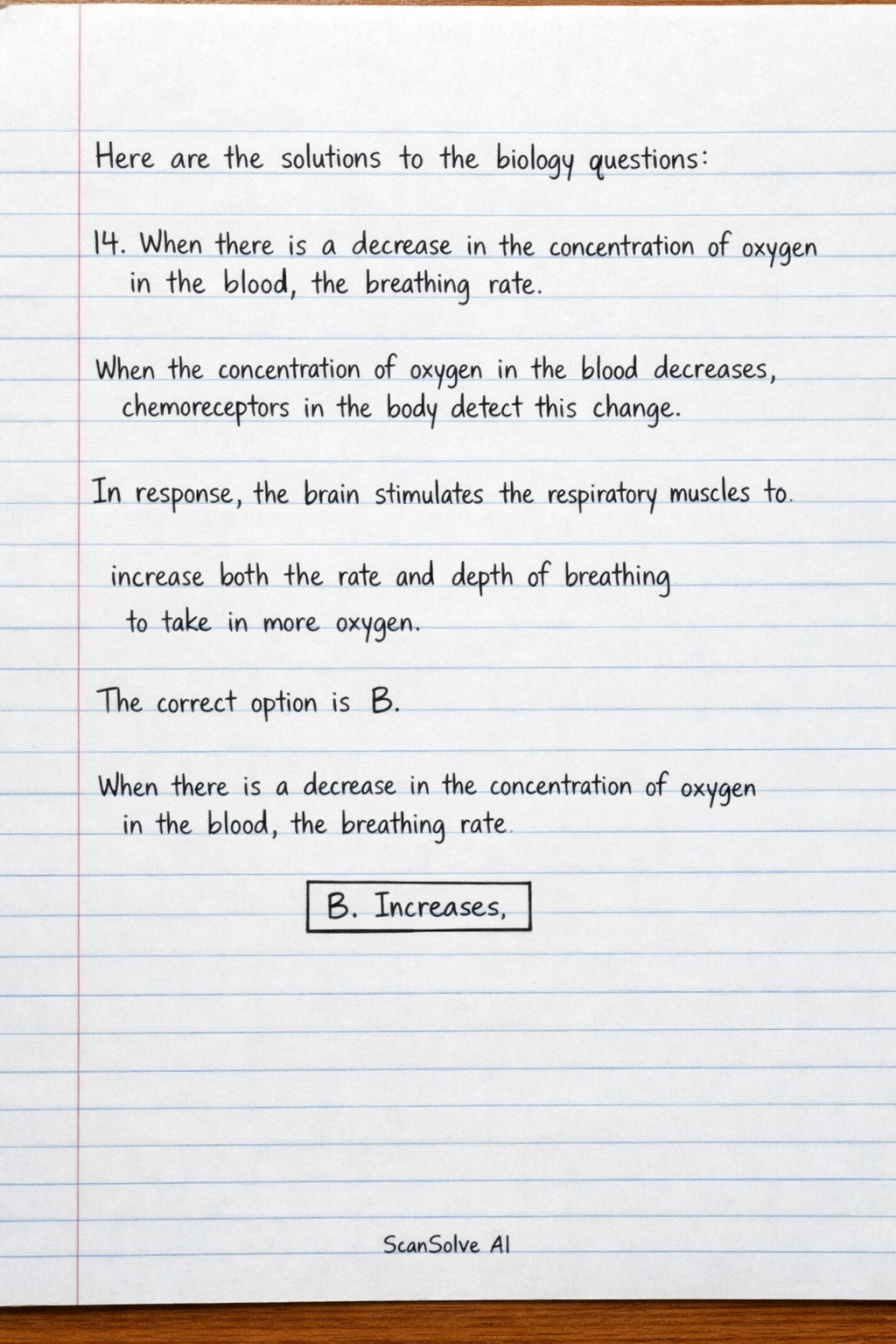
14. When there is a decrease in the concentration of oxygen in the blood, the breathing rate
When the concentration of oxygen in the blood decreases, chemoreceptors in the body detect this change. In response, the brain stimulates the respiratory muscles to increase both the rate and depth of breathing to take in more oxygen.
The correct option is B.
When there is a decrease in the concentration of oxygen in the blood, the breathing rate .
15. The type of root system of all the following is tap root system, except that of
A taproot system is characteristic of dicotyledonous plants, where a single main root grows downwards with smaller lateral roots branching off. A fibrous root system, found in monocotyledonous plants, consists of a network of many fine roots.
- Orange tree (A), Mango tree (B), and Sunflower plant (C) are all dicotyledonous plants and have taproot systems.
- Maize plant (D) is a monocotyledonous plant and has a fibrous root system. The correct option is D. The type of root system of all the following is tap root system, except that of .
Use the diagram below to answer questions 16 and 17
Based on the diagram of a plant cell:
- I points to the cell wall.
- II points to the cell membrane.
- III points to the cytoplasm.
- IV points to the nucleus.
16. The organelle responsible for heredity is
Heredity is controlled by genetic material (DNA), which is primarily housed within the nucleus of eukaryotic cells. In the given diagram, IV represents the nucleus.
The correct option is D.
The organelle responsible for heredity is .
17. The cell organelle solely responsible for respiration is the
Cellular respiration, the process by which cells convert glucose and oxygen into energy (ATP), primarily takes place in the mitochondrion.
The correct option is A.
The cell organelle solely responsible for respiration is the .
18. The chromosomes of members of the Kingdom Monera are within the
Kingdom Monera comprises prokaryotic organisms (like bacteria), which lack a membrane-bound nucleus. Their genetic material (chromosomes) is located in a region of the cytoplasm called the nucleoid, not enclosed within a nucleus.
The correct option is A.
The chromosomes of members of the Kingdom Monera are within the .
Try one yourself
A new problem that tests the same skill.
Still stuck on this one?
Ask a follow-up, and the answer starts from this question.
More Chemistry Questions
Handwritten Step-by-Step Solution
Get this as a handwritten image on WhatsApp — like a tutor wrote it for you.
Try on WhatsApp