

This biology question covers important biological concepts and processes. The step-by-step explanation below helps you understand the underlying mechanisms and reasoning.
ScanSolve AI Answer
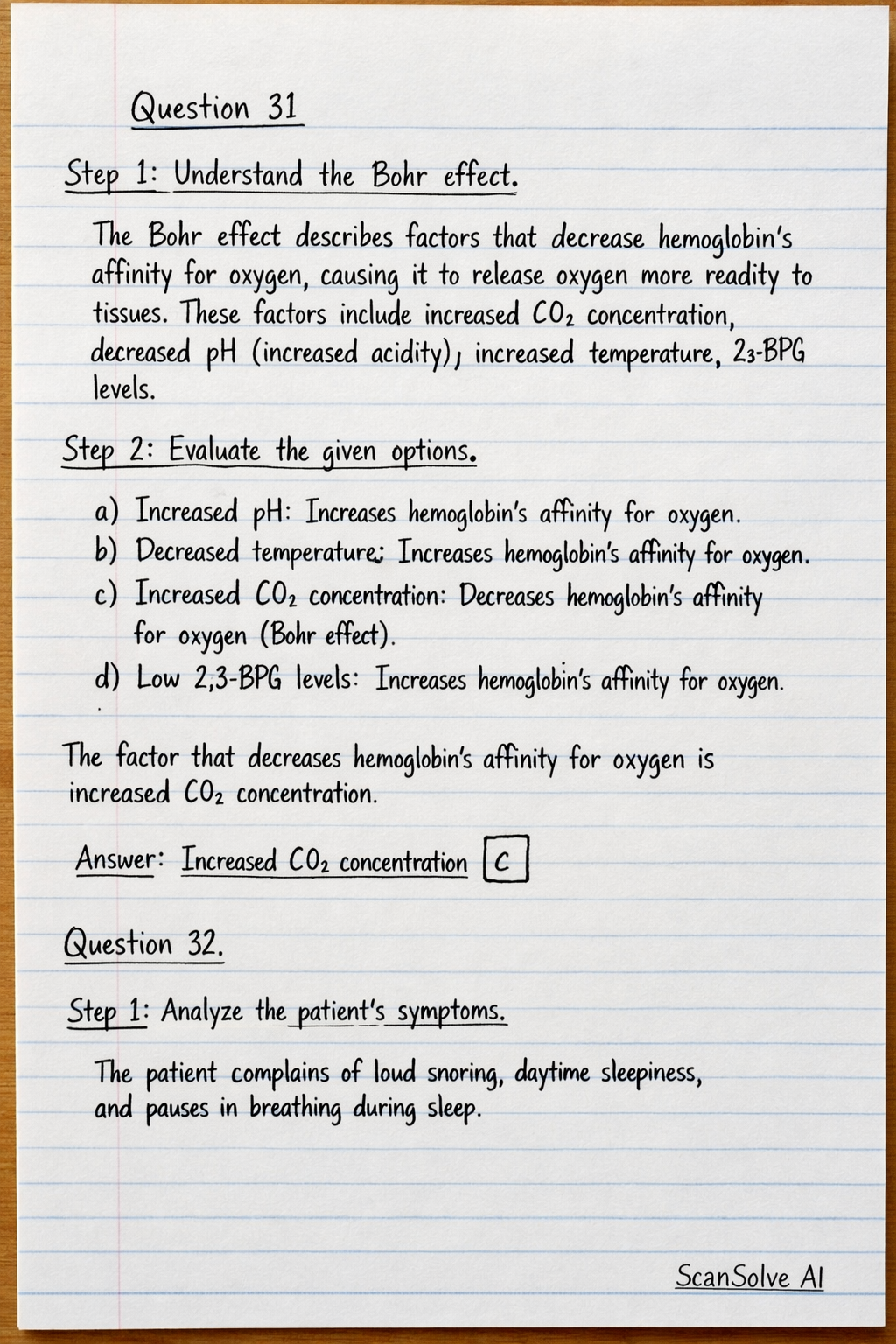
Question 31 Step 1: Understand the Bohr effect. The Bohr effect describes factors that decrease hemoglobin's affinity for oxygen, causing it to release oxygen more readily to tissues. These factors include increased CO_2 concentration, decreased pH (increased acidity), increased temperature, and increased 2,3-BPG levels. Step 2: Evaluate the given options. a) Increased pH: Increases hemoglobin's affinity for oxygen. b) Decreased temperature: Increases hemoglobin's affinity for oxygen. c) Increased CO_2 concentration: Decreases hemoglobin's affinity for oxygen (Bohr effect). d) Low 2,3-BPG levels: Increases hemoglobin's affinity for oxygen. The factor that decreases hemoglobin's affinity for oxygen is increased CO_2 concentration. Answer: Increased CO_2 concentration (c) c Question 32 Step 1: Analyze the patient's symptoms. The patient complains of loud snoring, daytime sleepiness, and pauses in breathing during sleep. Step 2: Evaluate the options based on symptoms. a) Chronic bronchitis: Characterized by chronic cough and sputum production, not typically pauses in breathing during sleep. b) Obstructive sleep apnea: This condition is characterized by recurrent episodes of upper airway obstruction during sleep, leading to loud snoring, pauses in breathing, and daytime sleepiness. The symptoms perfectly match this condition. c) Asthma: Characterized by reversible airway obstruction, wheezing, and shortness of breath, not typically pauses in breathing during sleep. d) Pulmonary fibrosis: Characterized by progressive shortness of breath and restrictive lung disease, not typically snoring and pauses in breathing. The most likely underlying condition is obstructive sleep apnea. Answer: Obstructive sleep apnea (b) b Question 33 Step 1: Consider the effect of chronic alcohol use on the body. Alcohol is a central nervous system depressant that can cause muscle relaxation. Step 2: Relate alcohol's effects to snoring. Relaxation of the pharyngeal muscles during sleep can lead to collapse of the upper airway, which causes snoring and can exacerbate obstructive sleep apnea. Chronic alcohol use contributes to this muscle relaxation. Step 3: Evaluate the options. a) Relaxation of pharyngeal muscles during sleep: Alcohol can cause this, leading to airway obstruction and snoring. b) Thickening of alveolar-capillary barrier: This affects gas exchange, not snoring. c) Enlarged tonsils: While a cause of snoring, it is not directly explained by chronic alcohol use. d) Enhanced oxygen binding to hemoglobin: Irrelevant to snoring. The factor explaining heavy snoring in a patient with chronic alcohol use is relaxation of pharyngeal muscles during sleep. Answer: Relaxation of pharyngeal muscles during sleep (a) a Question 34 Step 1: Analyze the patient's history and findings. The patient has a chronic smoking history, progressive shortness of breath, and chest X-ray shows hyperinflated lungs. These are classic signs of emphysema, a type of chronic obstructive pulmonary disease (COPD). Step 2: Identify the anatomical changes in emphysema. Emphysema is characterized by the destruction of the walls of the alveoli, leading to the formation of larger, less efficient air spaces. This destruction reduces the total surface area available for gas exchange and causes air trapping, leading to hyperinflation. Step 3: Evaluate the options. a) Thickened respiratory membrane: This would impede gas exchange but is not the primary cause of hyperinflation in emphysema. b) Increased surfactant secretion: Surfactant reduces surface tension; increased secretion is not a feature of emphysema. c) Narrowed trachea: While airway narrowing can occur in COPD (e.g., chronic bronchitis), the primary anatomical change leading to hyperinflation in emphysema is alveolar destruction. d) Loss of alveolar walls reducing surface area: This is the defining anatomical change in emphysema, leading to impaired gas exchange, hyperinflation, and shortness of breath. The anatomical change that explains the symptoms is the loss of alveolar walls reducing surface area. Answer: Loss of alveolar walls reducing surface area (d) d