
Explain the increase of Hb concentration on O2 Hb dissociation curve
Chemistry
ScanSolve AI Answer
Answer
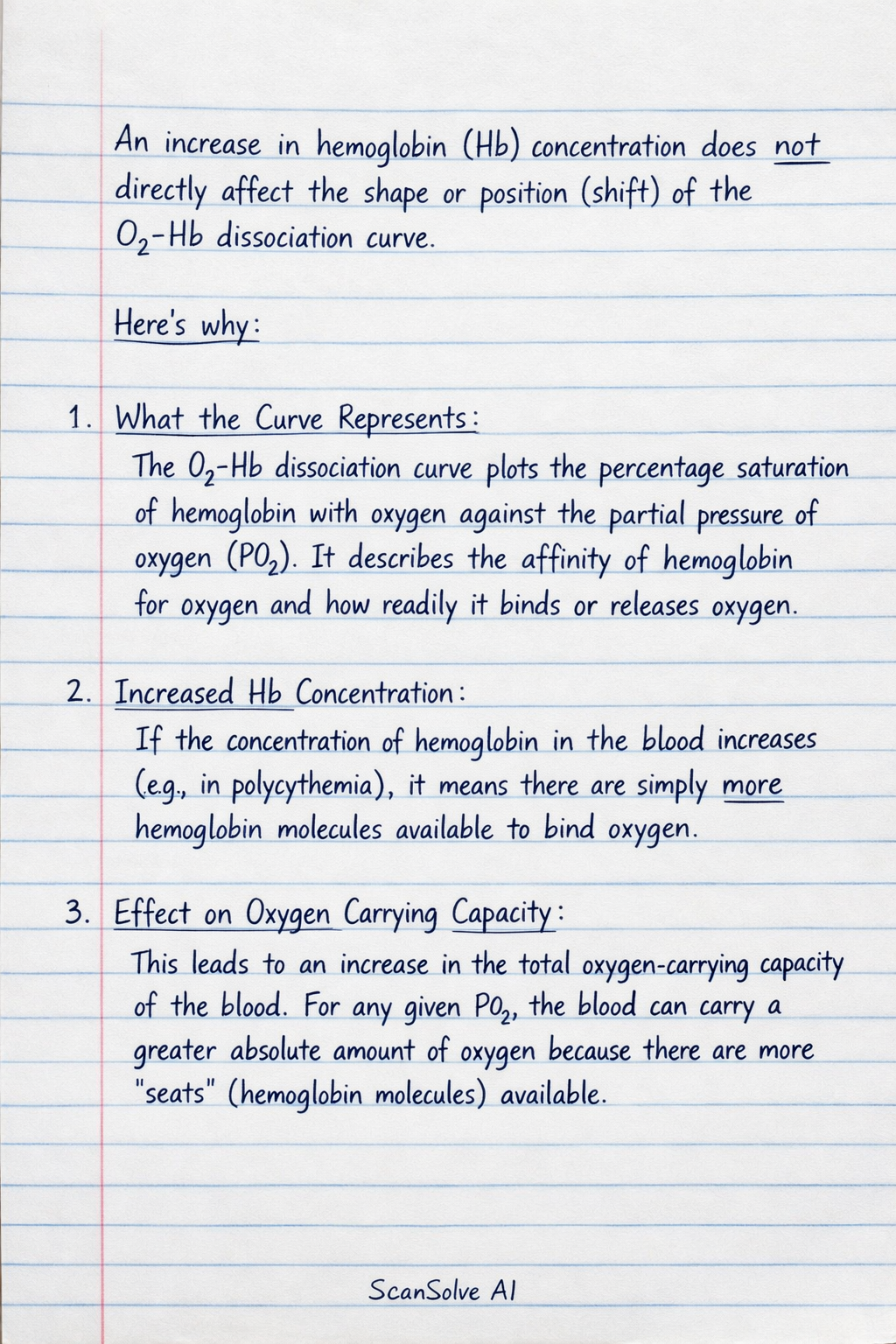
An increase in hemoglobin (Hb) concentration does not directly affect the shape or position (shift) of the O₂-Hb dissociation curve.
Here's why:
- What the Curve Represents: The O₂-Hb dissociation curve plots the percentage saturation of hemoglobin with oxygen against the partial pressure of oxygen (PO₂). It describes the affinity of hemoglobin for oxygen and how readily it binds or releases oxygen.
- Increased Hb Concentration: If the concentration of hemoglobin in the blood increases (e.g., in polycythemia), it means there are simply more hemoglobin molecules available to bind oxygen.
- Effect on Oxygen Carrying Capacity: This leads to an increase in the total oxygen-carrying capacity of the blood. For any given PO₂, the blood can carry a greater absolute amount of oxygen because there are more "seats" (hemoglobin molecules) available.
- No Change in Affinity: However, the affinity of each individual hemoglobin molecule for oxygen, and thus the percentage of hemoglobin saturated at a given PO₂, remains unchanged. The curve itself, which illustrates this percentage saturation, does not shift left or right.
Therefore, while an increased Hb concentration allows the blood to transport more oxygen overall, it does not alter the fundamental relationship between PO₂ and hemoglobin saturation, meaning the O₂-Hb dissociation curve itself does not shift.
Was this helpful?
Still stuck on this one?
Ask a follow-up, and the answer starts from this question.
Got a different question?Ask your own question
More Chemistry Questions
QHow increase in H+ affect the shifts of O2 Hb dissociation curve using bohrs effectQEffect of temperature at low and high that affects shifts of O2 Hb dissociation curveQDoes increased 2,3-DPG concentration shift the oxygen dissociation curve to the left or right?QWhich factor decreases hemoglobin's affinity for oxygen (Bohr effect)?QExplain the interrelationship between the bicarbonate and hemoglobin buffering systems shown in the…
Handwritten Step-by-Step Solution
Get this as a handwritten image on WhatsApp — like a tutor wrote it for you.
Try on WhatsApp