
Effect of temperature at low and high that affects shifts of O2 Hb dissociation curve
Biology
ScanSolve AI Answer
Answer
Higher temperatures promote oxygen release (right shift), while lower temperatures promote oxygen binding (left shift).
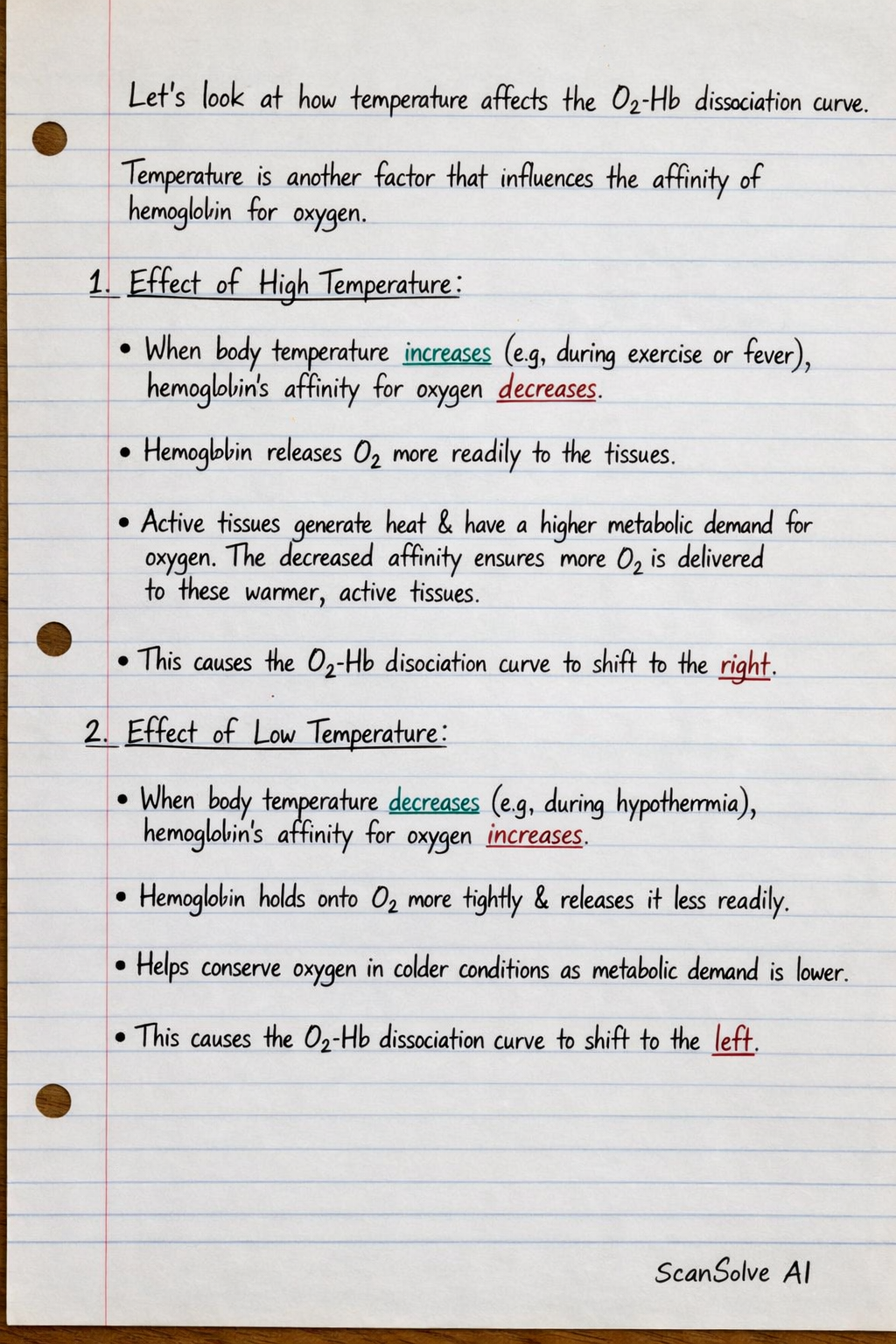
Let's look at how temperature affects the O₂-Hb dissociation curve.
Temperature is another factor that influences the affinity of hemoglobin for oxygen.
-
Effect of High Temperature:
- When body temperature increases (e.g., during exercise or fever), hemoglobin's affinity for oxygen decreases.
- This means hemoglobin releases oxygen more readily to the tissues.
- Physiologically, active tissues generate heat, and they also have a higher metabolic demand for oxygen. The decreased affinity ensures that more oxygen is delivered to these warmer, more active tissues.
- This causes the O₂-Hb dissociation curve to shift to the right.
-
Effect of Low Temperature:
- When body temperature decreases (e.g., during hypothermia), hemoglobin's affinity for oxygen increases.
- This means hemoglobin holds onto oxygen more tightly and releases it less readily.
- This effect helps to conserve oxygen in colder conditions, as metabolic demand is generally lower.
- This causes the O₂-Hb dissociation curve to shift to the left.
Was this helpful?
Still stuck on this one?
Ask a follow-up, and the answer starts from this question.
Got a different question?Ask your own question
More Biology Questions
QHow increase in H+ affect the shifts of O2 Hb dissociation curve using bohrs effectQExplain the increase of Hb concentration on O2 Hb dissociation curveQDoes increased 2,3-DPG concentration shift the oxygen dissociation curve to the left or right?QWhich factor decreases hemoglobin's affinity for oxygen (Bohr effect)?QExplain why the solubility of oxygen in water decreases as temperature increases, referencing the…
Handwritten Step-by-Step Solution
Get this as a handwritten image on WhatsApp — like a tutor wrote it for you.
Try on WhatsApp