

This biology question covers important biological concepts and processes. The step-by-step explanation below helps you understand the underlying mechanisms and reasoning.
ScanSolve AI Answer
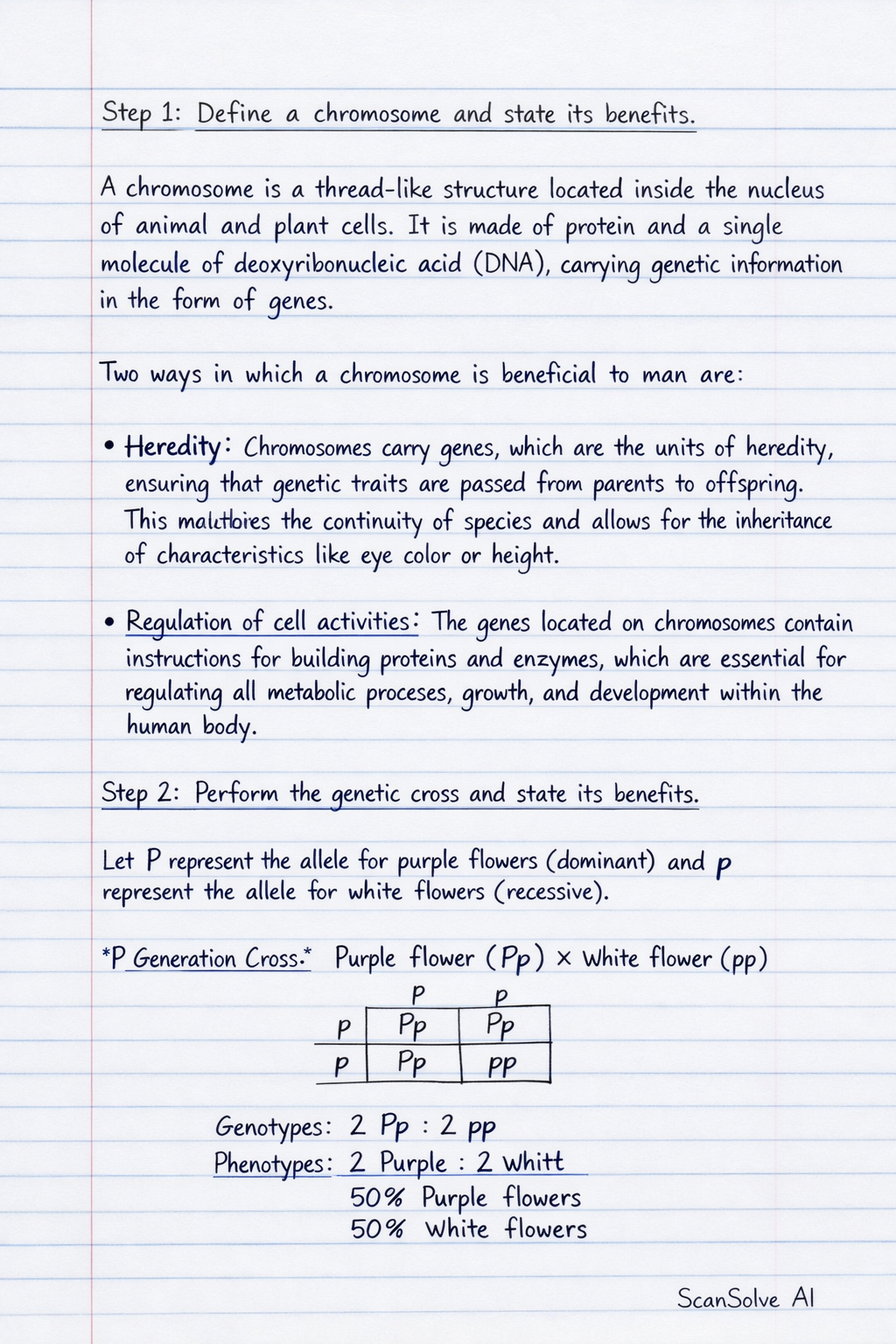
Step 1: Define a chromosome and state its benefits. A chromosome is a thread-like structure located inside the nucleus of animal and plant cells. It is made of protein and a single molecule of deoxyribonucleic acid (DNA), carrying genetic information in the form of genes. Two ways in which a chromosome is beneficial to man are: • Heredity: Chromosomes carry genes, which are the units of heredity, ensuring that genetic traits are passed from parents to offspring. This maintains the continuity of species and allows for the inheritance of characteristics like eye color or height. • Regulation of cell activities: The genes located on chromosomes contain instructions for building proteins and enzymes, which are essential for regulating all metabolic processes, growth, and development within the human body. Step 2: Perform the genetic cross and state its benefits. Let P represent the allele for purple flowers (dominant) and p represent the allele for white flowers (recessive). P Generation Cross: Purple flower (Pp) × White flower (pp) Gametes from Pp: P, p Gametes from pp: p, p F1 Generation Punnett Square: |c|c|c| Gametes & P & p \\ p & Pp & pp \\ p & Pp & pp \\ F1 Genotypes: 50\% Pp (heterozygous purple), 50\% pp (homozygous white) F1 Phenotypes: 50\% Purple flowers, 50\% White flowers F2 Generation Cross: To obtain the F2 generation, we typically cross two F1 individuals. Since the F1 generation contains heterozygous purple flowers (Pp), we will cross two of these individuals: Pp × Pp. Gametes from Pp: P, p Gametes from Pp: P, p F2 Generation Punnett Square: |c|c|c| Gametes & P & p \\ P & PP & Pp \\ p & Pp & pp \\ F2 Genotypes: 25\% PP, 50\% Pp, 25\% pp F2 Phenotypes: 75\% Purple flowers, 25\% White flowers F2 Phenotypic Ratio: 3 Purple : 1 White Two ways in which this type of genetic cross is beneficial to mankind are: • Selective Breeding: Understanding inheritance patterns allows breeders to select parents with desirable traits (e.g., high yield in crops, disease resistance in livestock) to produce offspring with improved characteristics. • Genetic Counseling: For humans, these crosses help predict the probability of offspring inheriting certain genetic disorders or traits, providing valuable information for family planning and medical decisions. Step 3: Define parasitic adaptations and classify air pollution. a) Two parasitic adaptations exhibited by most parasites and one example of each: • High Reproductive Capacity: Parasites often produce a large number of offspring (eggs or larvae) to increase the chances of finding and infecting a new host, compensating for the high mortality rate during transmission. Example: A tapeworm can produce millions of eggs to ensure its survival and spread. • Specialized Attachment Organs: Many parasites develop specific structures to firmly attach to their host's tissues, preventing them from being dislodged or expelled. Example: Tapeworms possess a scolex with hooks and suckers to anchor themselves to the intestinal wall of their host