
We read your photo as:
Combine the answers to questions about endoparasites, pest control, formula mass, and atomic structure.
ScanSolve AI Answer
Step-by-step solution
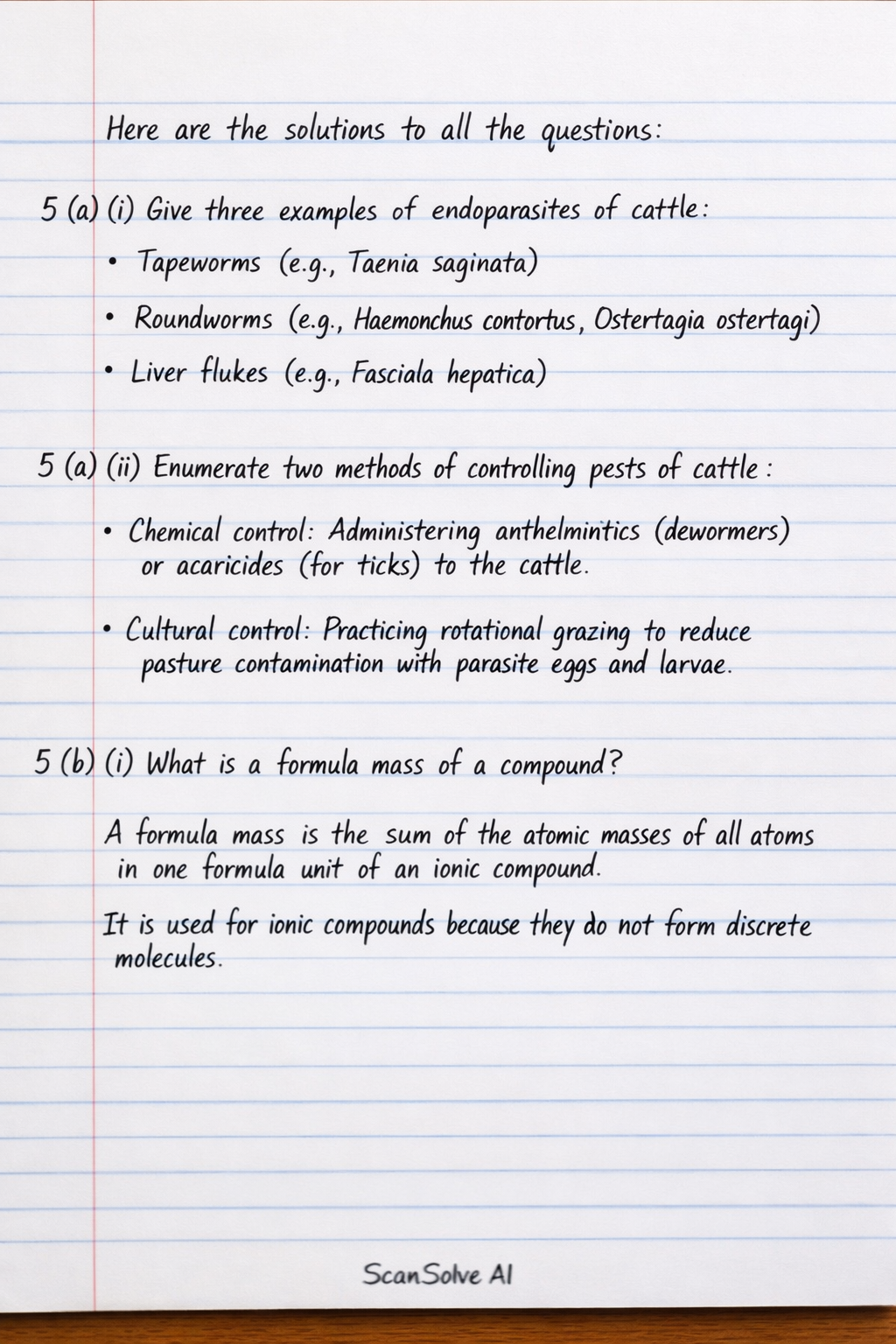
6 stepsHere are the solutions to all the questions:
5 (a) (i) Give three examples of endoparasites of cattle.
- Tapeworms (e.g., Taenia saginata)
- Roundworms (e.g., Haemonchus contortus, Ostertagia ostertagi)
- Liver flukes (e.g., Fasciola hepatica)
5 (a) (ii) Enumerate two methods of controlling pests of cattle.
- Chemical control: Administering anthelmintics (dewormers) or acaricides (for ticks) to the cattle.
- Cultural control: Practicing rotational grazing to reduce pasture contamination with parasite eggs and larvae.
5 (b) (i) What is a formula mass of a compound?
A formula mass is the sum of the atomic masses of all atoms in one formula unit of an ionic compound. It is used for ionic compounds because they do not form discrete molecules.
5 (b) (ii) At atom Q has 12 neutrons and 11 protons:
- (α) calculate its mass number.
Recall that mass number is the sum of protons and neutrons.
$$ \text{Mass number} = \text{Number of protons} + \text{Number of neutrons} $$ $$ \text{Mass number} = 11 + 12 $$ $$ \text{Mass number} = \boxed{\text{23}} $$- (β) write its electron configuration.
For a neutral atom, the number of electrons equals the number of protons, which is 11.
Distribute the electrons into energy shells.
$$ \text{Electron configuration} = \boxed{\text{2, 8, 1}} $$- (γ) what type of ion will Q form in a compound. Atom Q has 1 valence electron. It will tend to lose this electron to achieve a stable octet, forming a positive ion.
5 (c) (i) State two ways by which humans could be protected from harmful effects of radioactivity.
- Shielding: Using materials like lead or concrete to absorb radiation.
- Distance: Increasing the distance from the radioactive source, as radiation intensity decreases with distance.
5 (c) (ii) Give three uses of radioisotopes.
- Medical diagnosis and treatment: Used in imaging (e.g., PET scans) and radiotherapy for cancer.
- Carbon dating: Used to determine the age of ancient artifacts and fossils.
- Industrial tracers: Used to detect leaks in pipes or monitor wear in machinery.
5 (d) State five effects of climate change on humans.
- Increased frequency and intensity of extreme weather events (e.g., floods, droughts, heatwaves), leading to loss of life and property damage.
- Food insecurity due to altered agricultural yields and reduced crop productivity.
- Spread of vector-borne diseases (e.g., malaria, dengue fever) as warmer temperatures expand the range of disease carriers.
- Displacement and migration of populations due to sea-level rise and extreme weather, leading to social instability.
- Water scarcity in many regions due to changes in precipitation patterns and increased evaporation.
6 (a) (i) What are alkanoates?
Alkanoates are esters, which are organic compounds formed from the reaction between an alkanoic acid (carboxylic acid) and an alcohol, typically characterized by the -COO- functional group.6 (a) (ii) State three uses of alkanoates?
- Used as flavoring agents in food and beverages (e.g., ethyl acetate for fruity flavors).
- Used as solvents in industries for paints, varnishes, and glues.
- Used in the manufacture of perfumes due to their pleasant fragrances.
6 (b) (i) Explain the term weathering.
Weathering is the process of breaking down rocks, soil, and minerals on the Earth's surface through contact with the atmosphere, water, and biological organisms. It can be physical (mechanical), chemical, or biological.6 (b) (ii) State three ways of maintaining soil fertility on a sloppy land.
- Terracing: Creating level platforms on slopes to reduce runoff and soil erosion.
- Contour plowing: Plowing across the slope rather than up and down, which creates ridges that slow water flow.
- Cover cropping: Planting non-cash crops to cover the soil, protecting it from erosion and adding organic matter.
6 (c) (i) Give two reasons why genetic variation is important in living organisms.
- It provides the raw material for natural selection, allowing populations to adapt to changing environmental conditions.
- It increases the resilience of a species against diseases or environmental stresses, as some individuals may possess advantageous traits.
6 (c) (ii) Give three examples of genetic variations in humans.
- Eye color (e.g., blue, brown, green)
- Blood type (e.g., A, B, AB, O)
- Hair color (e.g., black, brown, blonde, red)
6 (d) (i) State Archimedes principle.
Archimedes' principle states that the upward buoyant force exerted on a body immersed in a fluid (whether fully or partially submerged) is equal to the weight of the fluid that the body displaces.6 (d) (ii) A boat of volume 200 m floats on sea water of density 1030 kg m. Calculate the upthrust of the sea water on the boat. [g = 10 m s]
Identify the given values.
Volume of water displaced () = (since the boat floats, it displaces a volume of water equal to its own volume, or the submerged part, which is given as 200 m)
Density of sea water () =
Acceleration due to gravity () =Apply the formula for upthrust (buoyant force).
Substitute the values and calculate the upthrust.
Still stuck on this one?
Ask a follow-up, and the answer starts from this question.
More Biology Questions
Handwritten Step-by-Step Solution
Get this as a handwritten image on WhatsApp — like a tutor wrote it for you.
Try on WhatsApp