
We read your photo as:
Explain the concepts of tonicity, water potential, osmosis, and partially permeable membranes using solutions A and B. Also, describe the thistle funnel experiment. For question 24, identify the optim
ScanSolve AI Answer
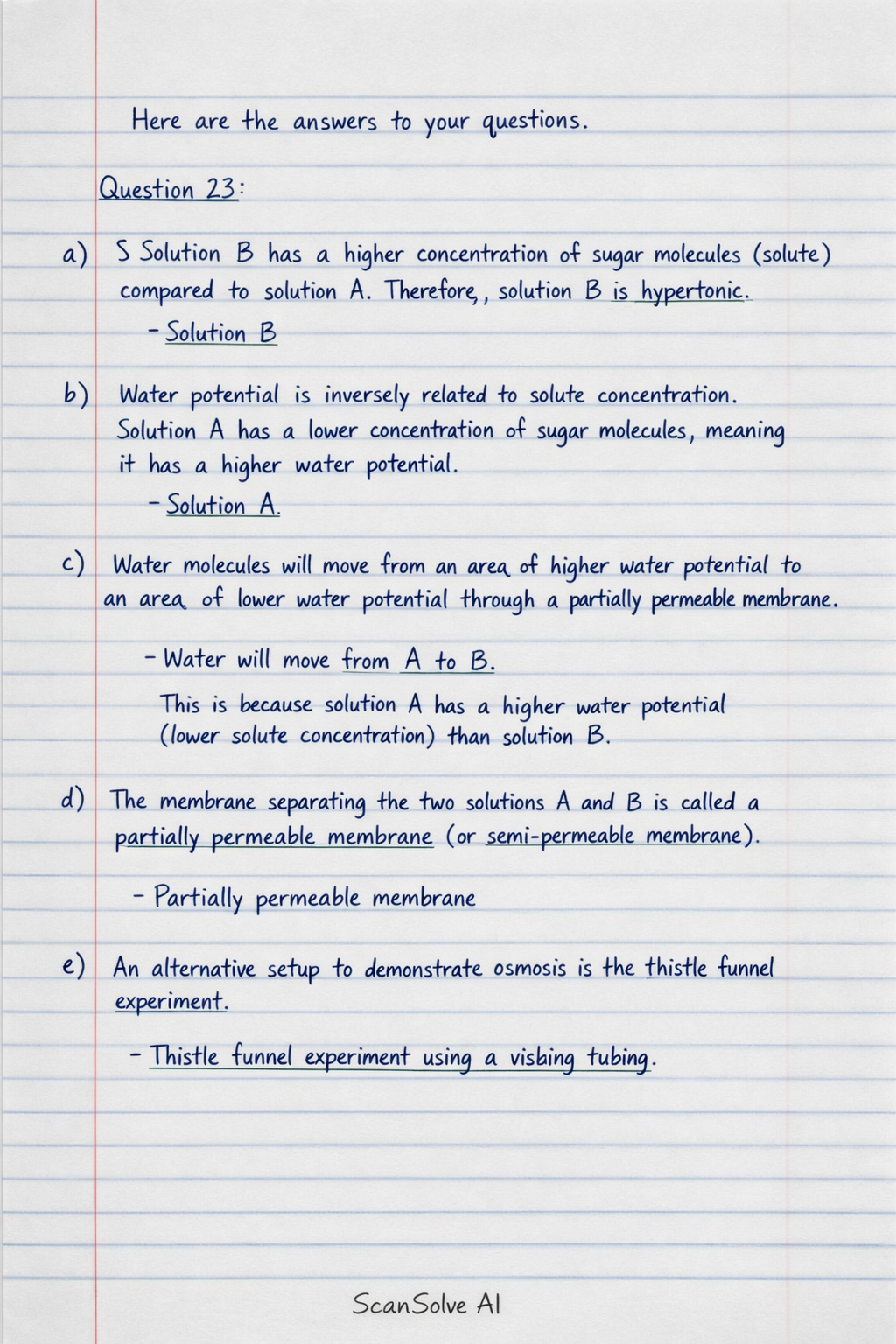
Here are the answers to your questions.
Question 23:
a) Solution B has a higher concentration of sugar molecules (solute) compared to solution A. Therefore, solution B is hypertonic.
- Solution B
b) Water potential is inversely related to solute concentration. Solution A has a lower concentration of sugar molecules, meaning it has a higher water potential.
- Solution A
c) Water molecules will move from an area of higher water potential to an area of lower water potential through a partially permeable membrane.
- Water will move from A to B. This is because solution A has a higher water potential (lower solute concentration) than solution B.
d) The membrane separating the two solutions A and B is called a partially permeable membrane (or semi-permeable membrane).
- Partially permeable membrane
e) An alternative setup to demonstrate osmosis is the thistle funnel experiment.
- Thistle funnel experiment using a visking tubing.
Question 24:
a)
- i) The peak of the pepsin curve is at approximately pH 2.
- Optimum pH for Pepsin: 2
- ii) The peak of the pancreatic lipase curve is at approximately pH 8.
- Optimum pH for Pancreatic lipase: 8
b)
- i) Pepsin works best in a strongly acidic medium (pH 2).
- Pepsin
- ii) Pancreatic lipase works best in a slightly alkaline medium (pH 8).
- Pancreatic lipase
c) The graph for "most enzymes" shows an optimum pH between 6 and 7. Two digestive enzymes that work best within this pH range are:
- Amylase
- Maltase
d) The normal pH of the stomach is highly acidic (around 1.5-3.5), which is optimal for pepsin activity. If the pH in the stomach increased to 7 (neutral), pepsin would become denatured or its activity would significantly decrease. This would lead to impaired protein digestion in the stomach.
Still stuck on this one?
Ask a follow-up, and the answer starts from this question.
More Biology Questions
Handwritten Step-by-Step Solution
Get this as a handwritten image on WhatsApp — like a tutor wrote it for you.
Try on WhatsApp