
We read your photo as:
Create a table summarizing surface specializations on epithelia, including examples, locations, and functions. Also, classify glands based on duct systems, providing examples and locations for exocrin
Biology
ScanSolve AI Answer
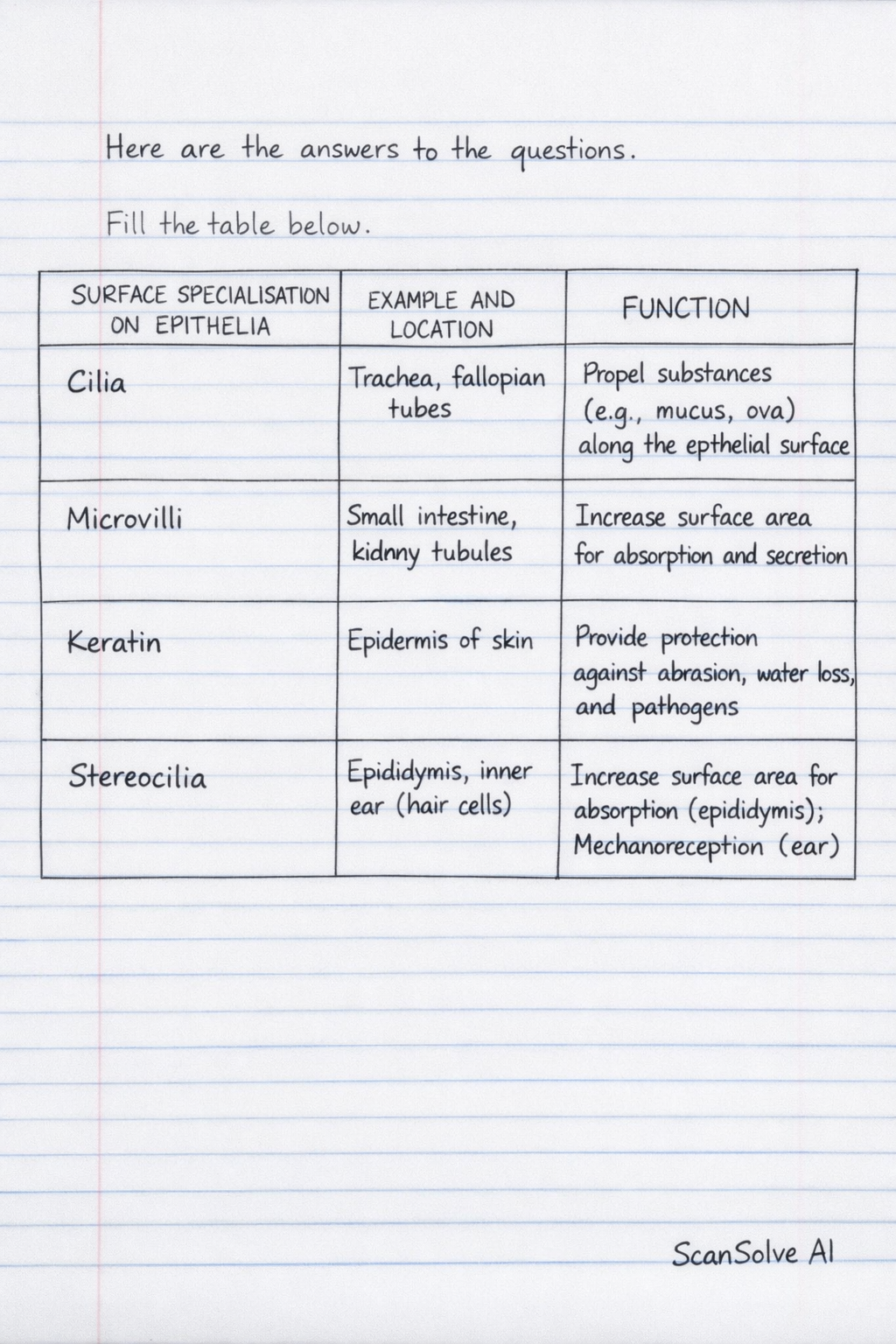
Here are the answers to the questions.
Fill the table below
| SURFACE SPECIALISATION ON EPITHELIA | EXAMPLE AND LOCATION | FUNCTION |
|---|---|---|
| Cilia | Trachea, fallopian tubes | Propel substances (e.g., mucus, ova) along the epithelial surface |
| Microvilli | Small intestine, kidney tubules | Increase surface area for absorption and secretion |
| Keratin | Epidermis of skin | Provide protection against abrasion, water loss, and pathogens |
| Stereocilia | Epididymis, inner ear (hair cells) | Increase surface area for absorption (epididymis); mechanoreception (ear) |
Classify glands using the following criteria and give examples and locations.
1. PRESENCE OR ABSENCE OF A DUCT SYSTEM
- a. Duct system present: Exocrine glands
- Examples: Salivary glands (mouth), Sweat glands (skin), Pancreas (digestive enzymes)
- b. Duct system absent: Endocrine glands
- Examples: Thyroid gland (neck), Adrenal glands (above kidneys), Pituitary gland (brain)
2. SHAPE OF SECRETORY END PIECE AND STRUCTURE OF DUCT SYSTEM
- a. Simple Tubular: Straight tube-like secretory portion, unbranched duct.
- Example: Intestinal glands (crypts of Lieberkühn)
- b. Simple Branched Tubular: Branched secretory portion, unbranched duct.
- Example: Gastric glands
- c. Simple Alveolar (Acinar): Sac-like secretory portion, unbranched duct.
- Example: Sebaceous glands
- d. Compound Tubular: Branched duct, tubular secretory portion.
- Example: Duodenal glands (Brunner's glands)
- e. Compound Alveolar (Acinar): Branched duct, sac-like secretory portion.
- Example: Mammary glands
- f. Compound Tubuloalveolar (Tubuloacinar): Branched duct, both tubular and sac-like secretory portions.
- Example: Salivary glands (submandibular, sublingual)
3. MODE OF SECRETION
- a. Merocrine secretion: Secretory products are released by exocytosis, with no loss of cellular material.
- Examples: Salivary glands, most sweat glands, pancreatic acinar cells.
- b. Apocrine secretion: Secretory products accumulate at the apical surface, which then pinches off, releasing the product along with a small amount of cytoplasm.
- Examples: Mammary glands (lipid secretion), some sweat glands (axillary, anogenital).
- c. Holocrine secretion: The entire secretory cell ruptures and becomes part of the secretion. The lost cells are replaced by mitotic division of basal cells.
- Examples: Sebaceous glands of the skin.
4. CHEMICAL NATURE OF THE SECRETION
- a. Serous secretion: Watery fluid rich in enzymes or other proteins.
- Examples: Parotid salivary gland, pancreatic enzymes.
- b. Mucous secretion: Viscous, glycoprotein-rich fluid (mucus) that lubricates and protects surfaces.
- Examples: Goblet cells in the respiratory and digestive tracts, sublingual salivary gland.
- c. Mixed (Seromucous) secretion: Contains both serous and mucous components.
- Examples: Submandibular salivary gland.
Was this helpful?
Still stuck on this one?
Ask a follow-up, and the answer starts from this question.
Got a different question?Ask your own question
More Biology Questions
QDefine epithelium and list its common features. Classify epithelia by cell shape, layers, nucleus…QGive me a long essay on Epithelium, types with tabular differences between themQEnumerate the various types of epithelial tissues in the body. Describe each type and give examples…QCreate tables for absorption in the small intestine, detailing region and function.QLook at a diagram of labelled Epithelial tissue provided for you. Identify the different types of…
Handwritten Step-by-Step Solution
Get this as a handwritten image on WhatsApp — like a tutor wrote it for you.
Try on WhatsApp