
We read your photo as:
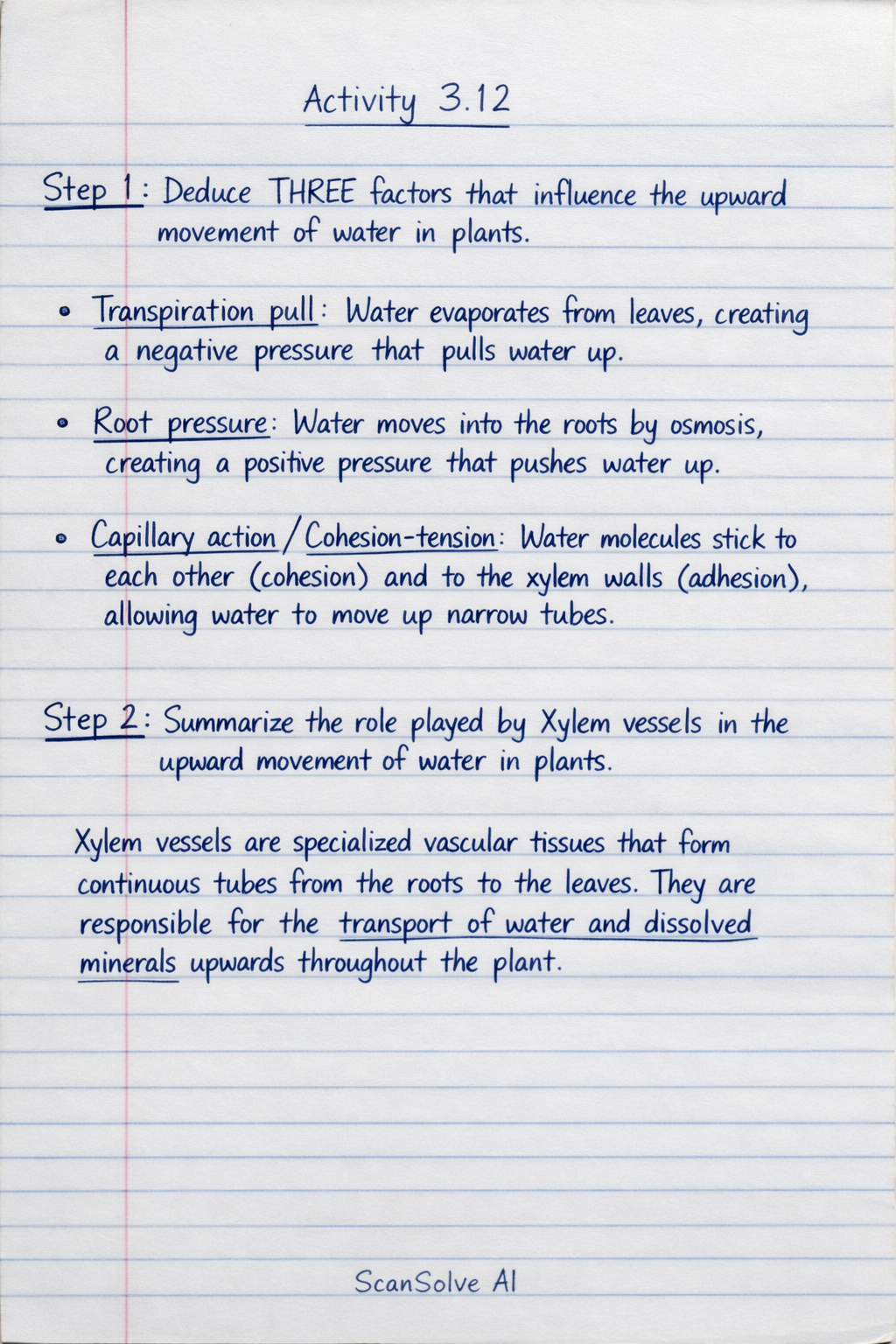
Deduce THREE factors that influence the upward movement of water in plants.
Biology
ScanSolve AI Answer
Step-by-step solution
4 stepsActivity 3.12
Deduce THREE factors that influence the upward movement of water in plants.
- Transpiration pull: Water evaporates from leaves, creating a negative pressure that pulls water up.
- Root pressure: Water moves into the roots by osmosis, creating a positive pressure that pushes water up.
- Capillary action/Cohesion-tension: Water molecules stick to each other (cohesion) and to the xylem walls (adhesion), allowing water to move up narrow tubes.
Summarize the role played by Xylem vessels in the upward movement of water in plants.
Xylem vessels are specialized vascular tissues that form continuous tubes from the roots to the leaves. They are responsible for the transport of water and dissolved minerals upwards throughout the plant.
List TWO functions of water in plants.
- Water is essential for photosynthesis, acting as a reactant.
- Water provides turgor pressure to maintain plant rigidity and support.
- Water acts as a solvent for transporting nutrients and sugars.
- Water helps regulate plant temperature through transpiration.
Use the table to distinguish between Osmosis and Diffusion.
Feature Osmosis Diffusion Movement of Water molecules Solute particles (or gas molecules) Membrane Requires a partially permeable membrane Does not require a membrane (can occur in any medium) Concentration From a region of higher water potential (lower solute concentration) to lower water potential (higher solute concentration) From a region of higher concentration to a region of lower concentration (down a concentration gradient) Energy Passive process (no metabolic energy required) Passive process (no metabolic energy required)
Was this helpful?
Still stuck on this one?
Ask a follow-up, and the answer starts from this question.
Got a different question?Ask your own question
More Biology Questions
QDescribe three factors which influence the uptake and absorption of water from soil to underground…QDiscuss Plants: (Page 3) Uptake and absorption of water from underground. Transpiration pull of root…QDescribe the adaptations of a root hair cell for water absorption and list three forces responsible…QDysic [Page 31] 1. Uptake and obsorption of water from underground 2. Transpiration pull of root…QState three environmental factors that affect the rate of stomatal transpiration
Handwritten Step-by-Step Solution
Get this as a handwritten image on WhatsApp — like a tutor wrote it for you.
Try on WhatsApp