
We read your photo as:
Dysic [Page 31] 1. Uptake and obsorption of water from underground 2. Transpiration pull of root pressure 3. Environmental factors
Biology
ScanSolve AI Answer
Here's a more detailed explanation of the points related to Dicot Plants:
-
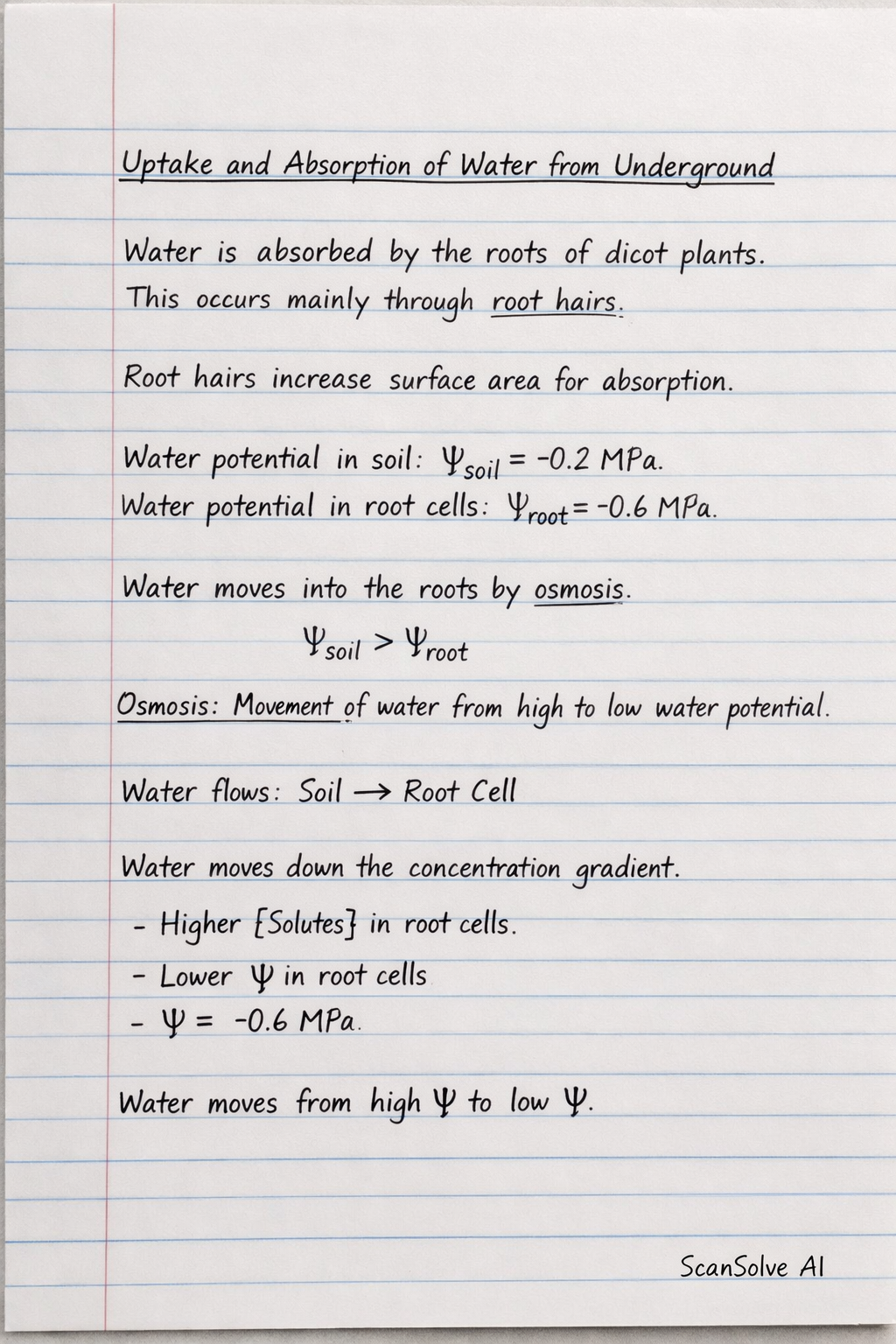
Uptake and absorption of water from underground
- Water is absorbed by the roots of dicot plants, primarily through specialized cells called root hairs. These hairs increase the surface area for absorption. Water moves from the soil, where its water potential is generally higher, into the root cells, where the water potential is lower, through the process of osmosis. This movement is facilitated by the concentration gradient of solutes within the root cells.
-
Transpiration pull and root pressure
- Transpiration pull is the main force driving water upwards in dicot plants. It occurs when water evaporates from the leaves through stomata, creating a negative pressure (tension) in the xylem vessels. This tension pulls the continuous column of water molecules (held together by cohesion) up from the roots.
- Root pressure is a secondary, weaker force. It's generated when water moves into the root xylem due to active transport of mineral ions into the xylem, which lowers the water potential inside the xylem. This causes water to follow by osmosis, creating a positive pressure that pushes water a short distance up the stem.
-
Environmental factors
- Several environmental factors influence the rate of water uptake and transpiration in dicot plants:
- Temperature: Higher temperatures increase the rate of evaporation from leaves, thus increasing transpiration.
- Humidity: High humidity reduces the water potential gradient between the leaf and the air, decreasing transpiration. Low humidity increases it.
- Wind: Wind removes water vapor from around the leaves, maintaining a steep water potential gradient and increasing transpiration.
- Light intensity: Light stimulates the opening of stomata, allowing for gas exchange and increasing transpiration.
- Several environmental factors influence the rate of water uptake and transpiration in dicot plants:
Was this helpful?
Still stuck on this one?
Ask a follow-up, and the answer starts from this question.
Got a different question?Ask your own question
More Biology Questions
QDiscuss Plants: (Page 3) Uptake and absorption of water from underground. Transpiration pull of root…QDescribe three factors which influence the uptake and absorption of water from soil to underground…QDeduce THREE factors that influence the upward movement of water in plants.QDescribe the adaptations of a root hair cell for water absorption and list three forces responsible…QExplain the process of water uptake by plants, identifying the structures and forces involved, and…
Handwritten Step-by-Step Solution
Get this as a handwritten image on WhatsApp — like a tutor wrote it for you.
Try on WhatsApp