
We read your photo as:
Calculate the density of plant species and the species diversity index based on the provided data.
ScanSolve AI Answer
Answer
The previous question was about filling the table. Now, let's address the calculations requested after the table in section A.
Step-by-step solution
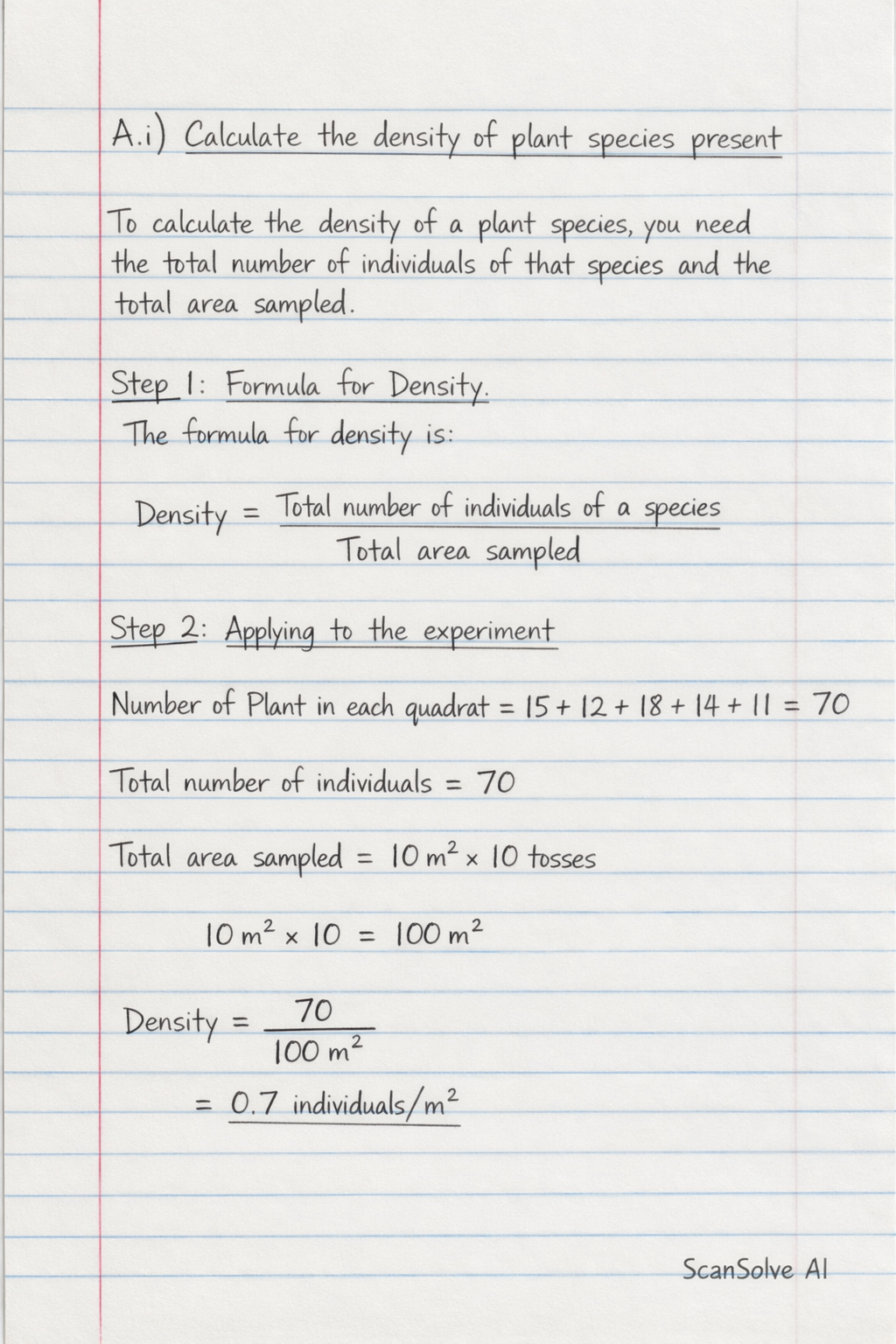
4 stepsA.i) Calculate the density of plant species present
To calculate the density of a plant species, you need the total number of individuals of that species and the total area sampled.
Formula for Density
The formula for density is:
Applying to the experiment
Based on the instructions, you would have counted the "NUMBER OF PLANT" in a marked area of . If the table was filled, you would sum the "NUMBER OF PLANT" from all tosses (quadrats) to get the total number of individuals. The total area sampled would be the area of one quadrat () multiplied by the number of times the toss was repeated (e.g., 10 times, as per the table rows).
For example, if the total number of plants counted across all 10 tosses was and each toss covered , the total area sampled would be .
The unit for density would typically be individuals per square meter (e.g., plants/m).
A.ii) Calculate the species diversity index
To calculate a species diversity index, you need to know not only the total number of individuals but also how many different species are present and the number of individuals for each species. The provided table only asks for "NUMBER OF PLANT", which implies a total count, not a breakdown by species. Assuming you have identified different species, a common index is the Shannon-Wiener Diversity Index ().
Formula for Shannon-Wiener Diversity Index
The formula for the Shannon-Wiener Diversity Index is:
Where:
- is the Shannon-Wiener Diversity Index.
- is the total number of species in the community.
- is the proportion of individuals belonging to species relative to the total number of individuals ().
- is the number of individuals of species .
- is the total number of individuals of all species.
- is the natural logarithm.
Applying to the experiment
To calculate this, you would need to:
- Identify all distinct plant species found in your sampled area.
- Count the number of individuals for each identified species ().
- Calculate the total number of individuals ().
- For each species, calculate its proportion ().
- Multiply each by its natural logarithm ().
- Sum these values and multiply by -1 to get .
This index provides a measure of both species richness (number of species) and species evenness (how evenly distributed the individuals are among the species).
Still stuck on this one?
Ask a follow-up, and the answer starts from this question.
More Biology Questions
Handwritten Step-by-Step Solution
Get this as a handwritten image on WhatsApp — like a tutor wrote it for you.
Try on WhatsApp