
We read your photo as:
Which option correctly defines density and its calculation?
ScanSolve AI Answer
Answer
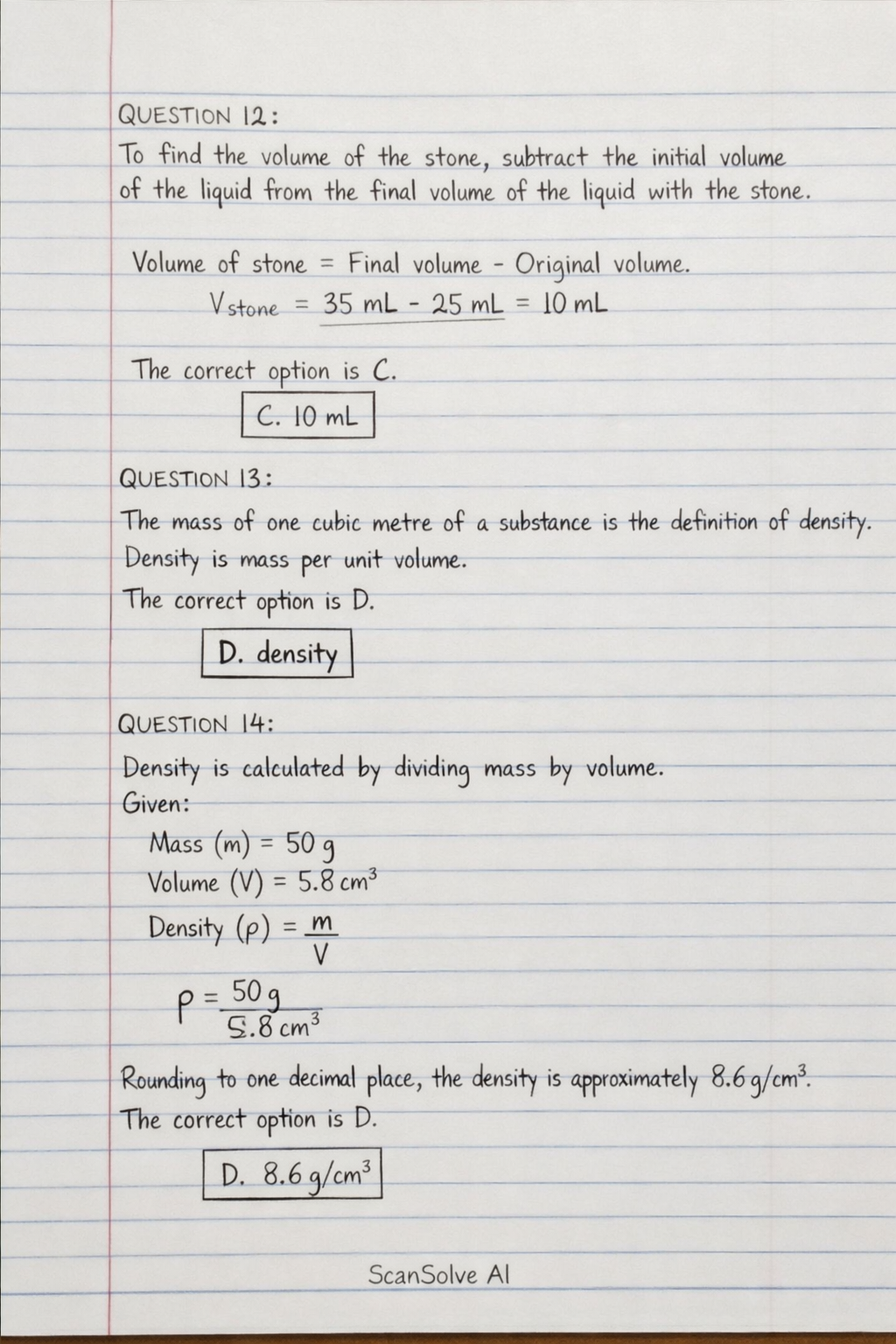
QUESTION 12:
To find the volume of the stone, subtract the initial volume of the liquid from the final volume of the liquid with the stone.
Volume of stone = Final volume - Original volume
The correct option is C.
QUESTION 13:
The mass of one cubic metre of a substance is the definition of density. Density is mass per unit volume.
The correct option is D.
QUESTION 14:
Density is calculated by dividing mass by volume.
Given:
Mass () = 50 g
Volume () = 5.8 cm³
Density () =
Rounding to one decimal place, the density is approximately 8.6 g/cm³.
The correct option is D.
QUESTION 15:
The gravitational force of the Earth, also known as the gravitational field strength (), is approximately 9.8 N/kg. A common approximation used is 10 N/kg.
The correct option is C.
Try one yourself
A new problem that tests the same skill.
Still stuck on this one?
Ask a follow-up, and the answer starts from this question.
More Physics Questions
Handwritten Step-by-Step Solution
Get this as a handwritten image on WhatsApp — like a tutor wrote it for you.
Try on WhatsApp