
All formulas for relative density
ScanSolve AI Answer
Step-by-step solution
4 stepsHere are the formulas for relative density:
Relative density (RD), also known as specific gravity, is a dimensionless quantity that is the ratio of the density of a substance to the density of a given reference material. For liquids and solids, the reference material is typically water at (or sometimes at room temperature), which has a density of or .
Using Densities
The most fundamental formula for relative density is the ratio of the density of the substance to the density of the reference substance.
Where:
- is the density of the substance
- is the density of the reference substance (e.g., water)
Using Masses (for equal volumes)
Since density () is mass () divided by volume (), if we consider equal volumes of the substance and the reference material, the formula can be expressed in terms of mass:
Where:
- is the mass of a certain volume of the substance
- is the mass of an equal volume of the reference substance
Using Weights (for equal volumes)
Similarly, since weight () is mass () times the acceleration due to gravity (), if we consider equal volumes, the formula can be expressed in terms of weight:
Where:
- is the weight of a certain volume of the substance
- is the weight of an equal volume of the reference substance
For a substance immersed in a fluid (Archimedes' Principle)
When a substance is weighed in air and then weighed while fully immersed in a fluid (like water), the apparent loss of weight is equal to the weight of the fluid displaced.
Where:
- is the weight of the substance in air
- is the weight of the substance when fully immersed in water
These formulas allow for the calculation of relative density based on different measurable properties.
Still stuck on this one?
Ask a follow-up, and the answer starts from this question.
More Physics Questions
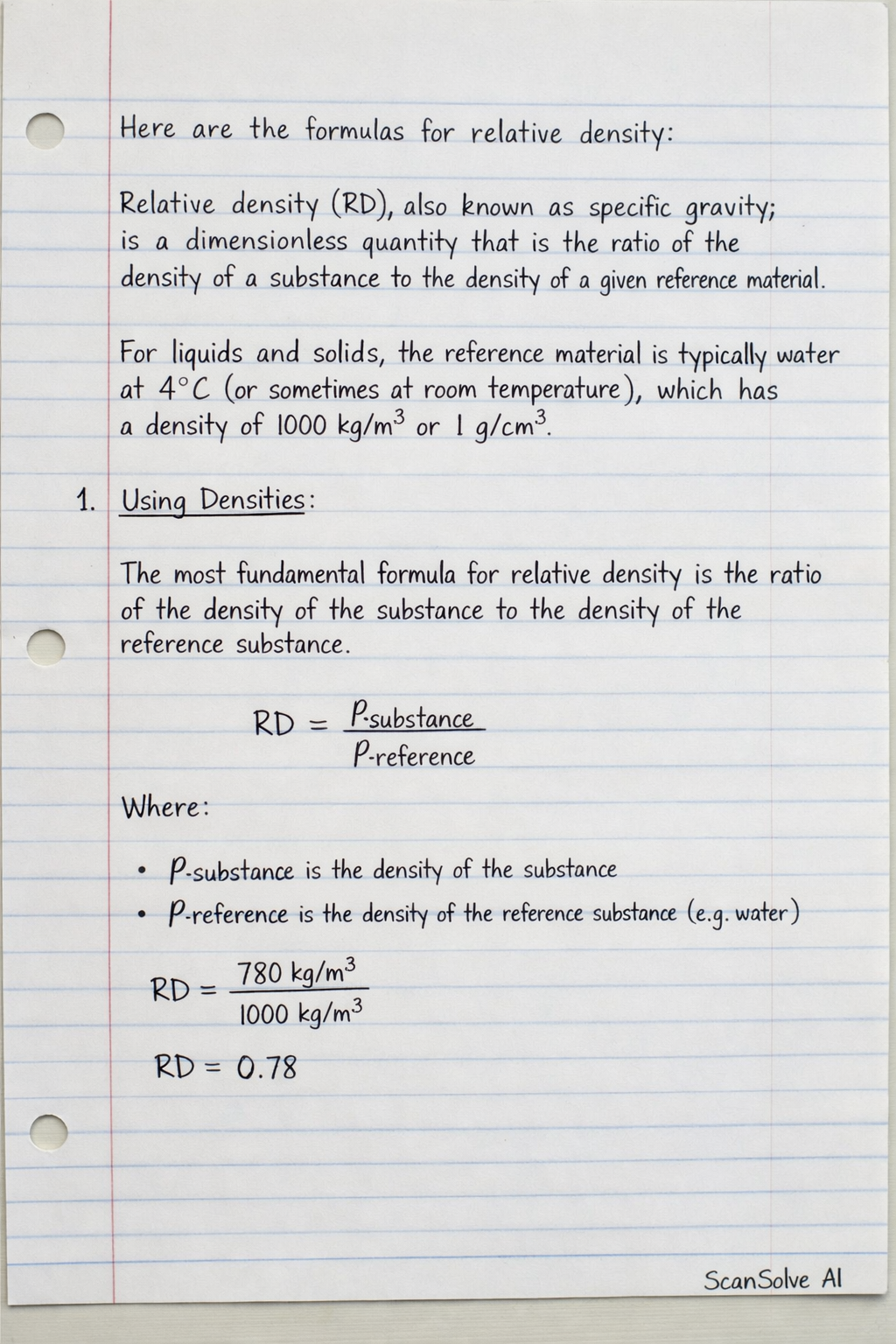
Handwritten Step-by-Step Solution
Get this as a handwritten image on WhatsApp — like a tutor wrote it for you.
Try on WhatsApp