
We read your photo as:
Explain the concepts of density and relative density, and describe how a U-tube can be used to determine the relative density of a liquid.
ScanSolve AI Answer
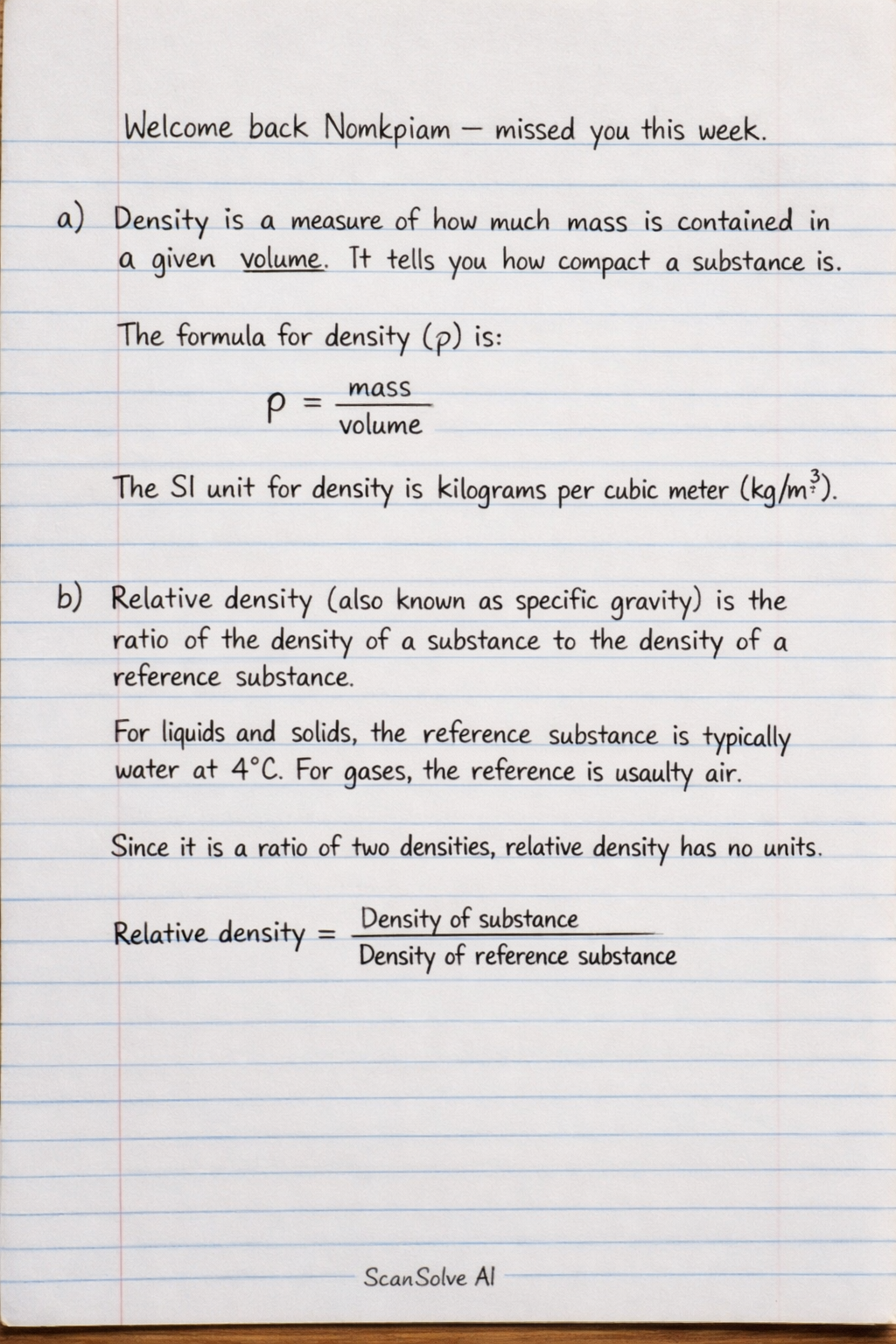
a) Density is a measure of how much mass is contained in a given volume. It tells you how compact a substance is.
The formula for density () is:
The SI unit for density is kilograms per cubic meter ().
b) Relative density (also known as specific gravity) is the ratio of the density of a substance to the density of a reference substance. For liquids and solids, the reference substance is typically water at . For gases, the reference is usually air.
Since it is a ratio of two densities, relative density has no units.
c) A U-tube is a simple glass tube bent into a 'U' shape. To use it for a relative density experiment:
- Two immiscible liquids (liquids that do not mix, like oil and water) are poured into the U-tube.
- The denser liquid will settle at the bottom, forming an interface with the less dense liquid in both arms of the U-tube.
- The heights of the liquid columns are measured from the common interface to the free surface of each liquid. Let these heights be and , and their respective densities be and .
- At equilibrium, the pressure exerted by both columns at the interface is equal. This means: Where is the acceleration due to gravity.
- The relative density of liquid 1 with respect to liquid 2 can then be found by: So, the relative density is the inverse ratio of their heights.
Still stuck on this one?
Ask a follow-up, and the answer starts from this question.
More Physics Questions
Handwritten Step-by-Step Solution
Get this as a handwritten image on WhatsApp — like a tutor wrote it for you.
Try on WhatsApp