Calculate the density of a mixture given the densities and volumes of its components.
|Chemistry
Calculate the density of a mixture given the densities and volumes of its components.
ScanSolve AI Answer
Answer
0.912g/cm3
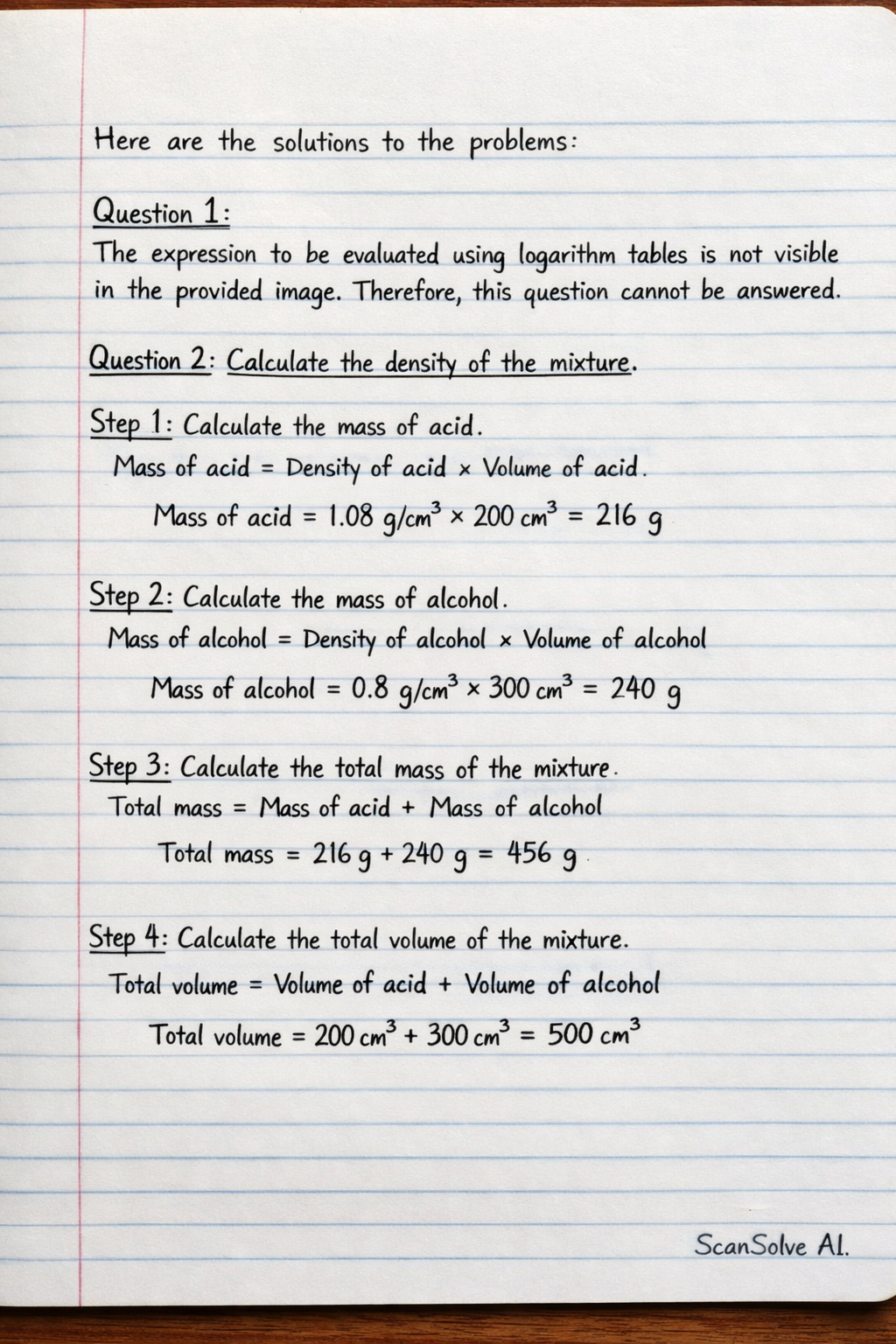
Here are the solutions to the problems:
Question 1:
The expression to be evaluated using logarithm tables is not visible in the provided image. Therefore, this question cannot be answered.
Question 2: Calculate the density of the mixture.
Step 1: Calculate the mass of acid.
Massofacid=Densityofacid×VolumeofacidMassofacid=1.08g/cm3×200cm3=216g
Step 2: Calculate the mass of alcohol.
Massofalcohol=Densityofalcohol×VolumeofalcoholMassofalcohol=0.8g/cm3×300cm3=240g
Step 3: Calculate the total mass of the mixture.
Totalmass=Massofacid+MassofalcoholTotalmass=216g+240g=456g
Step 4: Calculate the total volume of the mixture.
Totalvolume=Volumeofacid+VolumeofalcoholTotalvolume=200cm3+300cm3=500cm3
Step 5: Calculate the density of the mixture.
Densityofmixture=TotalvolumeTotalmassDensityofmixture=500cm3456g=0.912g/cm3
The density of the mixture is 0.912g/cm3.
Question 3: Find the magnitude of vector OM.
Step 1: Find the coordinates of point M.
Point M divides line PQ in the ratio 2:1. Given P(5, 1) and Q(11, 4).
Using the section formula M=(m+nnx1+mx2,m+nny1+my2), where (x1,y1)=(5,1), (x2,y2)=(11,4), m=2, n=1.
Mx=2+11×5+2×11=35+22=327=9My=2+11×1+2×4=31+8=39=3
So, the coordinates of M are (9,3).
Step 2: Determine the vector OM.
The vector OM is the position vector of M, which is (93).
Step 3: Calculate the magnitude of vector OM.
∣OM∣=92+32∣OM∣=81+9∣OM∣=90∣OM∣=9×10=310
The magnitude of vector OM is 310.
Question 4:
The income tax rates table is not visible in the provided image. Therefore, this question cannot be answered.
Question 5:
The formula to make a subject of is not visible in the provided image. Therefore, this question cannot be answered.
Question 6: A line passes through points (2, 5) and has a gradient of 2.a) Determine its equation in the form y=mx+c.
Step 1: Use the given gradient m=2 and the point (x,y)=(2,5) in the equation y=mx+c.
5=2(2)+c5=4+cc=5−4c=1
Step 2: Write the equation of the line.
y=2x+1
The equation of the line is y=2x+1.
b) Find the angle it makes with x-axis.
Step 1: Use the relationship between gradient and angle.
The gradient m=tanθ, where θ is the angle the line makes with the positive x-axis.
tanθ=2θ=arctan(2)θ≈63.43∘
The angle the line makes with the x-axis is 63.43∘ (to two decimal places).
Question 7: Find the value of P when Q=5.
Step 1: Write the general equation for P.
P is partly constant and partly varies as the cube of Q.
P=k+cQ3
where k and c are constants.
Step 2: Use the given conditions to form a system of equations.
When Q=1,P=23:
23=k+c(1)3⟹23=k+c(Equation1)
When Q=2,P=44:
44=k+c(2)3⟹44=k+8c(Equation2)
Step 3: Solve the system of equations for k and c.
Subtract Equation 1 from Equation 2:
(44−23)=(k+8c)−(k+c)21=7cc=721=3
Substitute c=3 into Equation 1:
23=k+3k=23−3=20
Step 4: Write the specific equation for P.
P=20+3Q3
Step 5: Find P when Q=5.
P=20+3(5)3P=20+3(125)P=20+375P=395
The value of P when Q=5 is 395.
Question 8: Determine the translation vector T and find the coordinates of A' and B'.
Given vertices A(1, 2), B(3, 5), C(4, 1). Image of C is C'(6, -2).
a) Determine the translation vector T.
Step 1: Use the formula Image = Original + Translation Vector.
C′=C+T(6−2)=(41)+TT=(6−2)−(41)T=(6−4−2−1)=(2−3)
The translation vector is T=(2−3).
b) Find the co-ordinates of A' and B' under the translation vector T.
Step 1: Find A'.
A′=A+TA′=(12)+(2−3)=(1+22−3)=(3−1)
So, A' is (3,−1).
Step 2: Find B'.
B′=B+TB′=(35)+(2−3)=(3+25−3)=(52)
So, B' is (5,2).
The coordinates are A′(3,−1)
Was this helpful?
Need help with your own homework?
Get instant step-by-step solutions to any question. Free to start.
This chemistry question involves key chemical concepts and calculations. The detailed solution below walks through each step, from identifying the reaction type to computing the final answer.
ScanSolve AI Answer
Here are the solutions to the problems: Question 1: The expression to be evaluated using logarithm tables is not visible in the provided image. Therefore, this question cannot be answered. Question 2: Calculate the density of the mixture. Step 1: Calculate the mass of acid. Mass of acid = Density of acid × Volume of acid Mass of acid = 1.08 g/cm^3 × 200 cm^3 = 216 g Step 2: Calculate the mass of alcohol. Mass of alcohol = Density of alcohol × Volume of alcohol Mass of alcohol = 0.8 g/cm^3 × 300 cm^3 = 240 g Step 3: Calculate the total mass of the mixture. Total mass = Mass of acid + Mass of alcohol Total mass = 216 g + 240 g = 456 g Step 4: Calculate the total volume of the mixture. Total volume = Volume of acid + Volume of alcohol Total volume = 200 cm^3 + 300 cm^3 = 500 cm^3 Step 5: Calculate the density of the mixture. Density of mixture = Total massTotal volume Density of mixture = 456 g500 cm^3 = 0.912 g/cm^3 The density of the mixture is 0.912 g/cm^3. Question 3: Find the magnitude of vector OM. Step 1: Find the coordinates of point M. Point M divides line PQ in the ratio 2:1. Given P(5, 1) and Q(11, 4). Using the section formula M = ((nx_1 + mx_2)/(m+n), (ny_1 + my_2)/(m+n)), where (x_1, y_1) = (5, 1), (x_2, y_2) = (11, 4), m=2, n=1. M_x = (1 × 5 + 2 × 11)/(2+1) = (5 + 22)/(3) = (27)/(3) = 9 M_y = (1 × 1 + 2 × 4)/(2+1) = (1 + 8)/(3) = (9)/(3) = 3 So, the coordinates of M are (9, 3). Step 2: Determine the vector OM. The vector OM is the position vector of M, which is 9 \\ 3 . Step 3: Calculate the magnitude of vector OM. |OM| = sqrt(9^2 + 3^2) |OM| = sqrt(81 + 9) |OM| = sqrt(90) |OM| = sqrt(9 × 10) = 3sqrt(10) The magnitude of vector OM is 3sqrt(10). Question 4: The income tax rates table is not visible in the provided image. Therefore, this question cannot be answered. Question 5: The formula to make a subject of is not visible in the provided image. Therefore, this question cannot be answered. Question 6: A line passes through points (2, 5) and has a gradient of 2. a) Determine its equation in the form y=mx+c. Step 1: Use the given gradient m=2 and the point (x,y) = (2,5) in the equation y=mx+c. 5 = 2(2) + c 5 = 4 + c c = 5 - 4 c = 1 Step 2: Write the equation of the line. y = 2x + 1 The equation of the line is y = 2x + 1. b) Find the angle it makes with x-axis. Step 1: Use the relationship between gradient and angle. The gradient m = , where is the angle the line makes with the positive x-axis. = 2 = (2) ≈ 63.43^ The angle the line makes with the x-axis is 63.43^ (to two decimal places). Question 7: Find the value of P when Q=5. Step 1: Write the general equation for P. P is partly constant and partly varies as the cube of Q. P = k + cQ^3 where k and c are constants. Step 2: Use the given conditions to form a system of equations. When Q=1, P=23: 23 = k + c(1)^3 23 = k + c (Equation 1) When Q=2, P=44: 44 = k + c(2)^3 44 = k + 8c (Equation 2) Step 3: Solve the system of equations for k and c. Subtract Equation 1 from Equation 2: (44 - 23) = (k + 8c) - (k + c) 21 = 7c c = (21)/(7) = 3 Substitute c=3 into Equation 1: 23 = k + 3 k = 23 - 3 = 20 Step 4: Write the specific equation for P. P = 20 + 3Q^3 Step 5: Find P when Q=5. P = 20 + 3(5)^3 P = 20 + 3(125) P = 20 + 375 P = 395 The value of P when Q=5 is 395. Question 8: Determine the translation vector T and find the coordinates of A' and B'. Given vertices A(1, 2), B(3, 5), C(4, 1). Image of C is C'(6, -2). a) Determine the translation vector T. Step 1: Use the formula Image = Original + Translation Vector. C' = C + T 6 \\ -2 = 4 \\ 1 + T T = 6 \\ -2 - 4 \\ 1 T = 6-4 \\ -2-1 = 2 \\ -3 The translation vector is T = 2 \\ -3 . b) Find the co-ordinates of A' and B' under the translation vector T. Step 1: Find A'. A' = A + T A' = 1 \\ 2 + 2 \\ -3 = 1+2 \\ 2-3 = 3 \\ -1 So, A' is (3, -1). Step 2: Find B'. B' = B + T B' = 3 \\ 5 + 2 \\ -3 = 3+2 \\ 5-3 = 5 \\ 2 So, B' is (5, 2). The coordinates are A'(3, -1)