
We read your photo as:
Differentiate between conversion and seasoning, and list uses for hardwoods and softwoods.
ScanSolve AI Answer
Here are the answers to your questions:
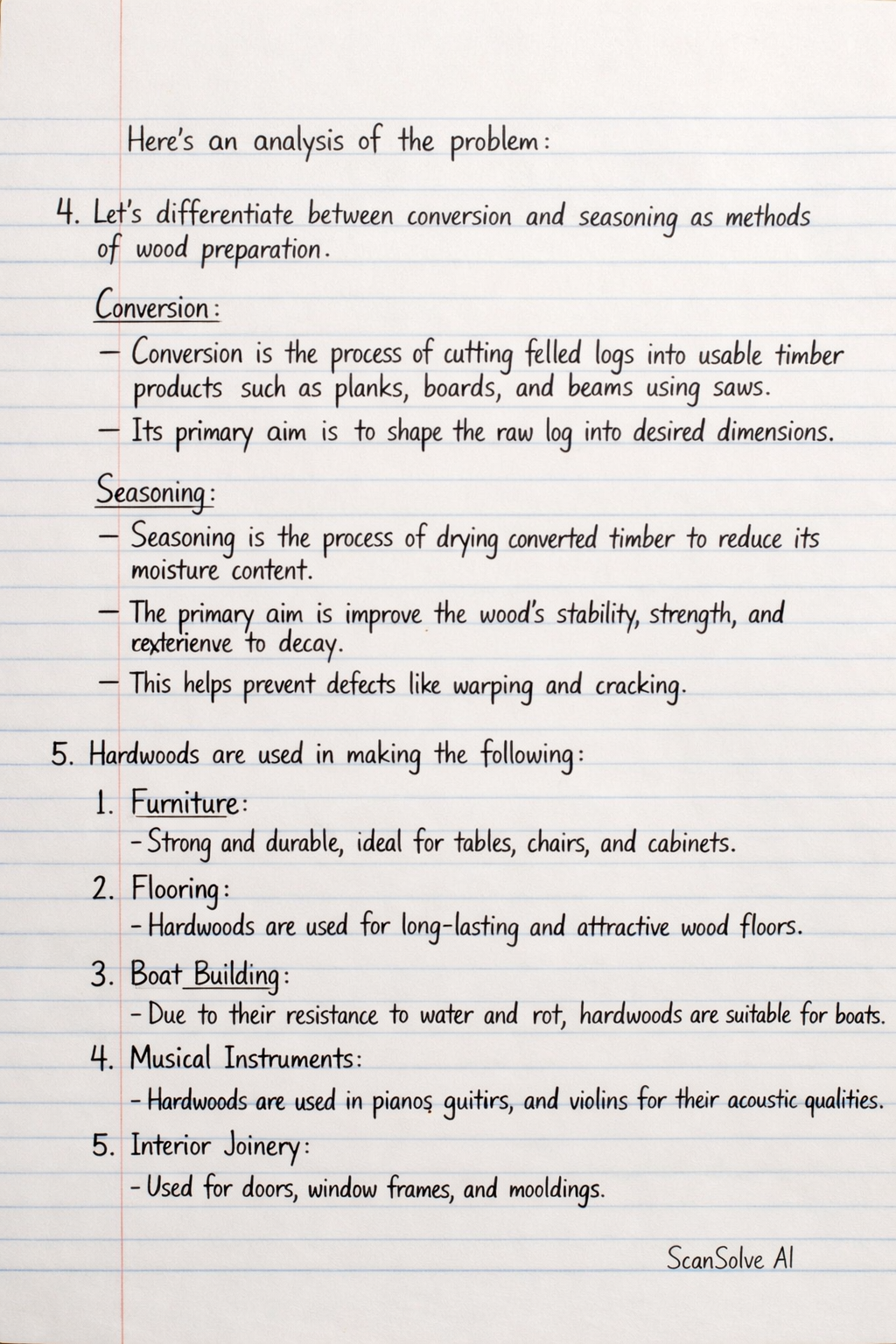
4. Differentiate between conversion and seasoning as methods of wood preparation.
- Conversion is the process of cutting felled logs into usable timber products such as planks, boards, and beams using saws. Its primary aim is to shape the raw log into desired dimensions.
- Seasoning is the process of drying converted timber to reduce its moisture content. Its primary aim is to improve the wood's stability, strength, and resistance to decay, preventing defects like warping and cracking.
5. Hardwoods are used in making the following:
- i) Musical instruments: Hardwoods like maple, mahogany, and rosewood are chosen for their density, excellent acoustic properties, durability, and aesthetic appeal. Their tight grain contributes to superior sound resonance and stability.
- ii) Furniture: Hardwoods such as oak, cherry, and walnut are preferred for furniture due to their strength, durability, resistance to dents and scratches, and attractive grain patterns. This makes them ideal for long-lasting and aesthetically pleasing pieces.
Softwoods are used in making the following:
- i) Paper: Softwoods like pine and spruce are extensively used for paper production because they have long cellulose fibers, which are essential for creating strong pulp and paper. They also grow relatively fast, making them a sustainable and cost-effective source.
- ii) Roof trusses: Softwoods such as fir and spruce are commonly used for roof trusses due to their good strength-to-weight ratio, ease of workability, and affordability. They are readily available and can be efficiently processed into the structural components required for framing.
6. Why is it important to take care of trees?
It is important to take care of trees because they are vital for the environment and human well-being. Trees produce oxygen and absorb carbon dioxide, helping to regulate the climate and improve air quality. They also prevent soil erosion, support biodiversity by providing habitats for wildlife, and play a crucial role in the water cycle.
7. Explain the meaning of the term debarking.
Debarking is the process of removing the bark from a felled log. This is done to prevent insect infestation and fungal growth, reduce the weight of the log for transport, and prepare the wood for further processing such as sawing into timber or pulping for paper production.
Still stuck on this one?
Ask a follow-up, and the answer starts from this question.
More Biology Questions
Handwritten Step-by-Step Solution
Get this as a handwritten image on WhatsApp — like a tutor wrote it for you.
Try on WhatsApp