
We read your photo as:
Compare and contrast metals and non-metals, define crop variety, list factors for crop selection, and compare organic and inorganic compounds.
Chemistry
ScanSolve AI Answer
here are the solutions to the questions from the image:
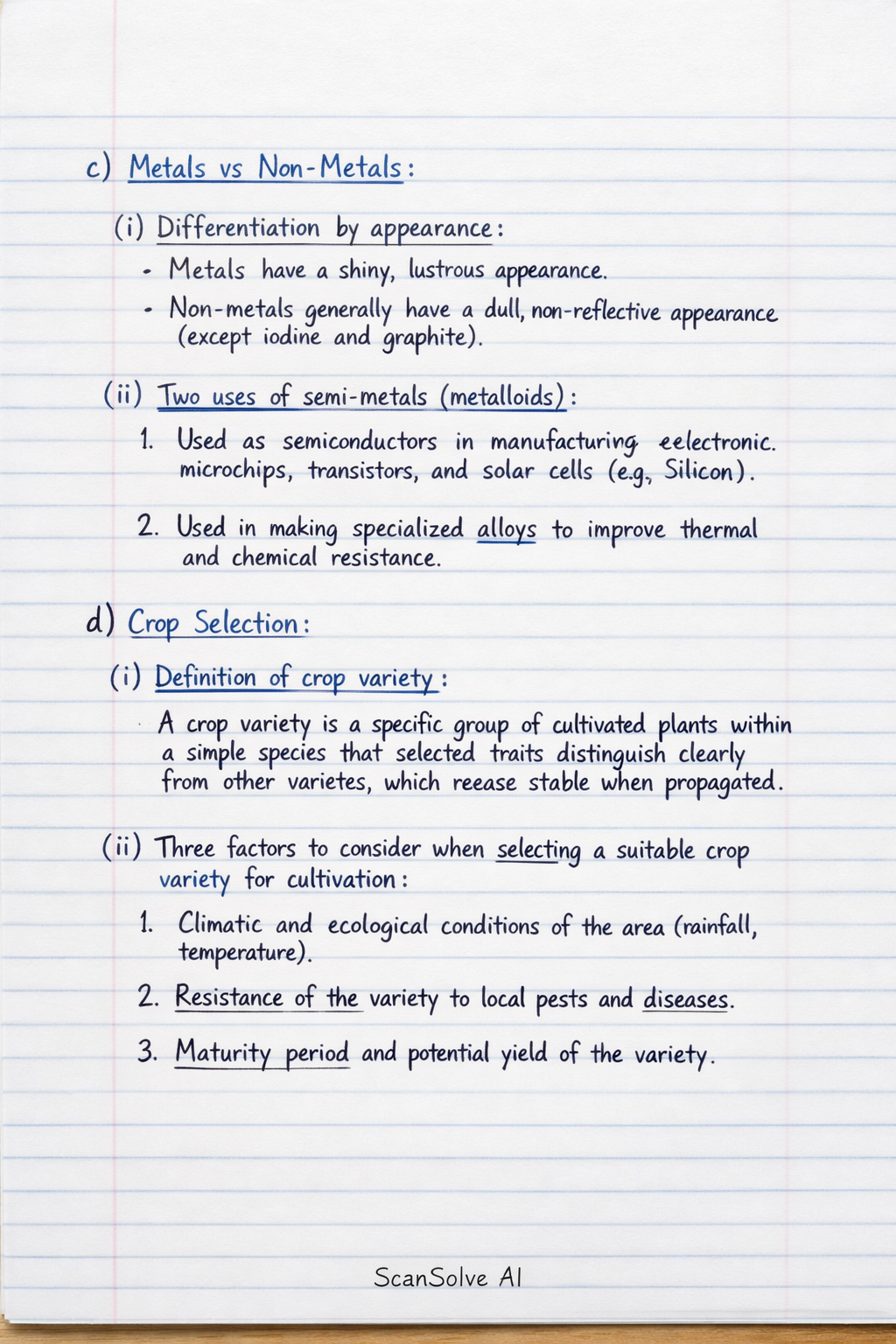
c) Metals vs Non-Metals:
- (i) Differentiation by appearance:
- Metals have a shiny, lustrous appearance.
- Non-metals generally have a dull, non-reflective appearance (except iodine and graphite).
- (ii) Two uses of semi-metals (metalloids):
- Used as semiconductors in manufacturing electronic microchips, transistors, and solar cells (e.g., Silicon).
- Used in making specialized alloys to improve thermal and chemical resistance.
d) Crop Selection:
- (i) Definition of crop variety: A crop variety is a specific group of cultivated plants within a single species that selected traits distinguish clearly from other varieties, which remain stable when propagated.
- (ii) Three factors to consider when selecting a suitable crop variety for cultivation:
- Climatic and ecological conditions of the area (rainfall, temperature).
- Resistance of the variety to local pests and diseases.
- Maturity period and potential yield of the variety.
Question 3
b) Comparison between organic and inorganic compounds:
- (i) Melting point:
- Organic Compounds: Generally low melting points.
- Inorganic Compounds: Generally high melting points.
- (ii) Boiling point:
- Organic Compounds: Generally low boiling points.
- Inorganic Compounds: Generally high boiling points.
- (iii) Solubility in water:
- Organic Compounds: Mostly insoluble in water (soluble in organic solvents).
- Inorganic Compounds: Mostly soluble in water (insoluble in organic solvents).
- (iv) Conductivity:
- Organic Compounds: Non-conductors of electricity (do not ionize).
- Inorganic Compounds: Good conductors when molten or in aqueous solution.
- (v) Biodegradability:
- Organic Compounds: Mostly biodegradable.
- Inorganic Compounds: Generally non-biodegradable.
c) Explanation of terms in ruminants:
- (i) Gestation period: The period from successful conception/fertilization to the birth of the offspring (pregnancy duration).
- (ii) Heat period: The period during the estrus cycle when the female ruminant is sexually receptive to the male for mating.
- (iii) Parturition: The physiological act of giving birth or bringing forth young ones at the end of the gestation period.
Was this helpful?
Still stuck on this one?
Ask a follow-up, and the answer starts from this question.
Got a different question?Ask your own question
More Chemistry Questions
QList 4 examples each of metals and non-metals, and describe 4 differences between them.QCompare and contrast different soil colors (dark/light, red/grey) and their impact on crop…QWhat are five differences between organic and inorganic farming?QDescribe the different ways crops can be classified and the essential conditions and functions of…QCompare and contrast organic and non-organic farming methods, and state which you believe is…
Handwritten Step-by-Step Solution
Get this as a handwritten image on WhatsApp — like a tutor wrote it for you.
Try on WhatsApp