

This biology question covers important biological concepts and processes. The step-by-step explanation below helps you understand the underlying mechanisms and reasoning.
ScanSolve AI Answer
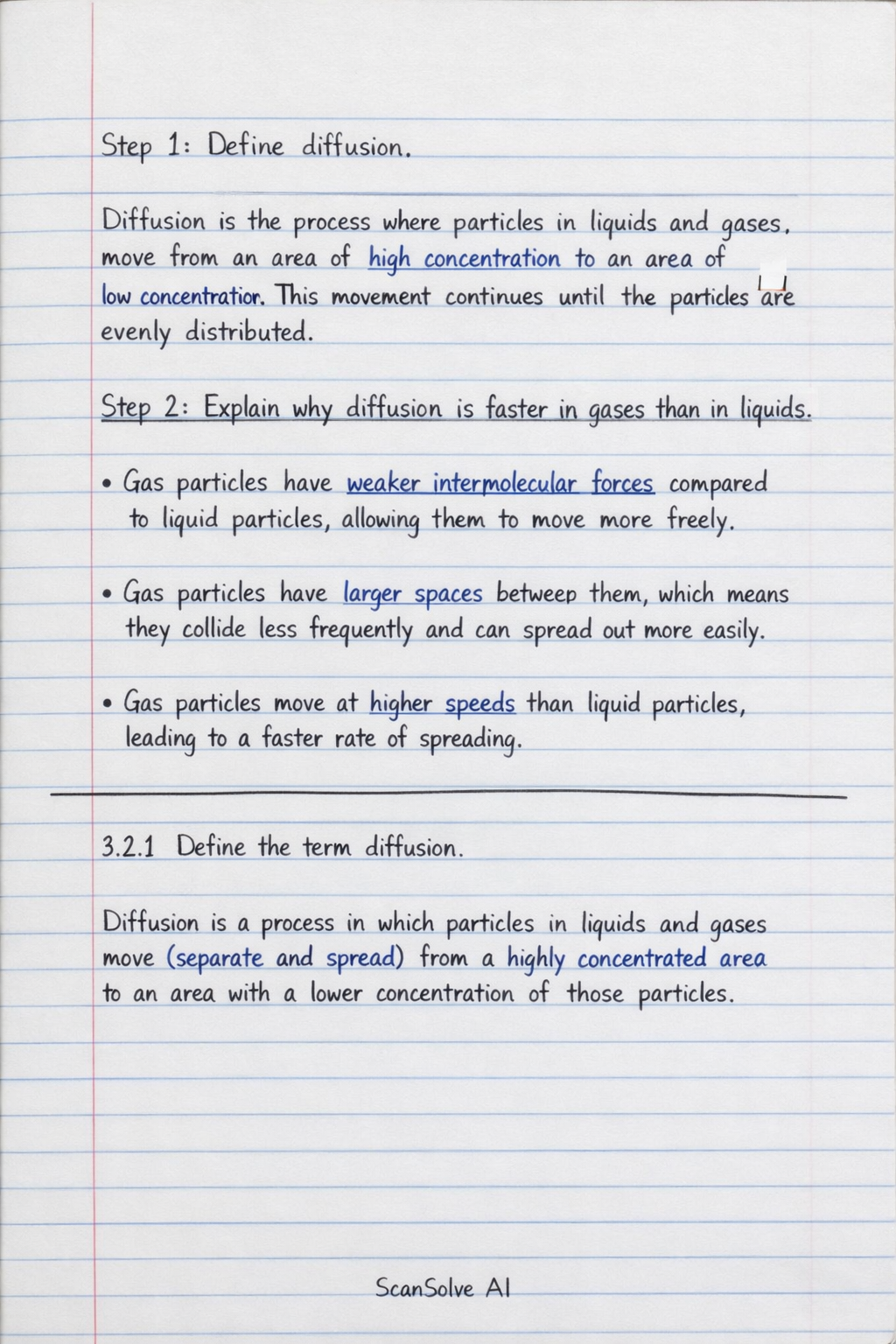
Step 1: Define diffusion. Diffusion is the process where particles in liquids and gases move from an area of high concentration to an area of low concentration. This movement continues until the particles are evenly distributed. Step 2: Explain why diffusion is faster in gases than in liquids. Diffusion occurs faster in gases than in liquids due to the following reasons: • Gas particles have weaker intermolecular forces compared to liquid particles, allowing them to move more freely. • Gas particles have larger spaces between them, which means they collide less frequently and can spread out more easily. • Gas particles move at higher speeds than liquid particles, leading to a faster rate of spreading. Here's the definition and explanation: 3.2.1 Define the term diffusion. Diffusion is a process in which particles in liquids and gases move (separate and spread) from a highly concentrated area to an area with a lower concentration of those particles. 3.2.2 Explain why diffusion in a gas takes much faster than in a liquid. Diffusion in a gas takes much faster than in a liquid because gas particles have extremely weak forces between them, allowing them to move very fast and with very big spaces between them. In contrast, liquid particles have stronger forces, move less freely, and have smaller spaces between them, which slows down their rate of diffusion. Send me the next one 📸