
We read your photo as:
Explain diffusion and active transport, including factors affecting diffusion and examples of active transport and leaf adaptations for photosynthesis.
ScanSolve AI Answer
Step-by-step solution
5 stepsAnswer question 8 a).
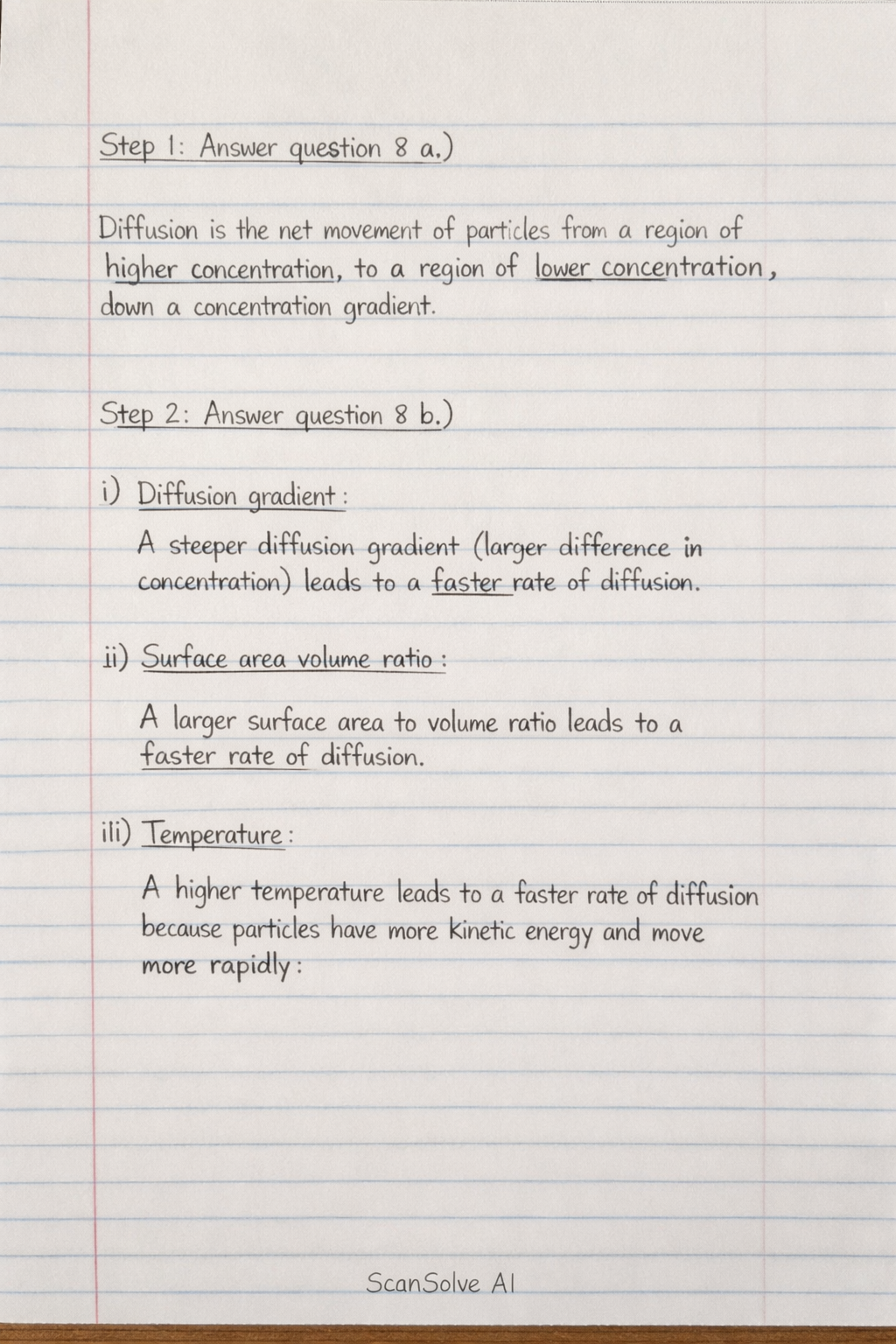
Diffusion is the net movement of particles from a region of higher concentration to a region of lower concentration, down a concentration gradient.
Answer question 8 b).
- i) Diffusion gradient: A steeper diffusion gradient (larger difference in concentration) leads to a faster rate of diffusion.
- ii) Surface area volume ratio: A larger surface area to volume ratio leads to a faster rate of diffusion.
- iii) Temperature: A higher temperature leads to a faster rate of diffusion because particles have more kinetic energy and move more rapidly.
Answer question 9.
Three roles of active transport in the human body are:
- Absorption of digested nutrients (e.g., glucose, amino acids) from the small intestine into the bloodstream, even when their concentration is higher in the blood.
- Reabsorption of useful substances (e.g., glucose, amino acids, salts) from the filtrate back into the blood in the kidney tubules.
- Maintenance of ion gradients across cell membranes, such as the sodium-potassium pump in nerve cells, which is crucial for nerve impulse transmission.
Answer question 10.
Two adaptations of leaves that maximize efficiency in trapping sunlight are:
- Leaves have a broad and flat lamina to provide a large surface area for absorbing sunlight.
- Leaves have a thin lamina to ensure a short diffusion distance for light to penetrate to the photosynthetic cells.
Verify question 7.
The student's answer for plasmolysis is largely correct.
✅ Correct.
Plasmolysis occurs when a plant cell is placed in a hypertonic solution, meaning the solution has a higher solute concentration than the cell's cytoplasm. Water moves out of the cell by osmosis, causing the cell to lose turgor and the protoplast (cell membrane and its contents) to shrink away from the cell wall.
Still stuck on this one?
Ask a follow-up, and the answer starts from this question.
More Biology Questions
Handwritten Step-by-Step Solution
Get this as a handwritten image on WhatsApp — like a tutor wrote it for you.
Try on WhatsApp